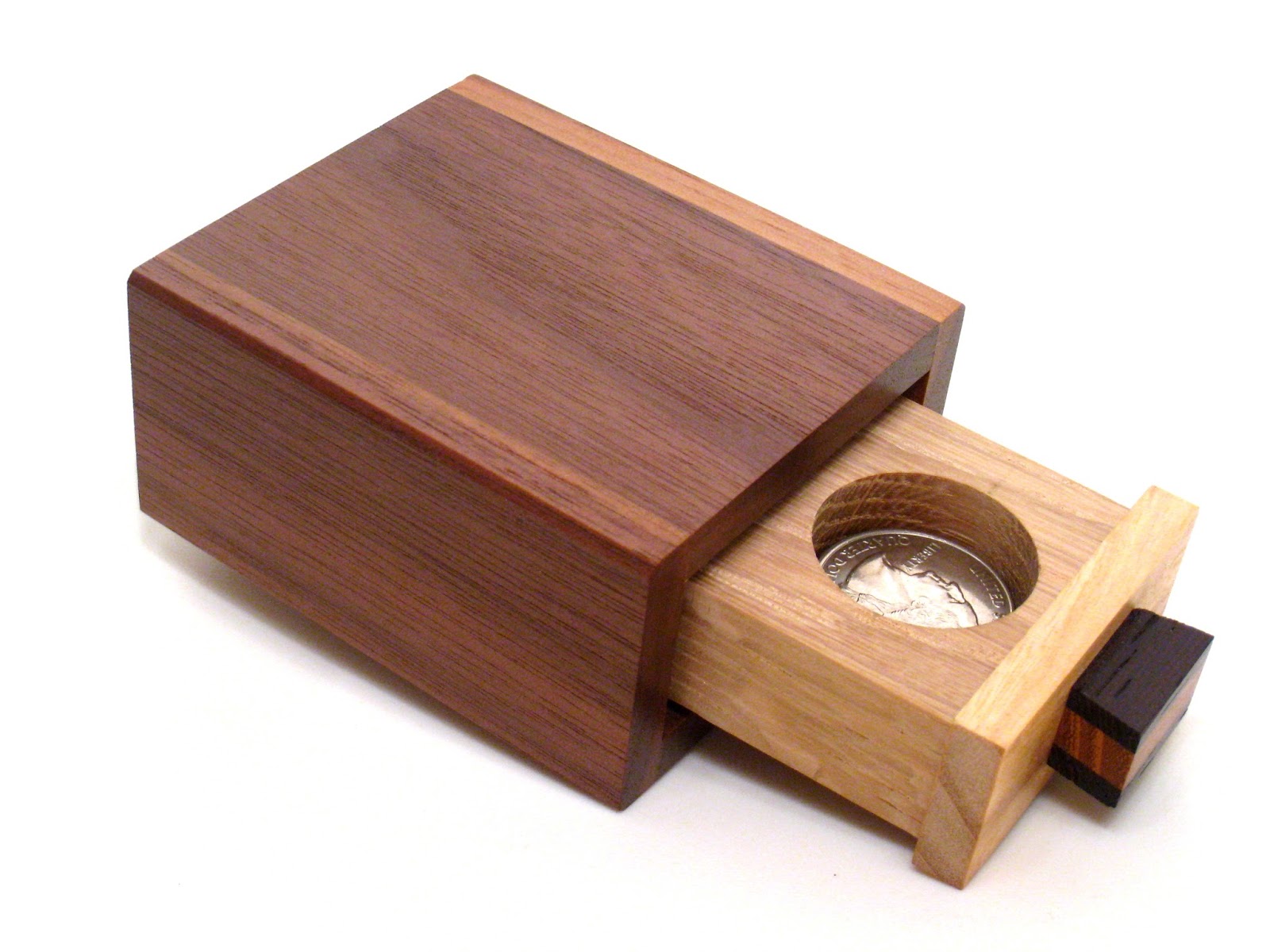
The name is quite a mouthful but this doesn't detract from the fact that the TLDD is extremely beautifully made. About the size of a small jewellery/ring box, and looks like one too.
This was Robert Sandfield's IPP34 Exchange Puzzle in London this past August. Designed by Perry McDaniel, the TLDD was crafted by Kathleen Malcolmson from two exotic hardwoods, Honduran Mahogany and Primavera.
If there are a couple of things that I really like about the TLDD, these are the very precise construction and finishing of the puzzle and the attention to detail. So precisely cut and edges sharp that if you are not careful, you can "pinch" your fingers accidentally during play. I really can't fathom the amount of work Kathleen went into making a hundred or so of these for the Exchange!
Unlike Sandfield's Rebanded Dovetail, the TLDD is more akin to the "impossible object" kind of dovetail puzzle, where you wonder, just by looking at it, if the two halves can be split apart at all.
The goal is not just to separate the two halves, but also to find a cavity within the puzzle which contains a cute little rubber star. From a puzzling perspective, not difficult for those who have experience with "impossible" dovetails, especially with the likes of Wil Strijbos' dovetail collection. But to the uninitiated, this one may take a while to figure out.
A very nicely made Exchange Puzzle, not too difficult, which displays well too!
Showing posts with label Kathleen Malcolmson. Show all posts
Monday, 20 October 2014
Saturday, 17 August 2013
Locked Drawer
Name
Sandfield's Locked Drawer Puzzle.
Designer
Robert E Sandfield and Kathleen Malcolmson.
Manufacturer
Kathleen Malcolmson
Type & Classification
Puzzle Box; Sequential Discovery
Dimensions
7.8cm (Length) x 6.5cm (Width) x 3.8cm (Height).
Materials & Construction
Walnut, Prima Vera and White Oak. Construction, fit and finish is excellent with slight bevelling on the exterior box to minimise sharp edges. Nice size with an attractive colour contrast between the handle, drawer and outer box. Overall, aesthetically very pleasing. It comes with its own drawstring pouch which is a nice touch.
IPP
The Locked Drawer was Robert Sandfield's Exchange Puzzle during IPP30 held at Hakone, Japan. in July 2010.
Overview
I had read Allard's review of this puzzle late last year and wanted one. The opportunity came along when I found Robert Sandfield selling several of these Locked Drawers during this year's IPP33 Puzzle Party. Although relatively expensive, I picked up one with little hesitation. This was also the first puzzle I bought during the Puzzle Party.
The Locked Draw is somewhat different from the Japanese style boxes with multiple sliding panels or other trick opening ones because it incorporates a sequential discovery aspect as well. Meaning that the puzzle has to be solved in a particular order of steps and using the tools that come together with the puzzle. No other external implements or tools are necessary.
The object of the Locked Drawer is NOT to open the drawer (as most people would assume looking at the box) but rather to figure out how to close the drawer once its been opened. To open is simple, nothing puzzling about it; just pull the drawer open normally and it will reveal a circular cavity that contains a US$0.25 coin. Pull the puzzle fully out and the drawer click locks. Here is where the puzzling begins; ie pushing the drawer back in again.
I took about six steps to get the drawer "unlocked" and then back into the closed position, which is the reset/ unsolved stage. There is no force whatsoever required to solve the Locked Drawer. A very clever and rather interesting trick to the whole mechanism.
Difficulty Level
For the total novice, he/she is likely to be stuck for quite a long time. But for the experienced puzzler, not overly difficult with enough challenge to make the puzzle fun and entertaining. This is the sort of puzzle that gives you mini "a-ha" moments to let you know you are on the right track until the final step when you know you have reached the goal. Easily solvable repeatedly once you know the solution. Nothing finicky about the Locked Drawer; everything works as intended.
Summary
For lovers of Sequential Discovery puzzles and/or puzzle boxes generally, a definite must-have for the collection.
Sandfield's Locked Drawer Puzzle.
Designer
Robert E Sandfield and Kathleen Malcolmson.
| This is the unsolved state! |
Kathleen Malcolmson
Puzzle Box; Sequential Discovery
Dimensions
7.8cm (Length) x 6.5cm (Width) x 3.8cm (Height).
Materials & Construction
Walnut, Prima Vera and White Oak. Construction, fit and finish is excellent with slight bevelling on the exterior box to minimise sharp edges. Nice size with an attractive colour contrast between the handle, drawer and outer box. Overall, aesthetically very pleasing. It comes with its own drawstring pouch which is a nice touch.
IPP
The Locked Drawer was Robert Sandfield's Exchange Puzzle during IPP30 held at Hakone, Japan. in July 2010.
Overview
I had read Allard's review of this puzzle late last year and wanted one. The opportunity came along when I found Robert Sandfield selling several of these Locked Drawers during this year's IPP33 Puzzle Party. Although relatively expensive, I picked up one with little hesitation. This was also the first puzzle I bought during the Puzzle Party.
The Locked Draw is somewhat different from the Japanese style boxes with multiple sliding panels or other trick opening ones because it incorporates a sequential discovery aspect as well. Meaning that the puzzle has to be solved in a particular order of steps and using the tools that come together with the puzzle. No other external implements or tools are necessary.
The object of the Locked Drawer is NOT to open the drawer (as most people would assume looking at the box) but rather to figure out how to close the drawer once its been opened. To open is simple, nothing puzzling about it; just pull the drawer open normally and it will reveal a circular cavity that contains a US$0.25 coin. Pull the puzzle fully out and the drawer click locks. Here is where the puzzling begins; ie pushing the drawer back in again.
I took about six steps to get the drawer "unlocked" and then back into the closed position, which is the reset/ unsolved stage. There is no force whatsoever required to solve the Locked Drawer. A very clever and rather interesting trick to the whole mechanism.
Difficulty Level
For the total novice, he/she is likely to be stuck for quite a long time. But for the experienced puzzler, not overly difficult with enough challenge to make the puzzle fun and entertaining. This is the sort of puzzle that gives you mini "a-ha" moments to let you know you are on the right track until the final step when you know you have reached the goal. Easily solvable repeatedly once you know the solution. Nothing finicky about the Locked Drawer; everything works as intended.
For lovers of Sequential Discovery puzzles and/or puzzle boxes generally, a definite must-have for the collection.
Friday, 7 September 2012
Rebanded Dovetail
The Rebanded Dovetail was Robert Sandfield's and Kathleen Malcolmson's exchange puzzle at IPP32, held during August this year. I managed to get a copy from Wil Strijbos who had attended IPP32 and brought back with him extra copies of the Dovetail and some other puzzles.
This is my second Kathleen Malcolmson puzzle after Bowling Alley In A Briefcase which was reviewed some time back in this blog. The Dovetail is hand-crafted by Kathleen in her workshop. In fact she has recently started her own puzzle blog and her first post is about this Dovetail.
Constructed of light baltic birch plywood and contrasting with walnut and lacewood, the Dovetail spots four distinctive colour tones. In particular the lightly textured surface of the lacewood which forms the two bands surrounding the box gives the puzzle a rather classy and unusual appearance.
Dimensionally, the Dovetail measures 8cm x 6.2cm with an overall thickness of 3.7cm. The puzzle is very well made and fit and finish is excellent with all sharp edges smoothed out. All parts have been cut to very exact tolerances (see the dovetail joints) making everything feel solid and tight. Of course, all this quality came with a rather expensive price-tag.
The object of the Dovetail is to open the box and remove a one-dime coin within. The puzzle has been classified as a trick-opening/puzzle box. A number of steps are required to open the box and depending on how you count, there are six moves required to free the dime inside. While the Dovetail does not have as many moves needed as some of its more complicated Japanese style counterparts, the execution of the solution is quite unusual and rather clever.
It didn't take me long to figure out the first step and the next two were pretty easy. The fourth step was also easy and thereafter, this was where I got stuck. Took me a good ten minutes or so, but eventually I discovered the fifth step and finally got the box to open. This step was rather tricky (probably the trickiest!) and quite unexpected. When I finally got to peek at the inside, I saw the amount of work that went into making the puzzle....hmm, maybe it isn't that expensive after all!
Overall, I found the Dovetail entertaining with a sufficiently nice amount of puzzle challenge. This is not to say that it is an easy solve...no, by no means at all. But definitely fun and most experienced puzzlers would be able to solve it without too much frustration.
This is my second Kathleen Malcolmson puzzle after Bowling Alley In A Briefcase which was reviewed some time back in this blog. The Dovetail is hand-crafted by Kathleen in her workshop. In fact she has recently started her own puzzle blog and her first post is about this Dovetail.
Constructed of light baltic birch plywood and contrasting with walnut and lacewood, the Dovetail spots four distinctive colour tones. In particular the lightly textured surface of the lacewood which forms the two bands surrounding the box gives the puzzle a rather classy and unusual appearance.
Dimensionally, the Dovetail measures 8cm x 6.2cm with an overall thickness of 3.7cm. The puzzle is very well made and fit and finish is excellent with all sharp edges smoothed out. All parts have been cut to very exact tolerances (see the dovetail joints) making everything feel solid and tight. Of course, all this quality came with a rather expensive price-tag.
The object of the Dovetail is to open the box and remove a one-dime coin within. The puzzle has been classified as a trick-opening/puzzle box. A number of steps are required to open the box and depending on how you count, there are six moves required to free the dime inside. While the Dovetail does not have as many moves needed as some of its more complicated Japanese style counterparts, the execution of the solution is quite unusual and rather clever.
| The dime out of the box....smallest denomination around but don't underestimate this little guy! |
Overall, I found the Dovetail entertaining with a sufficiently nice amount of puzzle challenge. This is not to say that it is an easy solve...no, by no means at all. But definitely fun and most experienced puzzlers would be able to solve it without too much frustration.
Wednesday, 20 June 2012
Bowling Alley In A Briefcase
I managed to snag this Bowling Alley In A Briefcase puzzle during the recent Jacques Haubrich Puzzle Auction for quite a reasonable price (well, reasonable in so far as dedicated puzzle auctions generally go). Designed by Kathleen Malcolmson and made by Norman Sandfield, this was their IPP26 exchange puzzle in 2006 in Boston.
Some time back, I had already come across Malcolmson's and Sandfield's three briefcase puzzles while searching for their availability on the internet; the Double Locked Briefcase Puzzle for IPP24 in Toyko, the Bollixed Briefcase Puzzle which was an entry in the IPP25 2005 Puzzle Design Competition in Helsinki and this one, the Bowling Alley Briefcase. I had also come across an online photo (Warning: Spoiler Alert) of an opened Bowling Alley Briefcase, so roughly I had an inkling how the puzzle worked. Notwithstanding, these puzzles were not available anywhere then (nor even now) and when this Bowling Alley Briefcase came up in the Haubrich auction, I grabbed the chance to go for it.
I would say this is a rather unique puzzle because most puzzle designers and makers create something from scratch or ground up using various materials such as aluminium, plastic or wood but instead, Kathleen Malcolmson has taken an existing item, an aluminium briefcase business cardholder (which is available commercially online) and turned it into a puzzle. In my view, this may be perhaps a harder way to produce a puzzle, since the designer/maker has to work within the constraints and restrictions of an existing object.
First off, the puzzle is a good size for the palm, measuring 9.9cm x 6.7cm x 1.6cm. Made of aluminium, it is a cute briefcase in miniature form, complete with a handle and working lock latches. The object of course is to open the briefcase and here, clear instructions on the lid state that "no major force is required". I would imagine the designer thought this was necessary to prevent undue damage through the unintended forcing open of the lid by either over-enthusiastic or inexperienced puzzlers. Quality of my copy is very good and the briefcase looks almost brand new with no blemishes or marks.
The first step was easy - I undid the lock latches which sprung open, but the lid remained tightly shut. Mind you I had already seen a photo and know what the inside of the briefcase looks like. The lid is kept shut via an internal mechanism which has to be unlocked. But even having seen the internals, it still took a bit of time for me to figure out how to solve the locking mechanism properly. The solution is actually quite simple and elegant and one can only be impressed at the ingenuity of the design. The difficulty lies in not being able to see what is happening inside the briefcase.
The Bowling Alley Briefcase is similar to the genre of puzzles such as Remove The Yoke, Brass Treasure Chest and Centrale where there is a hidden mechanism inside the puzzle that can only be solved via a number of sequential steps taken in the right order. If you have read my reviews of those puzzles, you will realise I didn't have any luck with any of those. Without any aid, I think this is really a difficult puzzle and I don't think I would have been able to solve it on my own. Brian Pletcher in his review of the same puzzle said he too scratched his head over it for quite a long time before finally solving it.
Overall, a rather unusual, unique and challenging puzzle, very hard to come by and I am glad I managed to get hold of one. Too bad it can't hold any of my business cards tho'
Subscribe to:
Posts (Atom)