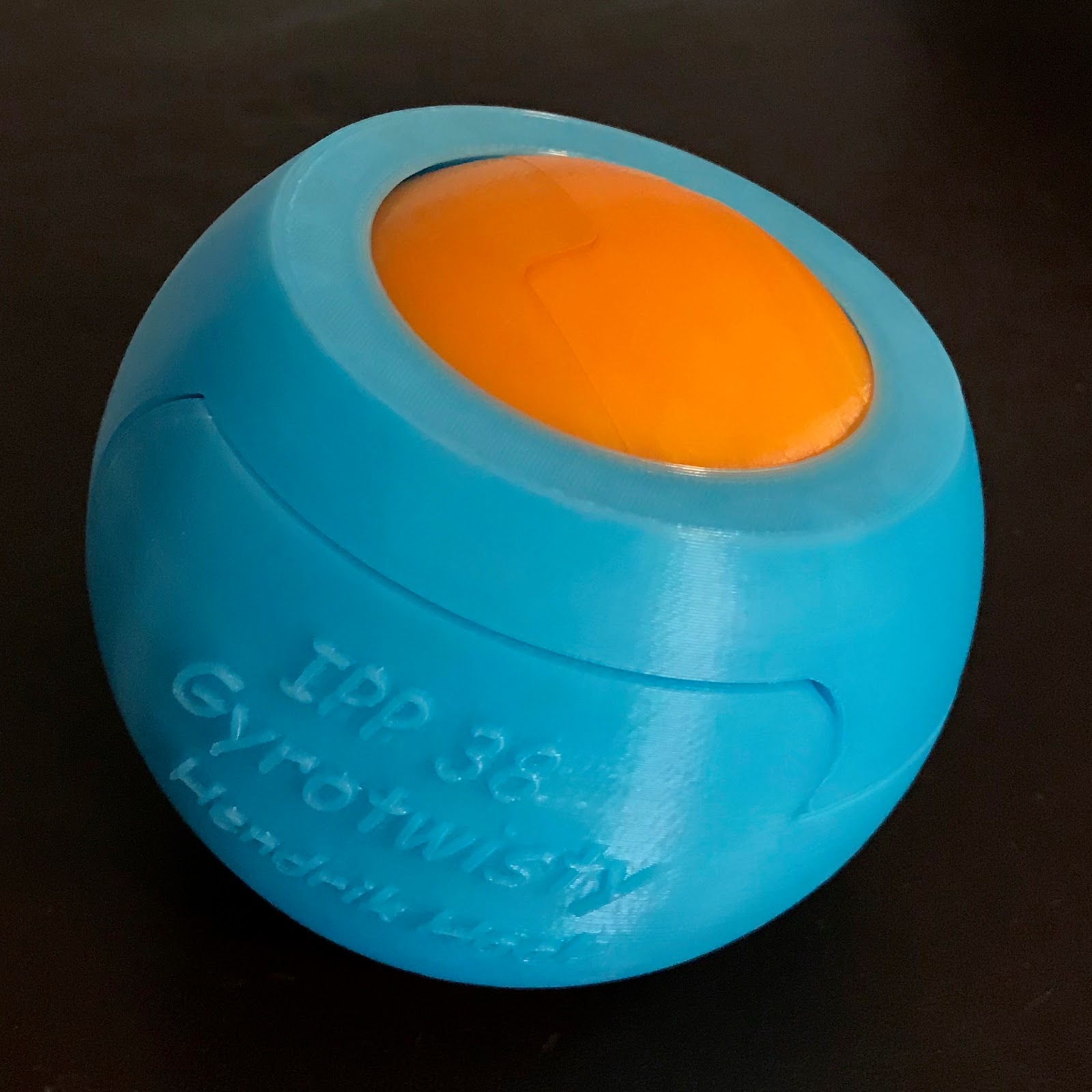
Here's another Diniar Namdarian-designed 3D printed "twist" puzzle. Exchanged by Hendrik Haak at IPP38 in San Diego, USA.
http://mechanical-puzzles.com/gyrotwisty/
Showing posts with label twisty. Show all posts
Saturday, 24 November 2018
Sunday, 9 September 2018
Super Cube
Is this cool or what?
George Miller's IPP38 Exchange Puzzle in San Diego, the Super Cube. I have added a video to the post to show you how the dedicated app solves the puzzle for you.
http://mechanical-puzzles.com/super-cube/
George Miller's IPP38 Exchange Puzzle in San Diego, the Super Cube. I have added a video to the post to show you how the dedicated app solves the puzzle for you.
http://mechanical-puzzles.com/super-cube/
Sunday, 26 July 2015
Singapore Puzzle Party (SPP01)
Towards the end of June this year, Roxanne Wong got in touch with me to let me know that Oskar van Deventer was coming to Singapore for a business trip and had given Oskar my email to link us both up. I had met Oskar twice previously, both times very briefly at IPP33 in Japan and IPP34 in London, the latter during which we also exchanged puzzles.
Since Oskar also knew puzzle designer Goh Pit Khiam, the plan was for the both of us to take him to dinner, play with some puzzles (I asked Oskar to bring his latest designs) and have a catch up. In the course of several email exchanges, I also got to know David Ang through Oskar. David runs CubeWerkz, a distributor of twisty (Calvin's) puzzles in Singapore, but I have never met him before.
Not only that, I also found out, after calling and speaking with David the first time, that he runs Rubik's competitions in Singapore. Kinda of strange as Singapore is such a small country (5.2M population) and I have been puzzling and blogging for some years now, yet have never heard of David nor he of me! Well, then again, its probably because I am not a twisty collector, hence I don't really move in the twisty circles which he operates.
What was going to be a simple three men meet up now became an eight persons gathering, as David was bringing several other twisty puzzle/cubing enthusiasts. There were several others who were invited but were unable to attend. Until now, I always thought I could count puzzle collectors in Singapore with just one hand.
Fast forward and we get to the evening of Saturday 25th July. Pit Khiam and I met with Oskar at his hotel and we took a stroll to the restaurant which was nearby. There we met David and his (young) twisty gang; two junior college students, one who was doing his stint in the army and a high school teacher.
Dinner commenced (and it was a pretty decent buffet mind you) but it was obvious that food was secondary. Well I should have known better that when puzzlers get together with lots of puzzles to play with, the world can suddenly be overrun by a zombie apocalypse and nobody would really pay any attention.
As to be expected, no one wanted second helpings and everyone was just eager to get the dirty dishes out of the way. Pit Khiam and I were the only two non-cubers and each of us had brought a number of puzzles with us. David brought some new interesting twisties he was introducing to the Singapore market, and the rest of the folks had a puzzle or two with them. Oskar had the largest stash which he carried all the way from the Netherlands comprising some of his latest prototypes (which incidentally are available on Shapeways but at rather expensive prices).
Everyone got round to playing with each other's puzzles especially the new ones from Oskar and even a couple of cubers tried their hand at Pit Khiam's and my non-twisty packing puzzles. Our table was full of loud and animated conversation. The other diners in the restaurant gave us bemused looks as we passed our toys around. We were in a world of our own! I kept hearing words like "parity", "algorithms" etc; twisty speak of course. The evening ended rather early to the disappointment of everyone...the restaurant was closing and the staff politely asked us come back another day!
Well, enough from me; I will just let the photos do the talking from here on...
This is perhaps the first Singapore Puzzle Party? And I was happy to have made a number of new puzzle friends from Singapore. Certainly it won't be the last...already I am planning on organising the second get-together after IPP35, now that I know there is more than just a few of us collectors around, twisty or otherwise.
| Clockwise from left: Me, Goh Pit Khiam, Seung Ha, Lim Chen, David Chua, David Ang, Oskar and KangZZ |
Not only that, I also found out, after calling and speaking with David the first time, that he runs Rubik's competitions in Singapore. Kinda of strange as Singapore is such a small country (5.2M population) and I have been puzzling and blogging for some years now, yet have never heard of David nor he of me! Well, then again, its probably because I am not a twisty collector, hence I don't really move in the twisty circles which he operates.
What was going to be a simple three men meet up now became an eight persons gathering, as David was bringing several other twisty puzzle/cubing enthusiasts. There were several others who were invited but were unable to attend. Until now, I always thought I could count puzzle collectors in Singapore with just one hand.
Fast forward and we get to the evening of Saturday 25th July. Pit Khiam and I met with Oskar at his hotel and we took a stroll to the restaurant which was nearby. There we met David and his (young) twisty gang; two junior college students, one who was doing his stint in the army and a high school teacher.
Dinner commenced (and it was a pretty decent buffet mind you) but it was obvious that food was secondary. Well I should have known better that when puzzlers get together with lots of puzzles to play with, the world can suddenly be overrun by a zombie apocalypse and nobody would really pay any attention.
As to be expected, no one wanted second helpings and everyone was just eager to get the dirty dishes out of the way. Pit Khiam and I were the only two non-cubers and each of us had brought a number of puzzles with us. David brought some new interesting twisties he was introducing to the Singapore market, and the rest of the folks had a puzzle or two with them. Oskar had the largest stash which he carried all the way from the Netherlands comprising some of his latest prototypes (which incidentally are available on Shapeways but at rather expensive prices).
Everyone got round to playing with each other's puzzles especially the new ones from Oskar and even a couple of cubers tried their hand at Pit Khiam's and my non-twisty packing puzzles. Our table was full of loud and animated conversation. The other diners in the restaurant gave us bemused looks as we passed our toys around. We were in a world of our own! I kept hearing words like "parity", "algorithms" etc; twisty speak of course. The evening ended rather early to the disappointment of everyone...the restaurant was closing and the staff politely asked us come back another day!
Well, enough from me; I will just let the photos do the talking from here on...
This is perhaps the first Singapore Puzzle Party? And I was happy to have made a number of new puzzle friends from Singapore. Certainly it won't be the last...already I am planning on organising the second get-together after IPP35, now that I know there is more than just a few of us collectors around, twisty or otherwise.
Thursday, 8 May 2014
The Force Was Not With Me
After reading puzzle blogger Kevin's Sadler's latest post on twisty puzzles, I was encouraged to try my hand at one. I have only several twisties in my collection, of which one is the ubiquitous Rubik's Cube and the rest of my minuscule collection have been mentioned in one of my blog post quite a while back. I have not ventured to the 'dark side"!
I headed for my puzzle cabinet and took out my (very) menacing looking Darth Maul. This puzzle came to me courtesy of puzzle blogger Roxanne Wong when I met her at IPP33 Puzzle Party last year in Japan. (Oops! sorry Rox, I just remembered that I still owe you money for some puzzles).
Darth Maul is produced and sold by Hasbro, under licence from Rubik. The puzzle is about 10cm tall and 7 cm wide; feels pretty large in the hands. It is very well made and high quality. Although plastic, it feels solid and sturdy. The twisting is snug but smooth and there is no "play" during rotation.
I am not a big fan of Twisties. But I do enjoy Star Wars movies. So I duly picked this one off Roxanne. I was hoping to get the rest of the characters of the cast, but to my surprise, Darth Maul is the only Star Wars character that is a Rubik's cube style puzzle of its kind in this sort of packaging today. Around 2002, there was also a range of similar Star Wars figures produced as promotional premiums for Kelloggs (Thanks to Rob Stegman for this info). For anyone interested, this Darth Maul can be bought off Ebay at very reasonable prices.
Darth Maul comes in a nice packaging with a Solution Hints booklet. Given that this is a high level twisty (for me, I think anything more than 1x1x2 is high), I was sure I would need the booklet. New words like "Diagonal Swapping" "Shunter" and "Shifter" entered my puzzle vocabulary...how come there is no "Parity"...whatever it means?
I wrongly assumed that a 2x2x2 couldn't be that difficult. I casually scrambled Darth Maul for a minute or so to make sure it was all properly mixed up...and promptly regretted it! I started to have problems right from the start - Darth Maul's two eyes couldn't come together and his jaw was at the back of his head. Suddenly a level 17.5.2 burr didn't seem so difficult after all.
After quite a bit of struggling, I finally got Darth Maul's face to what it is suppose to be, but the back of his head was still looking funny. Not properly solved yet!
This twisty is much harder than your standard 2x2x2 because each of the "blocks" of Darth Maul's head is an odd shape, not a normal cube. So if the orientation is wrong, it is very obvious, eg part of the back of his head sticking out sideways. Whereas in a standard 2x2x2 you can have the orientation wrong for one or more of the cubes, but still get the same colour.
Hardcore twisty puzzlers would probably not find this challenging but for casual, novice or non-twisty folks like me, this one can be real handful. As the packaging states, Darth Maul is truly a galactic challenge.
Happy Puzzling and May The Force Be With You!
I headed for my puzzle cabinet and took out my (very) menacing looking Darth Maul. This puzzle came to me courtesy of puzzle blogger Roxanne Wong when I met her at IPP33 Puzzle Party last year in Japan. (Oops! sorry Rox, I just remembered that I still owe you money for some puzzles).
Darth Maul is produced and sold by Hasbro, under licence from Rubik. The puzzle is about 10cm tall and 7 cm wide; feels pretty large in the hands. It is very well made and high quality. Although plastic, it feels solid and sturdy. The twisting is snug but smooth and there is no "play" during rotation.
I am not a big fan of Twisties. But I do enjoy Star Wars movies. So I duly picked this one off Roxanne. I was hoping to get the rest of the characters of the cast, but to my surprise, Darth Maul is the only Star Wars character that is a Rubik's cube style puzzle of its kind in this sort of packaging today. Around 2002, there was also a range of similar Star Wars figures produced as promotional premiums for Kelloggs (Thanks to Rob Stegman for this info). For anyone interested, this Darth Maul can be bought off Ebay at very reasonable prices.
Darth Maul comes in a nice packaging with a Solution Hints booklet. Given that this is a high level twisty (for me, I think anything more than 1x1x2 is high), I was sure I would need the booklet. New words like "Diagonal Swapping" "Shunter" and "Shifter" entered my puzzle vocabulary...how come there is no "Parity"...whatever it means?
I wrongly assumed that a 2x2x2 couldn't be that difficult. I casually scrambled Darth Maul for a minute or so to make sure it was all properly mixed up...and promptly regretted it! I started to have problems right from the start - Darth Maul's two eyes couldn't come together and his jaw was at the back of his head. Suddenly a level 17.5.2 burr didn't seem so difficult after all.
After quite a bit of struggling, I finally got Darth Maul's face to what it is suppose to be, but the back of his head was still looking funny. Not properly solved yet!
This twisty is much harder than your standard 2x2x2 because each of the "blocks" of Darth Maul's head is an odd shape, not a normal cube. So if the orientation is wrong, it is very obvious, eg part of the back of his head sticking out sideways. Whereas in a standard 2x2x2 you can have the orientation wrong for one or more of the cubes, but still get the same colour.
Hardcore twisty puzzlers would probably not find this challenging but for casual, novice or non-twisty folks like me, this one can be real handful. As the packaging states, Darth Maul is truly a galactic challenge.
Happy Puzzling and May The Force Be With You!
Sunday, 25 September 2011
Retro Plastic Twisty Puzzles Collection
Update 23 October 2017 - Dear Reader, please check out my new puzzle blog and e-store at http://mechanical-puzzles.com
For a change from the usual posts on wood and metal puzzles, I am featuring here a small collection of 7 different twist type puzzles all plastic and very retro!
I acquired these puzzles after having seen them over the internet from time to time, my purchase criteria being based on their unusual design, uniqueness in their puzzling aspects and of course their vintage rarity. Added to this, their bright and attractive colours and round shapes were also key selling points. Hence you will find there is no twisty cube-shaped puzzles here, which are not really my cup of tea anyway. There is also a fair amount of information that can be found on the internet about these plastic puzzles. For those interested in such plastic twist puzzles, there is an internet forum with a base of 2,000 members. I guess the likes of Rubik's Cube continue to live long and prosper!.
The Wisdom Ball, Gerdig UFO, Brain Ball and Back Spin came from a gentleman from the Czech Republic by the name of Milan Vodicka who has a site featuring an extensive number of plastic twist/non-twist puzzles for sale, some produced as far back as the 1980s. The Puck Puzzle came from the puzzle shop of Hendrik Haak, Saturn Brain Killer from Amazon and the Enigma from an Ebay seller who, at the time of this writing still has several of these puzzles left.
Wisdom Ball
This is the invention of Yang Iu-Hsin of Taiwan. It is a ball puzzle with 6 rotating circles, each comprising a different colour. In the solved state, each rotating circle has 8 number tabs in running order from Nos 1 to 8. The only exception is the red circle which has only tabs Nos1 to 7. In place of No.8, there is an empty slot to which a number tab from another circle can slide into. In the unsolved state, all the number tabs are of course jumbled up on each of the 6 circles.
The object of the puzzle is to take a jumbled up Wisdom Ball, rotate the coloured circles and slide the number tabs around and render the number tabs back in the correct order on each of the circles. This is but one of the 7 challenges available for this puzzle. Other challenges include arranging every tab to be the same number on each circle, and matching the same colour for both the number tabs and circles.
The puzzle is not unduly difficult and I had a lot of fun turning the circles and sliding the number tabs here and there. It came solved, so I was quite happy just to scramble it enough for me to have a decent feel for arranging it back to its solved state.
Enigma
The Enigma is a one of those puzzles that is occasionally massed produced as corporate gifts or souvenirs, usually bearing the logo or name of an organisation or a company.
The puzzle is round with a diameter of 3 1/4in and 7/8in thick. Made of sturdy plastic, it consist of 3 parts; a top and a bottom circular dial with finger grooves along its edge, both which can rotate. These two dials sandwich a centre disc with gear teeth. What the two top and bottom dials do is that when they are turned clockwise or anti-clockwise, they manipulate a series of internal gears within the puzzle which in turn will cause 8 small circles around the edge and a larger centre ring, all on the top surface to turn in various directions. This has the effect of jumbling up the image printed on the surface of the puzzle. In the solved state, the image looks normal and nothing appears to be amiss. The 8 circles and ring have pretty tight tolerances and they are not obvious within the image unless you look closely at the puzzle. The image looks normal just as in the photo on the right above.
Once you start turning the top and/or the bottom dials, the image starts to get jumbled and becomes illegible (as in the left photo). The goal here is to rotate both the dials in order to get the image back to "normal". The puzzle is not as easy as it appears to be since both the top and bottom dials control the rotation of the 8 small circles (each dial 4 at a time) as well as the larger centre ring. So quite a fair bit of turning left and right is required, for both dials to finally line up the image again. If the image is a relatively complicated one (like the one here), this makes the puzzle even harder to solve.
Overall, the Enigma is a fun and unusual puzzle (I think great for kids too since it is plastic, safe with no sharp edges, loose parts or unduly heavy). I just wished I had been able to obtain one with a nicer image and colours and not bearing the name of some organisation, but alas, my Ebay seller had already run out of decent looking ones. See Jaap's Puzzle Page for more info.
Back Spin
Back Spin was manufactured by Binary Arts (now ThinkFun) in the l990s. It is a fairly large puzzle measuring about 6in in diameter and 1 1/2in thick. It is well constructed and the plastic quality of my copy is very good.
The puzzle consists of two flat rotating black discs joined together at the centre. Both the top disc and the bottom disc each have 6 coloured slots, each containing (in the solved state) 3 balls of the same colour. In total, there are 12 slots from both the top and bottom discs. However, at any one time, one of the slots (depending on whether you are looking at it from the top or bottom) will have only two balls.
To play with the Back Spin, you are first required to scramble the puzzle to mix up the colour balls in their slots from both the top and bottom disc and you do this by rotating the 2 black discs, aligning the slot with 2 balls with a slot containing 3 balls and allowing a coloured ball from the 2nd slot to fill the slot which has only 2 balls. Now the 2nd slot that originally had 3 balls now is left with 2 and you find another ball from yet another slot (with 3 balls) to fill it. And you continue doing this until all the balls in the slots are sufficiently mixed up in colours. To solve the puzzle, now your objective is to fill each slot with 3 balls not only all of the same colour but also that the slot colours on both sides of the discs match the colours of its 3 balls within.
For a change from the usual posts on wood and metal puzzles, I am featuring here a small collection of 7 different twist type puzzles all plastic and very retro!
![]() |
| Top Row L to R: Wisdom Ball, Gerdig UFO, Puck Puzzle, Saturn Brain Killer Bottom Row L to R: Brain Ball, Back Spin, Enigma |
The Wisdom Ball, Gerdig UFO, Brain Ball and Back Spin came from a gentleman from the Czech Republic by the name of Milan Vodicka who has a site featuring an extensive number of plastic twist/non-twist puzzles for sale, some produced as far back as the 1980s. The Puck Puzzle came from the puzzle shop of Hendrik Haak, Saturn Brain Killer from Amazon and the Enigma from an Ebay seller who, at the time of this writing still has several of these puzzles left.
Wisdom Ball
The puzzle is not unduly difficult and I had a lot of fun turning the circles and sliding the number tabs here and there. It came solved, so I was quite happy just to scramble it enough for me to have a decent feel for arranging it back to its solved state.
My copy of the Wisdom Ball is well constructed and quality is very good. The surface is matted so that there is some texture and will not slip easily for those with sweaty palms. The ball is of a good size for the hands (diameter of about 3 1/4in) and all the coloured circles rotate smoothly.
The only grouse I have, and this is a minor one, is that to slide a tab, the two circles in question must be properly lined up so that the tab can slide across from one circle to the other smoothly, otherwise you will find that the tab gets stuck sometimes. However as I played more with the ball, I realised that after a while, one can easily get the hang of properly aligning the circles quite quickly and efficiently and solving becomes a much easier process. The Wisdom Ball is pretty rare so its worth getting if you come across one.
For more information on the Wisdom Ball, check out Jaap's Puzzle Page and Gabriel's blog. There is also a video review of the Ball on YouTube.
![]() |
| A green stopper restrains the two dials to prevent unintended movement |
The puzzle is round with a diameter of 3 1/4in and 7/8in thick. Made of sturdy plastic, it consist of 3 parts; a top and a bottom circular dial with finger grooves along its edge, both which can rotate. These two dials sandwich a centre disc with gear teeth. What the two top and bottom dials do is that when they are turned clockwise or anti-clockwise, they manipulate a series of internal gears within the puzzle which in turn will cause 8 small circles around the edge and a larger centre ring, all on the top surface to turn in various directions. This has the effect of jumbling up the image printed on the surface of the puzzle. In the solved state, the image looks normal and nothing appears to be amiss. The 8 circles and ring have pretty tight tolerances and they are not obvious within the image unless you look closely at the puzzle. The image looks normal just as in the photo on the right above.
Once you start turning the top and/or the bottom dials, the image starts to get jumbled and becomes illegible (as in the left photo). The goal here is to rotate both the dials in order to get the image back to "normal". The puzzle is not as easy as it appears to be since both the top and bottom dials control the rotation of the 8 small circles (each dial 4 at a time) as well as the larger centre ring. So quite a fair bit of turning left and right is required, for both dials to finally line up the image again. If the image is a relatively complicated one (like the one here), this makes the puzzle even harder to solve.
Overall, the Enigma is a fun and unusual puzzle (I think great for kids too since it is plastic, safe with no sharp edges, loose parts or unduly heavy). I just wished I had been able to obtain one with a nicer image and colours and not bearing the name of some organisation, but alas, my Ebay seller had already run out of decent looking ones. See Jaap's Puzzle Page for more info.
Back Spin
Back Spin was manufactured by Binary Arts (now ThinkFun) in the l990s. It is a fairly large puzzle measuring about 6in in diameter and 1 1/2in thick. It is well constructed and the plastic quality of my copy is very good.
The puzzle consists of two flat rotating black discs joined together at the centre. Both the top disc and the bottom disc each have 6 coloured slots, each containing (in the solved state) 3 balls of the same colour. In total, there are 12 slots from both the top and bottom discs. However, at any one time, one of the slots (depending on whether you are looking at it from the top or bottom) will have only two balls.
![]() |
| At any one time, one of the 12 slots on the Back Spin (for top and bottom) will only have 2 out of 3 balls such as the blue slot at 12 o'clock containing only a red and a blue ball |
The puzzle is not overly difficult but presents a fair challenge. However it can be a bit tedious since you are required not only to rearrange all 35 coloured balls back into 3 same coloured balls per slot but also into the slot of the correct colour.
After I had scrambled the Back Spin, I went about diligently trying to put everything back in order but at the time of this post, I still have not return it to the solved state....yet. Maybe I should have jumbled it less!! It's hard to describe the Back Spin in action so do watch videos of it; click here and here. Also check out Jaap's Puzzle Page; which gives the solution in very detailed steps. The Back Spin is no longer sold by ThinkFun. It also has a number of spin-offs (no pun intended) and imitations found for sale on the internet, so getting an original version may be quite difficult and would probably be via a private sale.
Puck Puzzle
For a puzzle with just one size, design and construction, I think the Puck Puzzle ranks up there with the Rubik's cube for having the most variants; perhaps even more than the basic Rubik's cube. The variants here I am talking about are the myriad of colours and graphics that adorn the Puck Puzzle in its many guises. If you did a Google search under Images for "Puck Puzzle", you will probably find no less than 15 different colours and designs of Puck Puzzles. My puck is the Blue IQ139. From what I can see from the Internet, there is also a Red, Yellow and Rainbow IQ139 puck.
The Puck measures about 3in in diameter and 1in thick and made of high quality plastic. Fit and finish is good and parts that are suppose to move all move smoothly. However, as you start twisting and turning, the puzzle becomes "seasoned" and the fit becomes less snug. Unlike a lot of plastic puzzles where parts are coloured using coloured stickers (eg; Rubik's Cube), the Puck's numbers are silk screen printed giving the puzzle a feeling of quality.
On all Pucks, the outer ring is made up of twelve separate sections (each shaped like a wedge) and together they can rotate around the centre circle.The centre circle is split into 2 halves and each half can also be turned 180 degrees forwards or backwards. In my case, rotating the outer ring in combination with turning either of the 2 centre halves has the effect of scrambling the twelve separate numbered sections.
The object is to rearrange the scrambled numbers back in running order from 1-12. To do this will again require rotating the outer ring and turning the centre halves. It takes a bit of figuring out to get the hang of rotating and turning the numbers to bring the numbers back in order again, since once you turn one half over, 6 of the top numbers disappear to the bottom leaving some to remain on top, so you may have a mix of numbered sections and blank sections. I scrambled the puzzle quite a bit but could not seem to get the numbers back in correct order again. I looked at Jaap's Puzzle Page and despite following his solution steps, can only manage Nos 4-12 in order. So now my Puck remains in a half scrambled state :-(. For a Puck in action, check out the videos on YouTube.
The Puck is not too bulky and quite pocketable. A portable puzzle to bring along to frustrate you on your travels!
Saturn Brain Killer
The Saturn puzzle consist of a ring with a recessed track on both sides. Within the track on either side are a number of movable discs. Each disc has a different colour on both sides. There are altogether 32 discs in the puzzle. In the centre of the ring is a bridge which can also rotate on its own axis.
The function of the bridge is to enable a disc to move from the top side to the bottom side of the ring and also allow a disc to change sides hence changing the colour from top to bottom or vice-versa. The object of the puzzle is to arrange the discs (with the help of the bridge) of 4 colours on 4 discs on each side of the rings. The Saturn measures 4 1/2in in diameter and is about 7/8in thick.
When I first unpacked the puzzle, I thought the puzzle was pretty simple, just rearrange the discs by pushing them around the rings and using the bridge to change the colours or flip it to the opposite side etc. Little did I realise that there are more than 8 colours (I had assume only 4 different colours for each side of the ring, hence a total of 8 colours for both sides).
As I continued playing with the puzzle, I found myself going around in circles (no pun intended) and it was then I discovered that there are more than 8 colours. There are actually 14 colours covering the 32 discs. This makes the puzzle very much harder to solve. Difficult because you can't remove the disc to see what colour is under a particular disc....the only way to know is for you to move a disc onto the bridge and then you can see the underside of it. Also difficult because you need to figure out which are the relevant 8 colours to solve the puzzle as intended.
After the usual scrambling of the colours, I tried to solve it but gave up after some time, not only because the puzzle is difficult, but also because the bridge keeps getting stuck and cannot rotate properly because one or more discs keeps getting jammed (half of the disc is in the ring and half onto the bridge). I wouldn't say the quality is bad, in fact the build of the puzzle is pretty solid and sturdy with the use of good plastic. The only complaint being that of the bridge and I guess its the way the puzzle has been designed.
I checked out Jaap's Puzzle Page for some explanation on how to figure out the colours in order to solve this puzzle, but unfortunately (through no fault of his) I can't quite follow his analysis and reasoning to determine which are the 8 colours needed to solve the puzzle. Jaap has listed the 8 colours on his site and once you know the 8, solving becomes relatively easy. Randomly trying to solve the puzzle by trial and error is not going to work as I also discovered. Now that I know what are the 8 colours to use, I am quite happy come back to the Saturn again another other day. While I thought this puzzle was a rare find, they are still available via Amazon.
For how the Saturn looks in action, check out this video on YouTube.
BrainBall
The BrainBall ("BB") looks like the planet Saturn; it consists of a ring of numbers from 1-13 (white on one side as in the photo and yellow on the reverse side). This ring encircles and can rotate in either direction around the ball. The ball itself consist of 3 parts, the blue portion which is flanked by two black circles (one larger than the other) on the sides and both these circles can rotate on its axis but not independently; ie both circles can only rotate together in the same direction at the same time.
In a way, the BB is similar to the Puck, the object of the puzzle is to unscramble and rearrange the numbers back in running order and in the same colour scheme. The BB looked to be promising at first but I had a hard time with it, not because the puzzle is difficult (yes this as well!) but I found the rotation of the number ring very stiff and arduous and I was practically using quite a bit of force to get it to turn around the ball. Flipping the black circles to turn the white numbers to yellow and vice-versa was only slightly easier. Having seen a video of the BB in action, I think its my own copy of the puzzle that is having this problem. Notwithstanding,
I would say the quality of the puzzle, in terms of materials used and colours applied (no stickers here) is very good. Everything is strong and sturdy, perhaps too sturdy! It could certainly do with some hard twisting to "season" the puzzle. The BB measures about 3 1/2in across at the widest points and the ball itself is 2 1/4in in diameter. Size is about right in the palm of the hand.
I didn't spend a lot of time with the BB; I scrambled it just a wee bit to get a feel of how the puzzle works and given how difficult my copy was to manipulate the number ring around the ball, I didn't want to make things too difficult for myself and was content to get it back to its solved state quickly. According to Jaap, the BB is a "very difficult puzzle". Looking at his analysis of the BB, the various permutations that abound and the moves required to solve the puzzle, I would not argue with his statement. There was even a website dedicated to the BB which now appears to be defunct, although Jaap on his site also mentions another link which has info about the BB. For its rarity, definitely worth getting one for keeps if you happen to come across a unit for sale.
Gerdig UFO
The Gerdig UFO ("GUFO") I think is probably the most mechanically complicated plastic twist puzzle I have ever come across. The design and number of moving parts integrated to form a workable puzzle is really quite amazing. The GUFO has its own website with a video, photos and a guide to how to play and solve the puzzle although you will probably require Google Translation unless you understand the Slovakian language.
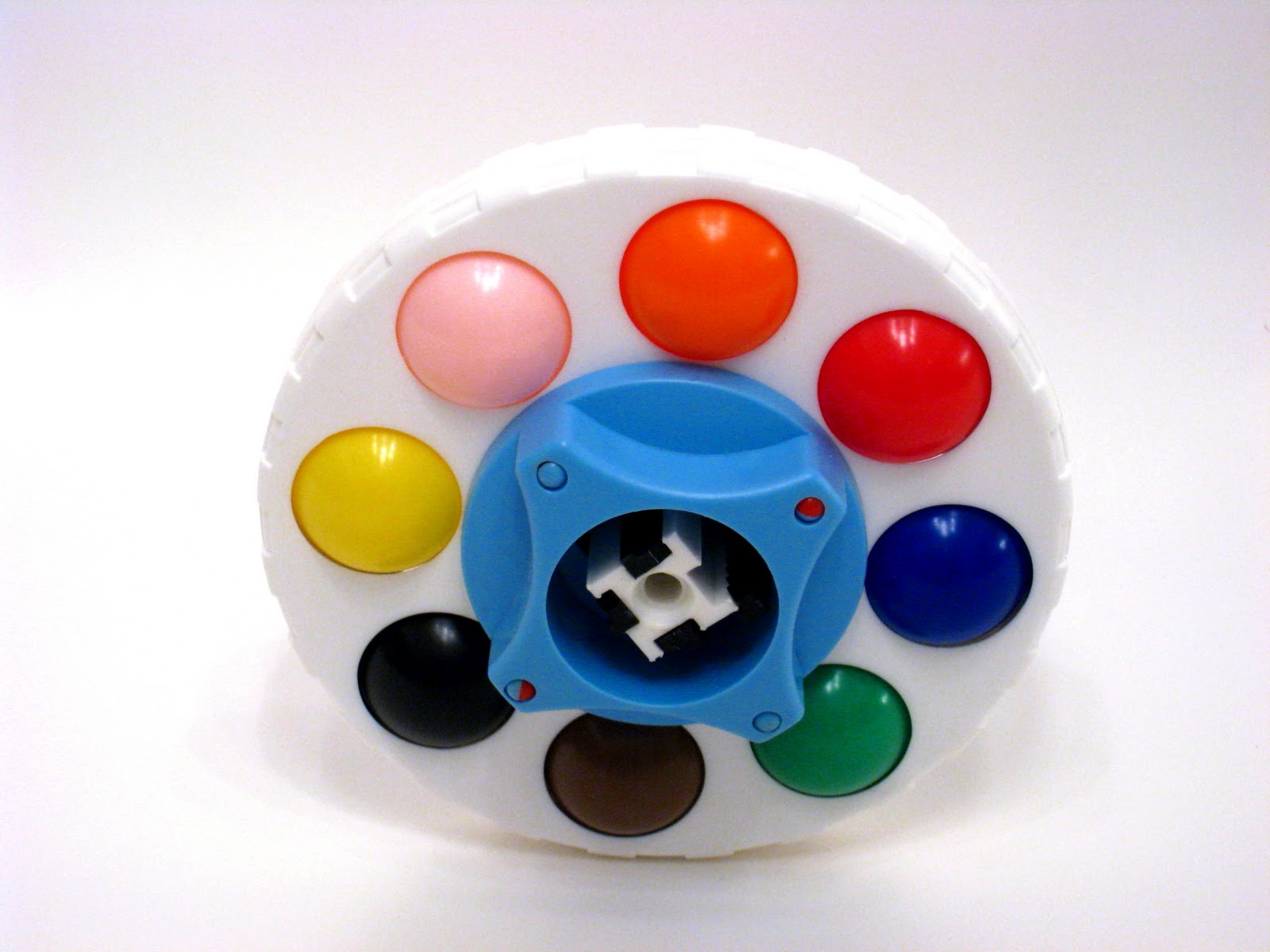
The GUFO consist of a white and thick flat "pancake" which is split horizontally in the middle into two halves with finger grooves for easy gripping. These two halves are connected via the centre and can rotate against each other. On the top rotating half, there are eight coloured semi-spheres protruding upwards. On the opposite, the bottom rotating half similarly also has 8 coloured semi-spheres protruding downwards. In the solved state, each semi-sphere is of the same colour, when viewed from either the top or bottom. When the top or bottom half is rotated, the 8 coloured semi-spheres move together along with whichever half that is being rotated. This has the effect of changing the colours of the top and bottom semi-spheres resulting in their colours being mixed. In the centre is also a rotatable light blue dial with a red dot and within the dial is a white button. When the button is depressed, depending at which semi-sphere the red dot is pointing ti, that sphere will flip over to reveal its bottom colour; ie top colour goes to bottom and bottom colour comes to the top. The GUFO is about 4 1/4in in diameter and 2in tall. Quality and construction is very good and all the parts move smoothly and click into position without anything getting stuck so far....
The puzzle must first be ramdomly scrambled to mix the colours of the semi-spheres top and bottom. This is done via rotation of the two halves, turning the blue dial's red dot to a semi-sphere and pressing the white button which will flip the spheres and mix the colours. Once its sufficiently scrambled, the fun of solving begins using the same type of actions that caused the puzzle to be scrambled in the first place.
The GUFO not only has an unusual design but it comes with 5 levels of difficulty built into the puzzle as well (ie something for the whole family as stated by the maker!). By increasing the level of difficulty beyond level 1, each time you depress the white button, more than 1 semi-sphere will flip simultaneously. At level 5, 4 semi-spheres (marked by 4 red dots) will flip at the same time. Each of the 5 levels can be adjusted by unscrewing the back plate of the white button to reveal a set of gear sticks which can be removed and placed at certain positions within the internal mechanism to set the puzzle to the desired level of difficulty.
I scrambled the GUFO quite sufficiently at random and was able to solve it fairly quickly. But this was only at Level 1. I did not want to be too ambitious, so I didn't challenge myself to the other more difficult levels. Besides, I wasn't sure about messing around with the internal mechanism, just in case I jam something in the process. Overall I found the GUFO to be pretty fun and engaging (in my case at level 1) and watching the spheres flip and change colour when pressing the white button is pretty cool. I think I had a bit more fun with the GUFO than the rest of the twisties above (all which I enjoyed except maybe for the BrainBall), or maybe its just the fairly intricate mechanism that captivated me. If only someone would produce a metal version....now that would be really cool!
For another take on the GUFO, see Gabriel's blog. As usual Jaap has detailed information and analysis on solving the GUFO so be sure to check that out if you decide to acquire a GUFO. Its a pretty rare puzzle and you might still be able to get one from Milan Vodicka mentioned at the beginning of this post if he has any left or possibly from this site as well.
After I had scrambled the Back Spin, I went about diligently trying to put everything back in order but at the time of this post, I still have not return it to the solved state....yet. Maybe I should have jumbled it less!! It's hard to describe the Back Spin in action so do watch videos of it; click here and here. Also check out Jaap's Puzzle Page; which gives the solution in very detailed steps. The Back Spin is no longer sold by ThinkFun. It also has a number of spin-offs (no pun intended) and imitations found for sale on the internet, so getting an original version may be quite difficult and would probably be via a private sale.
Puck Puzzle
For a puzzle with just one size, design and construction, I think the Puck Puzzle ranks up there with the Rubik's cube for having the most variants; perhaps even more than the basic Rubik's cube. The variants here I am talking about are the myriad of colours and graphics that adorn the Puck Puzzle in its many guises. If you did a Google search under Images for "Puck Puzzle", you will probably find no less than 15 different colours and designs of Puck Puzzles. My puck is the Blue IQ139. From what I can see from the Internet, there is also a Red, Yellow and Rainbow IQ139 puck.
The Puck measures about 3in in diameter and 1in thick and made of high quality plastic. Fit and finish is good and parts that are suppose to move all move smoothly. However, as you start twisting and turning, the puzzle becomes "seasoned" and the fit becomes less snug. Unlike a lot of plastic puzzles where parts are coloured using coloured stickers (eg; Rubik's Cube), the Puck's numbers are silk screen printed giving the puzzle a feeling of quality.
The object is to rearrange the scrambled numbers back in running order from 1-12. To do this will again require rotating the outer ring and turning the centre halves. It takes a bit of figuring out to get the hang of rotating and turning the numbers to bring the numbers back in order again, since once you turn one half over, 6 of the top numbers disappear to the bottom leaving some to remain on top, so you may have a mix of numbered sections and blank sections. I scrambled the puzzle quite a bit but could not seem to get the numbers back in correct order again. I looked at Jaap's Puzzle Page and despite following his solution steps, can only manage Nos 4-12 in order. So now my Puck remains in a half scrambled state :-(. For a Puck in action, check out the videos on YouTube.
The Puck is not too bulky and quite pocketable. A portable puzzle to bring along to frustrate you on your travels!
Saturn Brain Killer
![]() |
| The coloured discs can slide along inside the tracks around the ring |
The function of the bridge is to enable a disc to move from the top side to the bottom side of the ring and also allow a disc to change sides hence changing the colour from top to bottom or vice-versa. The object of the puzzle is to arrange the discs (with the help of the bridge) of 4 colours on 4 discs on each side of the rings. The Saturn measures 4 1/2in in diameter and is about 7/8in thick.
![]() |
| The bridge in the centre of the ring transport the discs from top to bottom and allows the disc to change sides so the colour is correspondingly changed |
As I continued playing with the puzzle, I found myself going around in circles (no pun intended) and it was then I discovered that there are more than 8 colours. There are actually 14 colours covering the 32 discs. This makes the puzzle very much harder to solve. Difficult because you can't remove the disc to see what colour is under a particular disc....the only way to know is for you to move a disc onto the bridge and then you can see the underside of it. Also difficult because you need to figure out which are the relevant 8 colours to solve the puzzle as intended.
After the usual scrambling of the colours, I tried to solve it but gave up after some time, not only because the puzzle is difficult, but also because the bridge keeps getting stuck and cannot rotate properly because one or more discs keeps getting jammed (half of the disc is in the ring and half onto the bridge). I wouldn't say the quality is bad, in fact the build of the puzzle is pretty solid and sturdy with the use of good plastic. The only complaint being that of the bridge and I guess its the way the puzzle has been designed.
I checked out Jaap's Puzzle Page for some explanation on how to figure out the colours in order to solve this puzzle, but unfortunately (through no fault of his) I can't quite follow his analysis and reasoning to determine which are the 8 colours needed to solve the puzzle. Jaap has listed the 8 colours on his site and once you know the 8, solving becomes relatively easy. Randomly trying to solve the puzzle by trial and error is not going to work as I also discovered. Now that I know what are the 8 colours to use, I am quite happy come back to the Saturn again another other day. While I thought this puzzle was a rare find, they are still available via Amazon.
For how the Saturn looks in action, check out this video on YouTube.
BrainBall
In a way, the BB is similar to the Puck, the object of the puzzle is to unscramble and rearrange the numbers back in running order and in the same colour scheme. The BB looked to be promising at first but I had a hard time with it, not because the puzzle is difficult (yes this as well!) but I found the rotation of the number ring very stiff and arduous and I was practically using quite a bit of force to get it to turn around the ball. Flipping the black circles to turn the white numbers to yellow and vice-versa was only slightly easier. Having seen a video of the BB in action, I think its my own copy of the puzzle that is having this problem. Notwithstanding,
I would say the quality of the puzzle, in terms of materials used and colours applied (no stickers here) is very good. Everything is strong and sturdy, perhaps too sturdy! It could certainly do with some hard twisting to "season" the puzzle. The BB measures about 3 1/2in across at the widest points and the ball itself is 2 1/4in in diameter. Size is about right in the palm of the hand.
I didn't spend a lot of time with the BB; I scrambled it just a wee bit to get a feel of how the puzzle works and given how difficult my copy was to manipulate the number ring around the ball, I didn't want to make things too difficult for myself and was content to get it back to its solved state quickly. According to Jaap, the BB is a "very difficult puzzle". Looking at his analysis of the BB, the various permutations that abound and the moves required to solve the puzzle, I would not argue with his statement. There was even a website dedicated to the BB which now appears to be defunct, although Jaap on his site also mentions another link which has info about the BB. For its rarity, definitely worth getting one for keeps if you happen to come across a unit for sale.
Gerdig UFO
The Gerdig UFO ("GUFO") I think is probably the most mechanically complicated plastic twist puzzle I have ever come across. The design and number of moving parts integrated to form a workable puzzle is really quite amazing. The GUFO has its own website with a video, photos and a guide to how to play and solve the puzzle although you will probably require Google Translation unless you understand the Slovakian language.
![]() |
| The Gerdig UFO standing vertically on its side to show the two halves and the 8 coloured semi-spheres on both the top and bottom halves |
The puzzle must first be ramdomly scrambled to mix the colours of the semi-spheres top and bottom. This is done via rotation of the two halves, turning the blue dial's red dot to a semi-sphere and pressing the white button which will flip the spheres and mix the colours. Once its sufficiently scrambled, the fun of solving begins using the same type of actions that caused the puzzle to be scrambled in the first place.
The GUFO not only has an unusual design but it comes with 5 levels of difficulty built into the puzzle as well (ie something for the whole family as stated by the maker!). By increasing the level of difficulty beyond level 1, each time you depress the white button, more than 1 semi-sphere will flip simultaneously. At level 5, 4 semi-spheres (marked by 4 red dots) will flip at the same time. Each of the 5 levels can be adjusted by unscrewing the back plate of the white button to reveal a set of gear sticks which can be removed and placed at certain positions within the internal mechanism to set the puzzle to the desired level of difficulty.
![]() |
| The back plate removed to show the internal mechanism and the black gear sticks which can be moved to different positions to adjust the level of difficulty |
For another take on the GUFO, see Gabriel's blog. As usual Jaap has detailed information and analysis on solving the GUFO so be sure to check that out if you decide to acquire a GUFO. Its a pretty rare puzzle and you might still be able to get one from Milan Vodicka mentioned at the beginning of this post if he has any left or possibly from this site as well.
Subscribe to:
Posts (Atom)