Tuesday, 9 August 2016

IPP36 - Puzzle Party - 7th August 2016

This year's International Puzzle Party (IPP36) was held in Kyoto, Japan from 4th to 7th August 2016. The venue chosen for the festivities was the Kyoto Tokyu Hotel situated about 3.5 km from downtown Kyoto and about 94 km from Kyoto Kansai International Airport.

There were 137 invitees including spouses, partners and kids. Typically the number of attendees for IPPs held in Asia tend to be lesser as a many puzzlers from the US and Europe do not wish to make the long (and perhaps rather costly) journey to Japan.

The Puzzle Party itself was held on Sunday 7th August. To know more and what typically happens at the Puzzle Party, click here.


As the turnout for this year's IPP was lower, the number of "stalls" were fewer and consequently, a lesser number and variety of puzzles were also offered for sale. Nonetheless, the mood of the attendees was no less exuberant and the crowd rushed in when the event doors were opened at 9am sharp. I will let the pictures do the talking....scroll down further to see close-ups...


Eitan Cher

Robert Sandfield

Susumu Kimura & Meiko Kimura (Torito Japan)

Atsushi Katagiri

Shiro Tajima

Brian & Sue Young (Mr Puzzle Australia)

Takahisa Nakanishi

Frederic Boucher (with Anh Bui, Vietnam)

Osanori Yamamoto

Koshi & Yuko Arai

Andrew Rhoda & Kathy Hess

Guan Shi & Min Shih

Emrehan Halici & Ezgi Karasin

The Krasnoukhovs

Wil Strijbos

Tania Gillen

Left: Andreas Rover (Burr Tools) and Gary Foshee

Oscar & Jose van Deventer

Peter Hajek


Henry Strout

John Rausch


Steve Nicholls & Stephen Miller

Allan Stein (Puzzlemaster, Canada) & Amy Jepson

Carl & Patricia Hoff

Nick Baxter (standing) and Jerry Slocum

Sue Toorenburg

Naoaki Takashima

Mr & Mrs Edi Nagata

Hiroshi Uchinaka

Hiroshi Yamamoto

Jerry Slocum

Scott Elliot

Kathleen Malcolmson ("Please please buy my puzzle...")
& Ginda Fisher (kneeling)

Peter von Knorre

Hirokazu Iwasawa
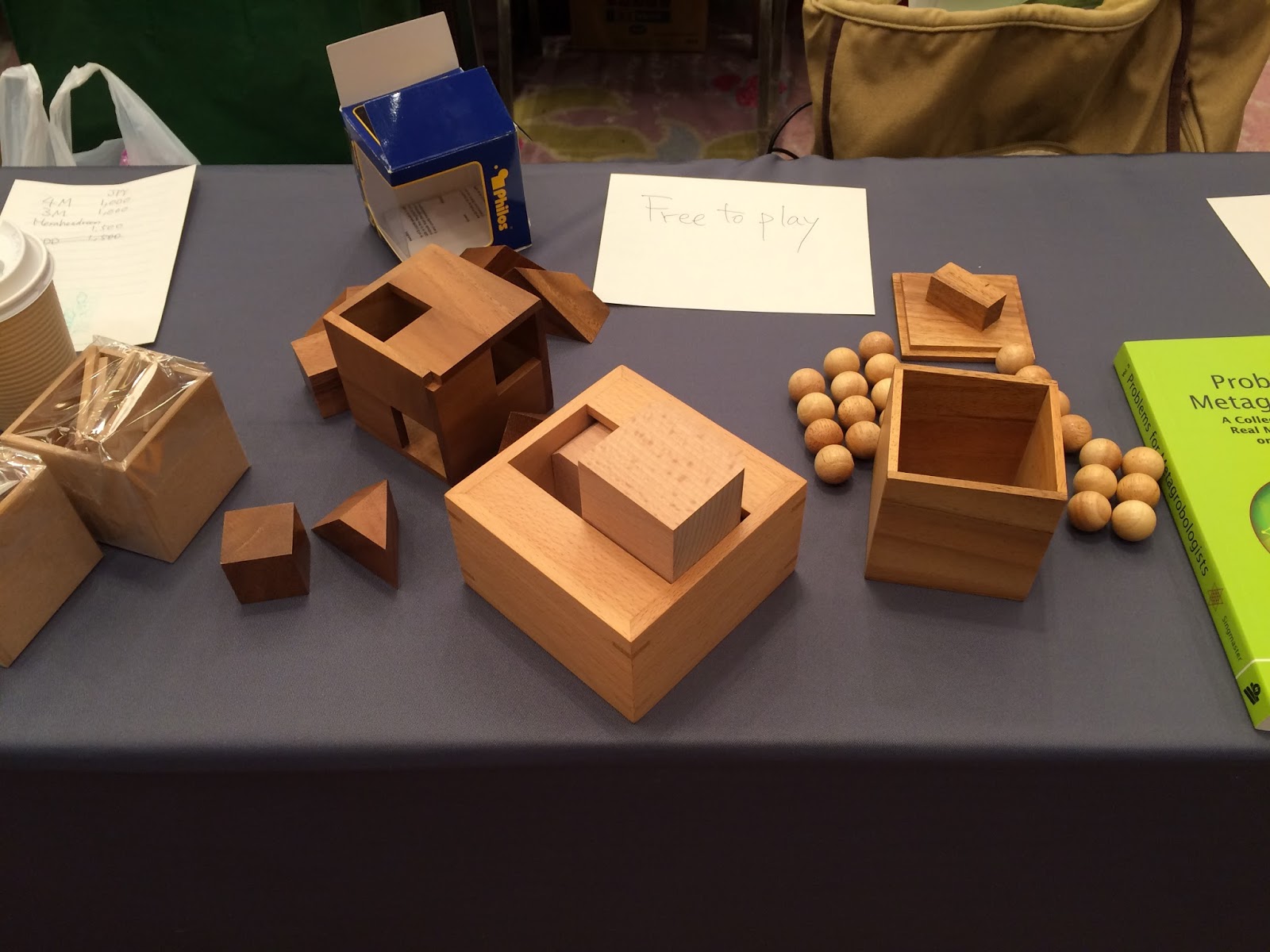
Close up shots of the puzzles...


That's all folks! Look out for my future posts on Exchange Puzzles....

Wednesday, 3 August 2016

Pentagon Jam

This is the fourth puzzle I played with in the Jam Series. From what I know there are 5 puzzles in the series and they are produced by different sellers, some under different names and using a variety of materials including plastic, wood and MDF board. 


The 5 designs are:-

1. Hexangular Jam
2. Rightangle Jam
3. Triangle Jam
4. Rectangle Jam
5. Pentagon Jam

[Edit 3 Aug 16: I have just been informed that there is a "Yen In The Jam" which was made as an exchanged puzzle for Dutch Cube Day 2014; thanks to Michel van Ipenburg for the info] 

I have already reviewed the Hexangular, Rightangle and Rectangle Jams previously. All were designed by Hirokazu Iwasawa who has produced unique and award winning puzzles like Square In The Bag and ODD Puzzle.  

Like the rest of the Jam puzzles, the object requires the puzzler to remove a single piece (our of several) through a opening slot on the front side of the tray (without lifting any of the pieces off the tray). 

My copy of Pentagon Jam came to me courtesy of fellow puzzle designer and collector Frederic Boucher a while back. You may have come across his works such as Artefacts and his popular Marble Cake. This copy is a "CD Case" version in plastic. In fact, I received 3 other CD puzzles from Frederic as well! This range appears to be retailed by a company called Chronos of Japan.

The Pentagon Jam took me a short while to figure out and like all the Jam puzzles, you need to manipulate the pieces within the tray to make room for the piece in question to be removed. Rotations galore here and I counted about 10 to 11 moves to extract the red piece. But all the moves and the solution for this puzzle are rather elegant. Also, no force whatsoever is needed. It is not easy at all but if you have played with one or two of the Jam puzzles, you will have some idea how to go about solving it. This version is nice and compact and I would assume also inexpensive. Great puzzles the Jam series they are! The rest of the CDs I have are shown in the photos below. I have yet to solve the Triangle Jam.


Yen In The Jam (photo courtesy of Michel van Ipenburg)


Tuesday, 26 July 2016

Naked (Coloured) Maze

This "new" design of mine is not really new....at least not the concept. There are a number of similar puzzles incorporating see-through maze channels, including some interesting ones like the Cubus, the Boston Subway and The Lunatic Revealed.


I wanted to try my hand at designing a hidden maze and I also know a guy who can do laser cutting and familiar with the puzzles (packing ones) that he has been churning out for me. It was also an opportunity to try out Burr Tools for this design...a puzzle with only ONE moving piece.


Basically the Naked Maze consists of 3 layers of 10mm thick acrylic (plexiglass) that is glued together and these 3 are sandwiched by a 3mm top and 3mm bottom translucent coloured layer. Each of the 3 main layers have maze channels cut into it and the combination of the 3 layers results in both horizontal and vertical channels throughout the "box".

The maze has a number of twists and turns and in this first prototype, there are about 12 dead-ends. The object is to pass a ball bearing through the hole in the green layer, navigate and exit the ball from the hole in the orange layer. For this puzzle, I used a 9.5mm ball bearing that is heavy enough and fits very nicely inside the channels.


Because I used transparent acrylic, you can actually see the ball from the side of the puzzle as well as through the top and bottom coloured translucent layers. However, while you can see the ball, the channels are not that easy to determine and the dead-ends make the puzzle a tad harder. For a really difficult puzzle, the maze can be constructed of all black (opaque) acrylic and there would be no way to see the channels and/or the ball, making it a really "blind" maze in every sense of the word.


I know how the channels run (cos I designed them) so it wasn't difficult for me to navigate the ball to the exit rather quickly. I am curious to see how another puzzler or non-puzzler would perform, so this coming weekend, I will try it on some unsuspecting friends and also ask award-winning puzzle designer Goh Pit Khiam to have a go at it when we next catch up. My next prototype will be a 4 layer maze which should make it even more challenging, particularly if its a blacked-out totally blind one.

And did I mention its really cool to see the solve on Burr Tools...as you watch a little cube (representing the ball bearing), going in one hole and out the exit, racing through the channels using the shortest route possible!

Tuesday, 19 July 2016

Twins

Now here's an interesting type of puzzle I got to play with for the first time. This one is called Twins (although there are 3 pieces but there's a reason) and this was Gary Foshee's IPP35 Exchange Puzzle.


Many puzzlers may already know Gary as the designer of the famous Lunatic Lock as well as the highly sought after and very rare Open/Transparent Lock.

Twins comprise three odd shaped pieces of light and dark coloured cubes glued together. The object of the puzzle is to "put all three pieces together so that the following conditions are met:-

1. Each light cube is connected to another light cube by a cube face
2. Each dark cube is connected to another dark cube by a cube face
3. The shapes formed by the light and dark cubes are identical. Mirror images are allowed.

(NB- the solution (at least the one I have) results in two pairs of identical light and dark shaped pieces; now you see why they are called Twins?)

Usually I am not too keen on such puzzles because I have to consider the various parameters (and many puzzles of this sort tend to have quite long winded and complex conditions to adhere to) during the solve. But in this case, the conditions were relatively few and simple to understand.

The three pieces look rather innocuous and the goal didn't appear to be that difficult, but I found it surprising challenging and it took me quite a while of fiddling before I finally came to what I think is the solution. I have been told before by another seasoned puzzler that the best puzzles are those that are simple looking with just a few pieces, but yet very challenging. The Twins is one of those puzzles.  

Unfortunately I am not 100% sure if my result is the correct one. I have emailed Gary but have yet to receive a reply. So if anyone else has solved it correctly, please drop me a note so that I can check my solution against yours.

Sunday, 10 July 2016

Square Dissection

I don't normally spend too much time on a single puzzle, because I have many puzzles in my collection (a lot of them Exchange Puzzles) that I have yet to go through. From my last count from two exchanges, I have still over 140 more which are untouched. I know there are those who persist with a single puzzle for weeks at an end, eg Kevin Sadler and I truly respect their efforts! But I am not one of them. 


But Square Dissection got more than my usual fair share of attention because firstly I quite like packing puzzles and secondly, I also enjoy designing them and producing working copies in plexiglass for myself or for sale. So when I selected Nick Baxter's Square Dissection from my stash, which was his IPP34 Exchange Puzzle, and thinking to myself that its JUST 9 ordinary rectangles into a tray, I decided to test my solving powers on his design....and failed quite miserably!

First the specs...the tray measures 9.5cm x 9.5cm x 0.6cm. The pieces are all rectangles with differing measurements for each like 18x20, 24x25 etc. These are not actual measurements but unit values of the length x width of the pieces. Both tray and pieces are made of translucent red and green acrylic/plexiglass. Everything is laser cut to perfection...and tight tolerances are indeed needed for this puzzle! 

The goal is to place all the 9 green rectangles into the tray with none of the pieces sticking out. Your regular 2D tray packing puzzle right? Yes, but nothing regular about it. In fact after trying for several days on and off and not getting anywhere (there is always just one last piece that refuses to go in), I did what I usually advocate; that is to ask the designer for help. Nick came back with a series of questions which were actually hints on the solve. Needless to say, these hints were lost on me and another round of email exchanges resulted in yet more hints. Still no luck and a couple of weeks later, I threw in the towel and asked for the solution. Damn...everything fits so easily and nicely into the tray! Actually there is a bit more to this puzzle that meets the eye but I shan't mention anything more here as I don't want to have any spoilers for those who may still be tearing their hair out over the Square Dissection.

This puzzle may look innocuously ordinary, but there is a lot of "mathematics" behind the design and IMHO, very difficult and challenging. According to Nick, there are 23,224,320 ways to lay the pieces in a 3x3 format but only one will enable the correct fit inside the tray. And before I forget, don't waste your time with Burr Tools, it won't work.

For hardcore packing fans, this is a must have! Dave Holt, hope you are reading this. Go for one!


Sunday, 3 July 2016

DP3

DP3 stands for Daisy Petal Puzzle Pin. It not only resembles a Daisy flower (an "Ox-Eye" daisy) it's also a wearable pin! Now how cool is that?


DP3 was Mike Snyder's IPP25 exchange puzzle and the materials used are White Ash for the petals, Red Oak for the back with pin attached and front center button is an unidentified Yellow Wood. The DP3 measures approximately 7.8cm in diameter.


The puzzle comes assembled and the goal is the remove the magnetic back, scramble the petals and rearrange the 17 petals back around the circular back and pin it onto your clothes. But the moment you remove the magnet back, all the petals will fall out. However, in order to assist with the re-packing, Mike has also provided a jig to hole the magnetic back while you try to re-arrange the petals.


The DP3 indeed looks like a wooden version of the real flower with great detailing, especially the petals. No wonder the fabrication of the puzzle required over 800 man hours and took 6 people to do it. The petals are laser cut and engraved with their identification numerals. Very well made and although the petals may look fragile at first sight, they are actually pretty thick and sturdy. Going by the numbers, here are the stats:-

1. 137 Puzzles made (so I believe Mike may still have some copies left if anyone is interested)
2. 6,302 pieces in total
3. 3,425 glue joints
4.2,466 carved pieces


To pack the 17 petals back into their original state is needless to say very difficult. There appears to be only one way to put back the petals in their original position but the petals can still be packed together in alternate ways although the fit and edge-to-edge line-up of the petals would not be perfect. Not to worry, all the necessary instructions and solution number pattern come with the puzzle.

Beautiful and nature inspired. The DP3 is definitely one of the nicest and more unusual exchange puzzles around for IPP35...and something you can wear too! If anyone is keen, please PM me for Mike's contact.