Tuesday, 26 July 2016

Naked (Coloured) Maze

This "new" design of mine is not really new....at least not the concept. There are a number of similar puzzles incorporating see-through maze channels, including some interesting ones like the Cubus, the Boston Subway and The Lunatic Revealed.


I wanted to try my hand at designing a hidden maze and I also know a guy who can do laser cutting and familiar with the puzzles (packing ones) that he has been churning out for me. It was also an opportunity to try out Burr Tools for this design...a puzzle with only ONE moving piece.


Basically the Naked Maze consists of 3 layers of 10mm thick acrylic (plexiglass) that is glued together and these 3 are sandwiched by a 3mm top and 3mm bottom translucent coloured layer. Each of the 3 main layers have maze channels cut into it and the combination of the 3 layers results in both horizontal and vertical channels throughout the "box".

The maze has a number of twists and turns and in this first prototype, there are about 12 dead-ends. The object is to pass a ball bearing through the hole in the green layer, navigate and exit the ball from the hole in the orange layer. For this puzzle, I used a 9.5mm ball bearing that is heavy enough and fits very nicely inside the channels.


Because I used transparent acrylic, you can actually see the ball from the side of the puzzle as well as through the top and bottom coloured translucent layers. However, while you can see the ball, the channels are not that easy to determine and the dead-ends make the puzzle a tad harder. For a really difficult puzzle, the maze can be constructed of all black (opaque) acrylic and there would be no way to see the channels and/or the ball, making it a really "blind" maze in every sense of the word.


I know how the channels run (cos I designed them) so it wasn't difficult for me to navigate the ball to the exit rather quickly. I am curious to see how another puzzler or non-puzzler would perform, so this coming weekend, I will try it on some unsuspecting friends and also ask award-winning puzzle designer Goh Pit Khiam to have a go at it when we next catch up. My next prototype will be a 4 layer maze which should make it even more challenging, particularly if its a blacked-out totally blind one.

And did I mention its really cool to see the solve on Burr Tools...as you watch a little cube (representing the ball bearing), going in one hole and out the exit, racing through the channels using the shortest route possible!

Tuesday, 19 July 2016

Twins

Now here's an interesting type of puzzle I got to play with for the first time. This one is called Twins (although there are 3 pieces but there's a reason) and this was Gary Foshee's IPP35 Exchange Puzzle.


Many puzzlers may already know Gary as the designer of the famous Lunatic Lock as well as the highly sought after and very rare Open/Transparent Lock.

Twins comprise three odd shaped pieces of light and dark coloured cubes glued together. The object of the puzzle is to "put all three pieces together so that the following conditions are met:-

1. Each light cube is connected to another light cube by a cube face
2. Each dark cube is connected to another dark cube by a cube face
3. The shapes formed by the light and dark cubes are identical. Mirror images are allowed.

(NB- the solution (at least the one I have) results in two pairs of identical light and dark shaped pieces; now you see why they are called Twins?)

Usually I am not too keen on such puzzles because I have to consider the various parameters (and many puzzles of this sort tend to have quite long winded and complex conditions to adhere to) during the solve. But in this case, the conditions were relatively few and simple to understand.

The three pieces look rather innocuous and the goal didn't appear to be that difficult, but I found it surprising challenging and it took me quite a while of fiddling before I finally came to what I think is the solution. I have been told before by another seasoned puzzler that the best puzzles are those that are simple looking with just a few pieces, but yet very challenging. The Twins is one of those puzzles.  

Unfortunately I am not 100% sure if my result is the correct one. I have emailed Gary but have yet to receive a reply. So if anyone else has solved it correctly, please drop me a note so that I can check my solution against yours.

Sunday, 10 July 2016

Square Dissection

I don't normally spend too much time on a single puzzle, because I have many puzzles in my collection (a lot of them Exchange Puzzles) that I have yet to go through. From my last count from two exchanges, I have still over 140 more which are untouched. I know there are those who persist with a single puzzle for weeks at an end, eg Kevin Sadler and I truly respect their efforts! But I am not one of them. 


But Square Dissection got more than my usual fair share of attention because firstly I quite like packing puzzles and secondly, I also enjoy designing them and producing working copies in plexiglass for myself or for sale. So when I selected Nick Baxter's Square Dissection from my stash, which was his IPP34 Exchange Puzzle, and thinking to myself that its JUST 9 ordinary rectangles into a tray, I decided to test my solving powers on his design....and failed quite miserably!

First the specs...the tray measures 9.5cm x 9.5cm x 0.6cm. The pieces are all rectangles with differing measurements for each like 18x20, 24x25 etc. These are not actual measurements but unit values of the length x width of the pieces. Both tray and pieces are made of translucent red and green acrylic/plexiglass. Everything is laser cut to perfection...and tight tolerances are indeed needed for this puzzle! 

The goal is to place all the 9 green rectangles into the tray with none of the pieces sticking out. Your regular 2D tray packing puzzle right? Yes, but nothing regular about it. In fact after trying for several days on and off and not getting anywhere (there is always just one last piece that refuses to go in), I did what I usually advocate; that is to ask the designer for help. Nick came back with a series of questions which were actually hints on the solve. Needless to say, these hints were lost on me and another round of email exchanges resulted in yet more hints. Still no luck and a couple of weeks later, I threw in the towel and asked for the solution. Damn...everything fits so easily and nicely into the tray! Actually there is a bit more to this puzzle that meets the eye but I shan't mention anything more here as I don't want to have any spoilers for those who may still be tearing their hair out over the Square Dissection.

This puzzle may look innocuously ordinary, but there is a lot of "mathematics" behind the design and IMHO, very difficult and challenging. According to Nick, there are 23,224,320 ways to lay the pieces in a 3x3 format but only one will enable the correct fit inside the tray. And before I forget, don't waste your time with Burr Tools, it won't work.

For hardcore packing fans, this is a must have! Dave Holt, hope you are reading this. Go for one!


Sunday, 3 July 2016

DP3

DP3 stands for Daisy Petal Puzzle Pin. It not only resembles a Daisy flower (an "Ox-Eye" daisy) it's also a wearable pin! Now how cool is that?


DP3 was Mike Snyder's IPP25 exchange puzzle and the materials used are White Ash for the petals, Red Oak for the back with pin attached and front center button is an unidentified Yellow Wood. The DP3 measures approximately 7.8cm in diameter.


The puzzle comes assembled and the goal is the remove the magnetic back, scramble the petals and rearrange the 17 petals back around the circular back and pin it onto your clothes. But the moment you remove the magnet back, all the petals will fall out. However, in order to assist with the re-packing, Mike has also provided a jig to hole the magnetic back while you try to re-arrange the petals.


The DP3 indeed looks like a wooden version of the real flower with great detailing, especially the petals. No wonder the fabrication of the puzzle required over 800 man hours and took 6 people to do it. The petals are laser cut and engraved with their identification numerals. Very well made and although the petals may look fragile at first sight, they are actually pretty thick and sturdy. Going by the numbers, here are the stats:-

1. 137 Puzzles made (so I believe Mike may still have some copies left if anyone is interested)
2. 6,302 pieces in total
3. 3,425 glue joints
4.2,466 carved pieces


To pack the 17 petals back into their original state is needless to say very difficult. There appears to be only one way to put back the petals in their original position but the petals can still be packed together in alternate ways although the fit and edge-to-edge line-up of the petals would not be perfect. Not to worry, all the necessary instructions and solution number pattern come with the puzzle.

Beautiful and nature inspired. The DP3 is definitely one of the nicest and more unusual exchange puzzles around for IPP35...and something you can wear too! If anyone is keen, please PM me for Mike's contact.

Tuesday, 28 June 2016

Maker Faire 2016

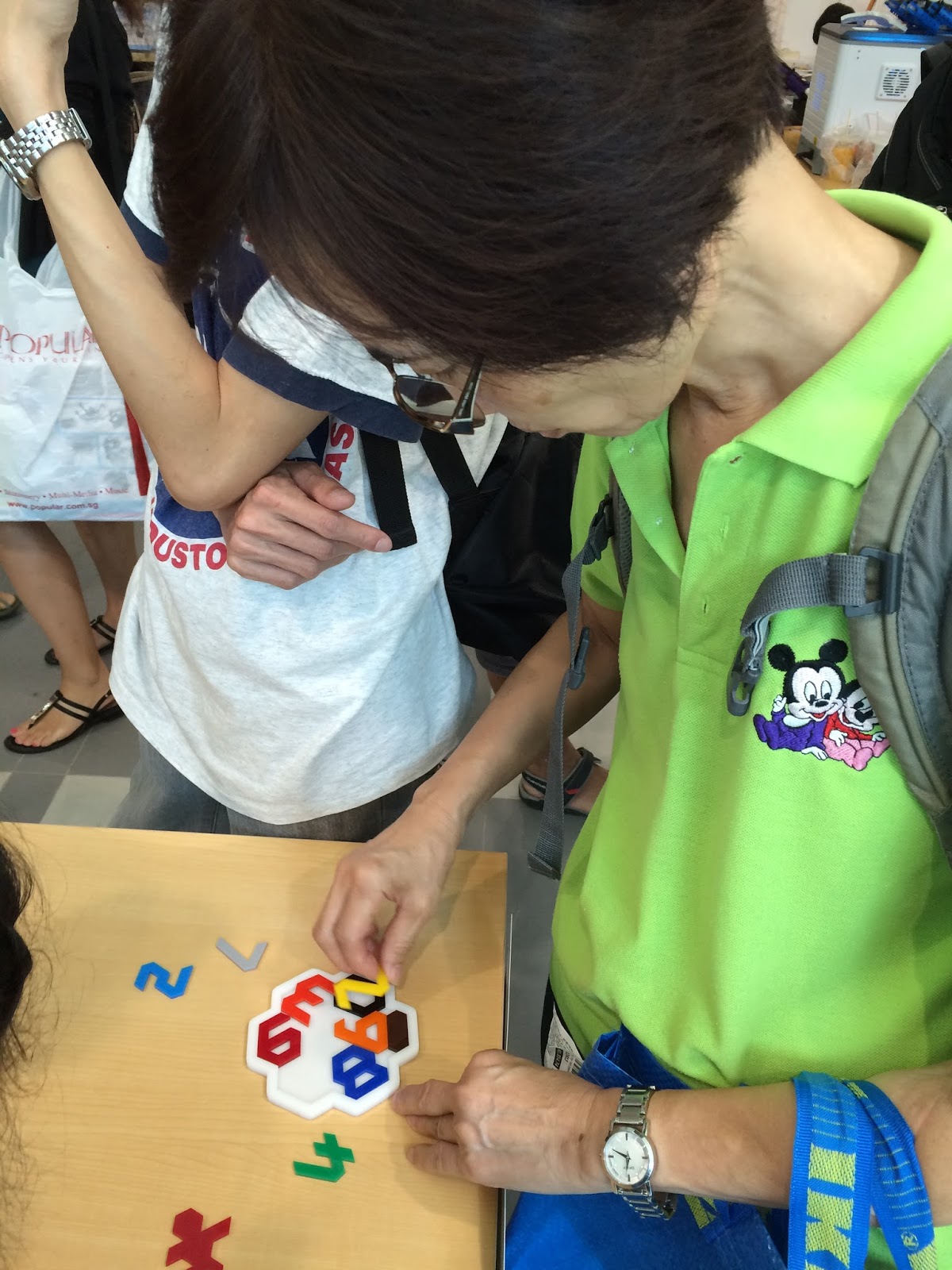
Last Sunday I spent a nice afternoon at Maker Faire 2016 which was held on the grounds of the Singapore University Of Technology & Design. I was invited by David Ang of Cubewerkz to share his table to showcase some of my own puzzle designs. In preparation for this event, I had produced a number of copies each of five of my 2D packing puzzle designs plus one from Rex Rossano Perez. I also added two other designs I had produced from last year; Goh Pit Khiam's Triple Play (my exchange puzzle for IPP34) as well as my SG50 puzzle.

Clockwise from top right corner - Turtles, 4 Ducks & A Duckling (my IPP35 Exchange Puzzle), Digi-Hex, Jurassic Pack, No Pushing (by Rex Rossano Perez) and Double Happiness

From Left - Goh Pit Khiam's Triple Play and SG50

The table David had was rather small and he had piles of twisties for sale, including a number of scientific and educational toys as well. But I was extremely fortunate that the table next to ours was vacant; the vendor/maker who rented it had decided not to show up, so I gamely shifted my puzzles over and created more breathing space for both David and myself. 


The fair started at 10am in the morning and ended at 6pm in the evening. However, I had sold out all of my puzzles by around 4:30pm in the afternoon and had to "close shop" for the day. It was a very interesting day as I interacted with the folks who visited my table and tried their hand at puzzling. For many it was the first time they had come across mechanical puzzles, let alone 2D packing puzzles. 

Surprising (or perhaps not so surprisingly, the majority of people that visited my table and played with the puzzles were kids and youths, some as young as 4 years old. Many of the children were probably fascinated with the colourful pieces I had purposely created along the animals theme. Without doubt my Jurassic Pack was one of the most popular, a 4 piece packing puzzle with a dinosaur theme. Some kids stood in front of my table for over an hour tirelessly trying to figure out the solutions. In terms of adult puzzlers, there were very few, less than ten or so who showed any keen interest, including a 67 year old grandma who was rather intrigued by my 4 Ducks & A Duckling. Most of the adults who were there were there just to pay for my puzzles for their kids! Now I am now wondering if there is a kid's market out there for puzzles in Singapore? Something I will definitely look into.

I am currently producing more copies of the above puzzles to fulfill some back-orders I received at the fair. If anyone is interested to buy any of the above, please PM me. 

Wednesday, 22 June 2016

Restricted Area

This "crooked" shaped box puzzle is Saul Bobroff's IPP35 Exchange Puzzle. For those serious puzzlers, you may know Saul as the guy behind the very unusual and unique impossible object; 4 Street Elbows, which I never quite figured out how to take apart although I have heard stories of puzzlers who have.


When I first un-packaged this puzzle and saw the blue box, I thought it was made by Brian Young, who had produced something physically similar (but straight at right angles) called the Restricted Soma. But its actually manufactured by "Here To There", which I believe its Saul's own puzzle company. 

Now back to Restricted Area - it's a Stewart Coffin design, #270-A and the goal is to pack eight pieces into the box which has a restricted opening, reminiscent of Lacika Kmolnar's L-I-Vator Cube. What is unusual about this puzzle is that the box is slanted at an angle from all sides (not obvious from the photo). Whichever side you look at, you will see a "pararellogram" shape on each face of the box. Consequently the pieces inside; each piece comprising of two glued-together "slanted" squares are also at an angle. Quality is good with all the pieces cut and fitting nicely. Dimensions wise, the box is 6.5cm x 6.5cm x 7cm.


If this was a "normal" packing puzzle with straight edges, I don't think it would have been that difficult; but because of the angle that the pieces have to go into the box and with the different shapes, the packing becomes consequently much harder. 

I fiddled with the pieces, taking each one out very slowly with several involving 2-step orthogonal movements because of the restricted opening. Took a bit of time and practice but after a while I memorized where each piece was suppose to go. I can say its not easy. I didn't want to scramble the lot because knowing my lack of packing skills, I probably won't be able to get them all back in later. I suspect Burr Tools could help here (configuring the pieces in the normal way) but I didn't bother to try. I am also not sure but there could be more than one way to solve this puzzle.

Not an easy packing puzzle by any means and certainly different from your normal box packing puzzles with the angles and all. Hardcore packing fans would most certainly love this one.

Saturday, 18 June 2016

Push Box - Two

This weekend's puzzle play was "Push Box-Two" designed and made by IPP34 award winning neurologist Dr. Simon Nightingale from the UK.


Push Box-Two is made entirely from Corian again and I really like the choice of material because it gives the puzzle the smooth cool feeling of stone/concrete; and weighty too. Only drawback is that it might crack and break if dropped from too high up. Push Box-Two is physically similar to Simon's IPP34 exchange puzzle, the "Push Box"

But it is of a different colour this time, a sort of a light beige. And of course the mechanism is different from its predecessor. It measures the same 6.3cm all round and the object is to open the spring loaded drawer. Very well made and high quality.

Again I have to admit that I managed to open the box without really fully understanding how the mechanism works although I know there are bits of moving parts (ie sounds like ball bearings) inside causing a rattling noise which keeps the "drawer" locked in place. 


Simon had previously sent me the solution to his earlier Push Box so I had a slight inkling as to the method of solve for Push Box-Two. But this didn't help much and I spent a bit of time turning and tilting the box and pushing here and there, a lot at random, before the box suddenly popped open. The drawer doesn't come out all the way (unfortunately) so there is no way I can inspect the internals of the puzzle. Unless of course I crack open the puzzle which would be a silly thing to do of course. 

Wednesday, 15 June 2016

Heat Wave

As I was trawling through my box of IPP35 Exchange Puzzles (hoping to find something interesting and not too difficult to play with), I came across Yee Dian Lee's puzzle called Heat Wave. 


My prototype on the left and Yee Dian Lee's Exchange Puzzle on the right

Heat Wave is one of many 2D packing puzzle designs from Goh Pit Khiam. Goh has designed a number of 2D and 3D packing puzzles including some award winning ones such as the IPP33 Puzzlers' Award Dancing Shoes as well as two Honourable Jury Mentions during IPP35 for his Road Blocks and Number Blocks. Very prolific indeed!

Prior to receiving Yee Dian Lee's puzzle, I had already obtained Goh's Heat Wave design a couple of years earlier and with his permission had laser cut a prototype copy for myself based on an even earlier prototype wooden laser cut copy made by Walter Hoppe for Goh. In keeping with the name of the puzzle, I chose bright yellow and red acrylic for my copy!

Goh's original version has 5 pieces which has to be fitted into the tray that has a covering on the top with a square hole that the pieces have to go through. Lee's exchange version is the same design, except that his has an additional small square 6th piece and Lee's top covering has dimensionally smaller square hole than the original design. Lee's version also has a transparent cover to better let you see how the pieces form up inside the tray.


Beautifully laser cut and great attention to detail
with the pieces each having their own slots at the back

Heat wave is not an easy puzzle at all and I needed Goh's help to solve his version back then. Hmm...maybe things may have been less frustrating if I had used a clear cover instead. Lets just say its not your typical packing puzzle (those who have played with Goh's puzzles would know what I mean) and a number of "unusual" moves are required to fit all 5 pieces into the tray underneath the cover. Can't say more without any spoilers.

With a transparent cover, I feel Lee's version is a tad easier since you can see your progress or mistakes as you move along. Although it's actually meant to be harder than the original. But to be fair, I had played with the prototype previously. A newcomer may find it very challenging indeed. And as Heat Wave was one of my earlier packing puzzles from Goh, it did give me the experience necessary to later solve his other packing puzzles such as Retrofit and Fusion.

A great (and difficult) packing puzzle, unfortunately none commercially available except Lee may have some spare copies left over from his Exchange.


Friday, 10 June 2016

Treasure Chest

This trick opening puzzle box is called Treasure Chest. And indeed there is stuff to be found and solved inside apart from opening the chest.


Treasure Chest is the exchange puzzle of Elaine Summerday at IPP35 last year. Its a relatively large puzzle measuring 20cm x 12cm  x 6.5cm. The top of the box has a plastic covered hole with a sticker atop. While this hole has nothing to do with the solving process, I am informed that perhaps the hole is there because the wood used may have been recycled from something else. Going green- good!

There are a two main goals for Treasure Chest; one of course is to open the box and the second is to solve a couple of other challenges found inside the box.


Actually the opening is rather tricky and the solution eluded me for a while as I examined every nook and cranny to find a way to move a panel or something. Eventually I did find it and I must say it is pretty well disguised. Hence there is no picture here of the opened box as it would most certainly contain a spoiler.


Once the box has been opened, there you will find a second puzzle and this one is in the form of a Raketti clone. A rather interesting version; using something resembling the cross-section of a tree trunk to form a ring with a wooden ball inside.

The rest of the tasks all relate to solving this puzzle, namely, to remove the ball out of the ring without touching the ball nor the ring. Those who know how to solve the Raketti would have no problem with this. Those who don't will find this step difficult or even impossible!


Elaine also included two pamphlets inside the box which mainly deal with geocaching activities, again nothing to do with the puzzle at hand but extra information and activities for any puzzler who may be interested in geocaching.

Monday, 6 June 2016

Sandfield's Secret Folding Hankie

This "puzzle" is one of the more unusual and unique (as well as pretty) Exchange Puzzles from my haul during IPP35 last year in Ottawa, Canada. The other which I thought also deserving of mention being Straight Up, reviewed a while back. 


Robert Sandfield's Secret Folding Hankie is parked under Slocum Classification 9; a "folding puzzle", and aptly so. The goal is to fold the handkerchief to reveal a secret image and a hidden message. The design of the Hankie is a joint effort by Robert, Perry McDaniel and Cindy Liang.

The handkerchief itself is printed on a square cloth of approximately 41cm x 41cm and the pattern includes the Canadian Maple leaf and squiggly scrawly lines along the edges, with swaths of red filling up the spaces in between.

As I played with the hankie, I was reminded of Mad Magazine's Fold-In on the inside back cover of each issue featuring those quirky, satirical and often humorous illustrations which dealt with current hot topics of the day. And this is exactly what I tried to do with Sandfield's Hankie...but of course to no avail. I tried various other ways of folding the Hankie in all directions including diagonally but somehow could not come up with the hidden message. 

Thankfully Robert included the solution instructions and I finally saw the words and images I needed to see. For the folded hankie solution click here - password - hankie.

A great and interesting puzzle concept and I hope there would be more of these in the future. For more information on secret folding handkerchiefs, Robert has also kindly provided the link to a reference site http://handkerchiefheroes.com/secret-love/. Another link which discusses vintage valentine puzzle handkerchiefs is here.

Tuesday, 31 May 2016

Star Beams

This cute and colourful puzzle came courtesy of Dutchman Oskar van Deventer during the IPP34 Puzzle Exchange in London in 2014. But its an old design which dates back to 1989.


Oskar is one of the rarer prolific designers who is comfortable with both puzzle genres; the twisties and non-twisties and amongst the non-twisties, he has designed over a dozen of the Hanayama Cast puzzles to-date including the Cast Twist and Cast Nutcase. He has also designed some unusual ones that include his Boston Subway and Snakes In A Plane.

Star Beams is an interlocking puzzle consisting of six "beams" produced by 3D printing. Overall quality is good. As described on Oskar's Shapeway shop:-

"The puzzle has six pentagram-shaped beams that are woven through each other. It was in 1989 that Oskar discovered this geometry. It is based on the geometry of a regular dodecahedron (with twelve pentagonal faces). When each of the six axes is offset a bit, this nice tetrahedral geometry results" 

The entire assembly is held together by one beam that cuts through four others.


The object of course is to take it apart and put it back together. Don't let the cute and colourful form factor fool you. While its not difficult to figure out how to take it apart and I got this done rather quickly, the putting together proved impossible for me. Even with the aid of photographs taken along the way, I had a lot of difficulty trying to assemble the lot. The notches and grooves are precisely cut and if you mesh the beams together the wrong way, you have to re-start. Of course given that the puzzle is rather small (each beam is 5cm) made it very fiddly and difficult to handle as well.

Check out Oskar's youtube video of the Star Beams (too bad it doesn't show the solve). Its available from Shapeways for US$38.43 as well as Puzzlemaster, the latter much cheaper at CA$29.99. 

Thursday, 26 May 2016

Octassembly

Here's a second puzzle I played with designed by Bill Sheckels and exchanged by Norton Starr (what a cool name! And nice guy too!) at IPP34 in London two years ago. The earlier one was the Packed Pyramid, this one's called Octassembly.


This puzzle comprises 6 odd shaped pieces made from Zebrawood with a very nice stripey surface. There are three different shapes and each has one identical pair. All nicely cut! The object here is to form an Octahedron. Now if you don't know what an octahedron is, like I didn't at the beginning, you probably won't know even where to start nor what to do. I know its got something to do with eight tho'. Thanks to the internet....this is an octahedron. Basically two 4-sided pyramids joined together at the bottom.


From the puzzling point of view, its not too difficult...once you know what shape you need to form. But the way the pieces have been cut (and I am sure there is some mathematical aspect to this...don't ask me what it is) make it a tad tricky. Quite amazing how the odd looking pieces can form a symmetrical 3D object.

Overall a really nice good quality shape-forming puzzle that is just the right level of difficulty for an Exchange Puzzle, something you can solve in minutes rather than hours. PM me if anyone wants to see the photo solution

For anyone interested, the Octassembly, is available from Bill via his Etsy puzzle shop mentioned above. And it cost US$21/-

Wednesday, 18 May 2016

Multi-Grain 275-AS

Name
Multi-Grain 275-AS.

Designer
Stewart Coffin was the designer of the original Multi-Grain 275-A. This version, the 275-AS with a modified grain pattern was by Jerry Slocum.


Manufacturer & Availability
Manufactured by Brian Young of Mr Puzzle Australia. Available for AU$66/-.

Type & Classification
Interlocking solid

Dimensions
7cm x 7cm x 7cm.

Materials & Construction
Papua New Guinea Rosewood. Overall very good quality and finish with a nice snug fit.

Overview
This dissection puzzle was Jerry Slocum's IPP35 Exchange Puzzle.

The object is to take it apart and then re-assemble it. Even though its only 4 pieces, the taking apart was pretty tricky, given its symmetrical assembly. The pieces all fit very snugly and I had to pull and push a bit, here and there everywhere before something finally moved. It took me a bit of time to release the first piece.

Like all burr puzzles, I try to take apart the rest of the pieces slowly and memorizing the moves, and placing them in a systematic manner on the table, so that assembly wouldn't be such a pain later. Brian encourages puzzles who want a real challenge to scramble the pieces and "...go for a walk round the block or something..." and then try to fit the pieces back to its symmetrical pyramidal shape, the latter which of course I didn't.


Thankfully I managed to put the 4 pieces back together, and this is after some trial and error which got me a bit worried in the beginning. But I would imagine that if I had followed Brian's advice, the pieces would have looked so confusing later that I would not have been able to put it together correctly.

If it had come un-assembled, it would certainly have been very difficult indeed. Again quoting Brian from his site:


"Even though it’s a symmetrical shape when it's done; visualising that shape while you're assembling the puzzle is extremely difficult even with the supplied photo of the finished puzzle.
An extension of the famous 'Three Piece Block' puzzle that Stewart is famous for; this one is just as hard if not harder than the original"


Difficulty
It is rated as 7/10 by Mr Puzzle but comes assembled so the difficulty quotient is lower.

Thursday, 12 May 2016

Restricted Soma

Name
Restricted Soma

Designer
Martin Watson. This is the guy who designed the famous Digigrams puzzle.


Manufacturer & Availability
Manufactured by Brian Young of Mr Puzzle Australia. Available for AU$45/-

Type & Classification
3D Packing/Interlocking solid

Dimensions
Pretty heavy puzzle measuring about 7cm x 7cm x 7cm.

Materials & Construction
Looks to be Queensland Silver Ash for the pieces. The box is lacquered black. Construction fit and finish is very good.

Overview
This puzzle was Brian Young's IPP35 Exchange Puzzle.

To know what's a Restricted Soma, you need to know first what is a Soma. This Soma is "restricted" because the goal is remove the pieces and to pack them back into the box through a T-shaped opening....which of course makes it harder than the traditional Soma.


The puzzle came packed so the first task on hand was to remove the pieces. Not difficult and soon I had all out. With 7 pieces comprising of "simple shapes", it was not too difficult to remember where each piece went and I actually managed to get all the pieces back to their original positions inside. To aid in the solve, the box has round holes on all sides and the bottom, so fingers can go in to move the pieces about. But (unfortunately) the pieces cannot enter or exit from these holes!

The writing on one of the pieces states that there is more than one solution with rotational moves but only one solution that does not require rotations. I tried searching for this solution for a good part of the evening but not surprisingly, with no success. 

According to Brian on his site-

To find the unique solution without rotational moves is very difficult.  In a recent email even the designer admitted to having some difficulties although to be fair Martin did design it some time back so maybe it’s been a while since he tried to solve.


I don't feel so bad now. Burr Tools showed 3 possible solutions, but with one of the pieces doubling as a cover for the box, there is thus only one solution. And this solution involves some rather unusual moves. A total of 21 moves is required, with the 4th piece alone needing 8. A lot of fingering through the holes!

Difficulty
Not too difficult just to unpack and re-pack, unless you forget where the pieces are supposed to go. But as mentioned, very difficult to find the unique solution without rotation. It is rated as 7/10 by Mr Puzzle.

Summary
A must have for packing puzzle lovers. 

Tuesday, 10 May 2016

Almost There....Balancing The Egg!

Played with two puzzles this evening. Had success with one but not the other.

The first puzzle (which I managed to solve without help) was Larry Siedman's IPP35 Exchange Puzzle called "Almost There", designed by Goh Pit Khiam. 


This is a 2D packing puzzle entirely made from laser cut wood with 5 pieces consisting of 2 different identical shapes. Good quality manufacture here. Object is to fit all 5 pieces flush inside the tray.

Having played with several of Goh's packing puzzles and knowing his "signature style" of design, it didn't take me too long to solve. Please PM me if you want to the solution. The less initiated will find it pretty difficulty I guess. Challenging and tricky but not as hard as for example Fusion.

The second puzzle which I failed miserably at and no clue at all how to solve is Stephen Chin's "Ze Balancing Egg", his IPP35 Exchange Puzzle. Crafted out of what appears to be Mahogany, this is a beautifully made wooden turned egg, the size of a typical real egg. It even comes with it own decorative stand. Goal here is to balance the egg upright on its own (not on the stand).


I can hear a weight (possibly a ball bearing or similar) rolling around within the internal confines of the egg and I know the weight needs to be right at the bottom of the egg to get it standing upright...It's a dexterity puzzle of some sort probably but I just have no idea how to execute the necessary moves. A couple of times I thought I got it...but no! I am writing to Stephen for a clue, but he takes a while to reply. So if any of my readers can help me, please feel free to drop me a note. Any assistance will be much appreciated.

Tuesday, 3 May 2016

Turn The Plug

Name
Turn The Plug

Designer
Shane Hales


Manufacturer & Availability
Hand-crafted by Shane Hales.

Type & Classification
Trick/Puzzle Lock

Dimensions
This a large and heavy puzzle measuring 14.5cm x 5.8cm x 10.2cm (inclusive of the base).

Materials & Construction
The block where the door lock is attached to is made from both Oak and Walnut. The lock itself looks to be the type of lock you will typically find on an office door. Affixed to the side is an ordinary looking key. Both lock and key comes from ERA, a manufacturer of door locks and components. Overall construction fit and finish is very good.

Overview
This is an "Interval Puzzle" from Shane. On Shane's puzzle site this is what he says:


"Smaller simpler puzzle designs.
I have decided to create some simpler puzzle designs while i'm working on my next project. Something easier for me to make, and also keeping everybody else's excitement alive!  Anyone that knows me knows i love locks! 
So i have created my Interval puzzles"


Turn The Plug is also my second puzzle from Shane, the first being The Circle, a great puzzle I reviewed just over two years ago on this blog.  


Shane does not sell these Interval Puzzles nor any of his "main" project puzzles, the latter which he makes just four copies at time; preferring to gift them to other close puzzler friends. The only exception was his very popular Hales Lock #1 which sold out within days of launch. 

The object of Turn The Plug is to "move the black dot on the back from "locked to "Open". Nope, you can't try to turn the knob with the black dot with you fingers, it won't work. The puzzle comes with a key that is attached to the side of the wooden block. So as not to create any spoilers here, nothing more about this key shall be mentioned. Also, no force or banging whatsoever is needed

It is obvious the lock has a part to play in the solving. This is one of those puzzles you can't say too little nor too much without giving anything away. Suffice to say, the solution has a few tricks up its sleeve and I got no where for a while, before discovering how to move the black dot to "Open"


Difficulty
For an experienced puzzler, I won't say its very difficult, but as mentioned, certainly a tad tricky and like all puzzles of this nature, some experimentation here and there is required before one gets the A-ha moment. For novices, well, that's another story.

Summary
An very nice design concept; with Shane using commercially available products and parts to fabricate into a great working puzzle.