Tuesday, 24 September 2013

CorRECTly In The Bag

Update 23 October 2017 - Dear Reader, please check out my new puzzle blog and e-store at http://mechanical-puzzles.com

Name
CorRECTly In The Bag

Designer
Hirokazu Iwasawa

Manufacturer
Mineyuki Uyematsu. Not available currently.

Type & Classification
Put-Together; 3D assembly

Dimensions
Bag - 18.5cm (Length) x 7.8cm (width)
Rectangle - 12cm (Length) x 9 (width)

Materials & Construction
Bag is made of a high quality cloth adorned with a dragonfly motif with a red inner lining. The rectangle is cut from a cross-section of four different woods joined together giving it a very nice checker board finish.

IPP
CorRECTly In The Bag is a variation of Iwasawa's earlier design, the Square In The Bag which won the Puzzlers' Award at IPP32 in Washington, USA last year.


Overview
I like Hirokazu Iwasawa's puzzle designs very much and in fact own two of his metal puzzles, the Alcyl and Tritalon, both reviewed earlier in this blog. I also had the opporunity to meet him at IPP33 in Tokyo, Japan just this August where he was Chairman of the IPP33 Organising Committee.

This CorRECTly In The Bag was kindly loaned to me by puzzle collector Lee Yee Dian of Malaysia, who happened to be in Singapore recently. Yee Dian had come with Maki Kaji (the Godfather of Sudoku) who was in town to meet some of the local Mensa club members. It was at this Mensa gathering (no, I am not a member cos I am not that smart!) that I first handled the puzzle. Puzzle designer Goh Pit Khiam was also present and had a bash at the puzzle. At IPP33 I had missed out on buying the puzzle sold by Mineyuki Uyematsu which were all snapped up almost immediately once the Puzzle Party began.

The object of the puzzle is to cover fully the entire rectangle with the cloth bag, leaving no gaps. No force is needed, otherwise the cloth bag may tear. Impossible you might say...and this is what I though too when I first looked at the puzzle. It looked like an impossible object at first glance.

I fiddled with the puzzle for quite a while before stumbling on the solution. This is one of those puzzles that give you the A-ha rush feeling once you solve it. The bag can and does cover the whole rectangle; really quite amazing! Even a few of the Mensa members couldn't quite figure out the solution. And these are folks that have an IQ of above 148.

What was even more surprising was that when I got home and showed my wife the puzzle and asked her to try it, she solved it in under five minutes while I went to take a shower. When I got out of the bath, the rectangle was all covered up sitting on the coffee table, with my wife giving me that nonchalant "its-really-no-big-deal" look. Or is it because women know some things about fabric while we men don't. Maybe we puzzlers just think too much while puzzling, that's why some of us (like moi) take ages to solve puzzles, or worse still, need to refer to the solution.

Difficulty Level
Not unduly difficult but provides a very good challenge. Given enough time, however you will eventually figure it out.

Summary
Whether its the CorRECTly In The Bag or Square In The Bag, it really is a very clever design, using non-traditional materials. The very fact that it looks so innocuously simple and the solution is so elegant truly makes this a very unique and wonderful puzzle.

I have heard that people who can't get their hands on this puzzle have resorted to making it themselves. Not difficult I would imagine so long as you have the right dimensions (see mine above but don't blame me if it doesn't turn out right). Also, access to a good seamstress. And for the rectangle (which can be substituted with acrylic or some other easily obtainable material). You may want to contact fellow blogger Roxanne Wong who has blogged about the Square version and has the specs for you to self-make one.

Personally I am considering making myself one as well since I would have to return the puzzle to Yee Dian the next time we meet. Hmm...let me see, how about 6061 Aluminium for the rectangle and calf leather for the bag...now wouldn't that be quite cool!

Wednesday, 18 September 2013

Loris

Name
Loris. The Loris is actually a nocturnal primate found in the forests of India, Sri Lanka and parts of South East Asia.

Designer
Dave Rossetti, the late Frank Chambers & K. Stevens

Manufacturer
The late Frank Chambers & K. Stevens. Not available commercially

Type & Classification
Trick/Puzzle box

Dimensions
12.8cm (Length) x 7.4cm (width) x 5.1cm (Height)

Materials & Construction
Body of the box is made of Corian (the material used for kitchen counter tops) while the white sliding lid is made of Velstone, a polyester resin similar to plastic. Construction is very good and built to close tolerances with fine edges, although the corners of my copy were very slightly blunt due to handling and wear over time.

IPP
The Loris was Dave's IPP23 Exchange Puzzle in Chicago, USA in 2003, so this box is now 10 years old.


Overview
I met Dave at IPP33 in Tokyo, Japan just this August during the Puzzle Party. He was in front of Wil Strijbos table and pondering if he should purchase Wil's Lotus puzzle that was on sale. I told him how good the Lotus was and we started a conversation.

I mentioned to him I owned one of his past exchange puzzles, the Oriental Toothpick Safe and asked if he had any other similar puzzle boxes made of Corian available. He said he would check when he got home from IPP33. True to his word, a week later he emailed to say he had a Loris box and asked if I wanted to purchase it from him. A couple of emails thereafter and several days later, the Loris was on its way to me.

What struck me when I first opened the packaging was the size of the Loris. This is a relatively large and hefty box and made my Oriental Toothpick Safe look diminutive. Like the Toothpick Safe, the object is to slide the lid off the box (without the need for banging or shaking).


Having puzzled over the Toothpick Safe (which I then needed help from fellow puzzle blogger Brian Pletcher), I knew the Loris would not be easy. And indeed it was not. I tried out the methods I had used on the Toothpick Safe, hoping for some similarities, but there was none. Since no tapping, banging or shaking was necessary, I orientated the Loris is various ways, upside down, sideways, rotating, checking for gravity and dowel pins etc to see if I could gain some clue how to open the box. But nothing worked.

Then I remembered one of my emails to Dave to ask what does "Loris" mean and he replied it is a "slow animal - a hint". I even thought Loris was a brand for wrist watches (the brand is actually Lorus). Suffice to say, Dave's reply gave me a an idea about how to go about solving.

With Dave's "slow animal" clue, I tried something (no spoilers here) and lo and behold, I got the lid to slide open after a while. What I saw inside the box totally flipped me out; a most unusual and unique mechanism locking the lid in place. No gravity pins but certainly gravity plays a part (hint!)

Difficulty Level
Very difficult! If not for Dave's clue, I would not have managed to solve the box on my own. The insides are totally invisible from the outside and one can do nothing but only guess what could be going on inside.

Summary
A very nice, well-made and aesthetically pleasing puzzle/trick box with a good use of alternative materials (other than the usual exotic or hard woods). Given its rarity and unavailability, the Loris is a real puzzle collector's gem!

Sunday, 15 September 2013

Hanayama Cast Box

Name
Cast Box.

Designer
Yuta Akira.

Yoshiaki Hirano also made an Impossible Object out of 4 Cast Boxes which was exhibited at IPP33 in Tokyo, Japan in August this year, as shown below.

4 Cast Boxes linked together by their rings...impossible?

Manufacturer
Hanayama. Released exactly a year ago in September 2012, the Cast Cylinder is currently available from the usual online retailers including Puzzlemaster of Canada as well as several sellers from Ebay.

Type & Classification
Take-part; disentanglement

Dimensions
3.5cm square

Materials & Construction
The box frame is made of brass and the ring steel. Very well made and solid. The patina finish with eight screws at the corners give this cast puzzle a look and feel of quality.


Overview
The object is to remove the ring from the box frame. It's like a 3D version of the Cast Duet. The box frame has got grooves cut into the individual sides where one end of the ring (which is split) can pass through.

Puzzling involves manoeuvring the ring through the different edges of the box where eventually, one side would allow the ring to disengage. I found it rather difficult at first and kept getting stuck in a couple of the same positions. But I soon realised that not only the box but the ring itself should also be orientated on its different axes around the box frame to allow for greater movement. Took me longer than expected but I freed the ring eventually. I think the engraved "START" and "Box" must have something to do with the puzzle but I am not sure how they help in the solving.

Difficulty Level
Hanayama rates the Cylinder at 2-stars out of 6. Agreed. Relatively easy but it may be rather confusing and dis-orientating at first and rushing to try to solve won't help. Be patient and soon you will get there. Re-assembly is easy. Some practice and one gets the hang of repeated solving it pretty quickly. I am very tempted to buy three more copies to try the Impossible Object shown above.


Monday, 9 September 2013

Hanayama Cast Cylinder

Update 23 October 2017 - Dear Reader, please check out my new puzzle blog and e-store at http://mechanical-puzzles.com

Name
Cast Cylinder

Designer
Vesa Timonen. A prolific puzzle designer with a number of well known designs including the popular (and wearable) Cast Loop. A number of Vesa's designs have been adopted and manufactured into cast puzzles by Hanayama.

Manufacturer
Hanayama. Launched in August 2013, the Cast Cylinder is currently available in Japanese puzzle shops including Torito but it should hit shops (including online retailers) outside of Japan soon. As of this blog post, the Cast Cylinder is the latest cast puzzle release from Hanayama.

Type & Classification
Take-part; disentanglement

Dimensions
3.6cm (diameter) and 3.5cm (Height)

Materials & Construction
Made of zinc alloy coated with chrome. Quality of construction, finish and fit is very good. Personally I would have preferred the puzzle in a matt finish (like Vesa's early prototypes) rather than the shiny chrome look, but I guess this would have been prohibitively expensive in terms of manufacture.


Overview
I first saw (and played with) the Cast Cylinder at IPP33 in Tokyo. During one of the evenings, Vesa had taken out several Cast Cylinders including his prototypes and spread them on the coffee table in front of us. I had a good fifteen minutes or so with one of the prototypes but got nowhere; maybe too much pressure being around other puzzlers I guess :-). I duly picked up one (together with the Cast G&G and some other puzzles) at the Torito stand during the Puzzle Party on the last day of IPP33.

You can certainly tell why its called the Cast Cylinder. It has got two knurled rings forming an external circular "shell" which surrounds and holds in place three other triangular-shaped pieces. The object is to unlock and separate the pieces.


The two rings can rotate freely in both the same and opposite directions. As you spin them around, now and again, there would be some resistance. At certain points, they can be even pulled slightly apart. I had a vague idea of how the inside pieces are kept in place and so began the usual manipulation of turning, pulling and tugging. Very soon one of the pieces began to "drop" out from the bottom a bit and with some more turning, the second  followed suit. After a bit more fiddling, finally the last piece released itself.

Difficulty Level
Hanayama rates the Cylinder at 4-stars and I think this is about right. Taking the Cylinder apart is tricky but not overly difficult. Putting the thing back together is where the real challenge is. Despite the rather long time I spent with it, I was unable to re-assemble the Cylinder into its original state. I contacted Vesa for help and he was very quick to reply with email instructions (which came "straight from his head", as he puts it) since there is no formal text solution or diagrams (Thanks Vesa!). There is a method to it which takes about six steps to getting the puzzle back together.

Summary
A good looking, well-made (and pocket-able) puzzle that can be solved repeatedly once you grasp the right technique. Practice is needed for this puzzle, otherwise you will be fiddling to no end dropping pieces everywhere. A must-have for any Hanayama Cast Puzzle fan!

UPDATE 24 OCT 2013 - I have received numerous queries from puzzlers, who like me have got stuck trying to reassemble the puzzle. You don't need to get frustrated over this and suffer in silence. Drop me a PM via my Profile email and I will get the re-assembly instructions to you.

Sunday, 1 September 2013

Manholes 55

Name
Manholes 55

Designer
Frederic Boucher.


Manufacturer
Frederic Boucher. Only two copies of the puzzle were made by Frederic for the IPP33 Nob Yoshigahara Puzzle Design Competition. One has been donated to the Lilly Library Jerry Slocum Mechanical Puzzle Collection. I have the other, hence none currently available; unless Frederic decides to make more.

Type & Classification
Dexterity

Dimensions
8.2cm (Length) x 8.2cm (Width) x 3.6cm (Height)

Materials & Construction
Wood, glass, aluminium, felt, brass, steel, coins. Very well constructed and put together. Despite repeated handling by more than 170 participants during the 3 days judging process at IPP33, the puzzle withstood whatever abuse and did not appear to show any signs of wear at all. Nice size and feels very hefty in the palm.

As you can see from the photos, the puzzle consists of a wooden box topped with a glass cover (which makes the puzzle more classy than if perspex had been used) held in place by aluminium plates. Within the box is a "street" with two manholes, covered by a 50 yen coin and a 5 yen coin (ie 50+5 = Manholes 55). Also inside the box are brass and steel ball bearings.

IPP
Apart from Manholes 55, Frederic's Elle interlocking puzzle was also a design entry for IPP33.

Overview
I came upon the Manholes 55 when I was playing with the various competition entries. What intrigued and drew my interest was this very nice looking box with an unusual combination of different materials used, including glass for the construction of the puzzle. The odd thing was that both Frederic and I attended IPP33; I played with his Manholes 55 and Elle and he tried his hand at my own competition entry Ball In Cylinder No1. Yet we did not meet each other in person the entire 3-4 days while we were both there! I still do not know what he looks like!

After I returned from IPP33, I emailed Frederic to ask if he could sell a copy to me. After a couple of emails, we eventually did an exchange; my new Ball In Cylinder No.2 for his Manholes 55. Frederic had also mentioned that he made the two Manholes 55s from left over parts from his Pyramida Puzzles; no wastage of anything here which has resulted in a beautiful and attractive puzzle.

There are 3 challenges to this puzzle:-

1. Hide each ball underneath the coin (manhole cover) of the same colour.
2. Place each ball on top of the coin (manhole cover) of the same colour.
3. Without spinning the puzzle, move the balls to the green areas on each side of the street.


Challenge 2 solution
Difficulty Level
Challenges 1 and 2 are not difficult. The manhole covers (coins) and ball bearings move into place nicely with the required dexterity. A gentle touch will aid more in the solving than hard shaking. Challenge 3 is the tough one. I tried for a rather long time but could not seem to get the balls onto the felt on opposite sides. I just can't seem to get one ball to stay put while trying to manipulate the second ball to the opposite felt. Frederic provided me with the 3 solutions; there is a certain technique to solve Challenge 3 which I will attempt to try.

Summary
A well made puzzle that is fun to play with, not only for adults but also for kids (I let a friend's 8 year old have a go at it and he got through Challenge 1 without any help). With its glass, metal and wood construction, the Manholes 55 also makes a really nice display item. And if there will only be two copies (or perhaps a few more in time to come?) well,... its certainly going to be a very rare collector's puzzle.

Monday, 26 August 2013

Peppermint

Name
Peppermint

Designer
Scott Elliot. Scott also runs his own 3D printing/puzzle blog.


Manufacturer
Scott Elliot. PM Scott via his blog for availability of the Peppermint. He may still have copies left over from IPP33.

Type & Classification
Take apart; disentanglement

Dimensions
6cm (Diameter) x 4.5cm (Thickness). Nice good size for the hands.

Materials & Construction
ABS resin. Construction, fit and finish is very good and all the parts are manufactured to pretty tight tolerances. The surface of the puzzle does have some texture and this aids in the gripping. Although plastic looking, the pieces are surprisingly solid and can take abuse.

IPP
The Peppermint was Scott's exhange puzzle at IPP33 held in Tokyo, Japan at the beginning of this August.

Overview

Scott had blogged about the preparation of his Peppermint as an IPP33 exchange puzzle at the beginning of this year. It looked rather interesting and when IPP33 came around, I emailed Scott to say I wanted a copy of both his Peppermint as well as his Moire Maze puzzle. He kindly reserved one of each during the Puzzle Party for me before they were all sold out. He also had one or two other puzzles on sale and I bought his Puckup puzzle as well. (see below).

The Peppermint has two tone colours of red and white and at first glance, it appears to be like a white ball surrounded by a thick red ring. The puzzle consist of four "interlocked" (or rather intertwined) pieces and the object is to separate them (without the need for any force). I have been told that the Peppermint bears some similarity to Hanayama's Cast Marble but as I have never played with the latter, I can't really compare the Peppermint against the Cast Marble.


Although it consist of only four pieces, the Peppermint is no walk in the park. It took me a good half hour of fiddling and twisting before I managed to separate the pieces. Re-assembly is a whole different ball game! As of this blog post, I have still not succeeded in getting the pieces back together. I have emailed Scott for some help and waiting to hear from him.

Difficulty Level
Fairly challenging to take apart (without the right technique, which I am sure there is one) but much much more difficult  it seems to put back together; again there must be some technique to be applied. His Puckup puzzle (below) is a simpler 2-piece put-together puzzle that is also dimensionally smaller (4.0cm in diameter). This one is made of nylon and came separated. The object is to join the two pieces. May be quite tricky for the inexperienced puzzler but I got the pieces to form a disc in a jiffy.


Summary
I felt the Peppermint's a bit different from the usual genre of mechanical puzzles. Tough and (almost) unbreakable; worth acquiring in my opinion. Throw in the Puckup while you are at it as well.


Saturday, 24 August 2013

Chinese Cricket Box

Name
Chinese Cricket Box

Solved state deliberately not shown in photos here
Type & Classification
Puzzle Box; Trick Opening

Dimensions
8.9cm (Length) x 5.8cm (Width) x 1.8cm (Thick).

Materials & Construction
Wood, glass and plastic. The box is made of a type o exotic hardwood and overall, the box is very well made and feels sturdy and solid.

Overview
As the name implies, a cricket box is a box for keeping crickets. In ancient China, there was a tradition of keeping crickets as pets. This in turn spawned (no pun intended) a whole industry of making cricket boxes, containers and homes for cricket lovers. However not all cricket boxes (or cages) were puzzle boxes with trick openings. For more information on cricket keeping during early Chinese history, click here.

I obtained this nice little black cricket puzzle box from Wil Strijbos during the IPP33 Puzzle Party in early August this year. Wil had brought with him a whole shoe box size of cricket boxes which he had sourced from China, of varying shapes, colours and designs.

The box I have is essentially a wooden box with rounded and patterned edges. The top cover is made of glass and the bottom has a number of Chinese characters. There is also a rectangular air hole on one of the ends of the box. The object of the box is to figure out how to "open" the box. It took me a couple of minutes of fiddling before I got the box opened.


Difficulty Level
It is certainly not difficult by any means but because the box is well constructed with tight tolerances, it can make it a bit tricky to solve. Different boxes also have varying opening mechanisms. Frans de Vreugd has written an entire book on Chinese cricket boxes. I flipped through a sample copy at IPP33; very nice with loads of detailed photographs (please PM me via my Profile Email should you wish to contact Frans to purchase a copy). There is also a video on YouTube which shows the opening of a couple of cricket boxes but this video is a spoiler, so be warned.

Summary
If you like trick boxes, well this is something certainly to consider, given that the box is associated with an interesting history.

Saturday, 17 August 2013

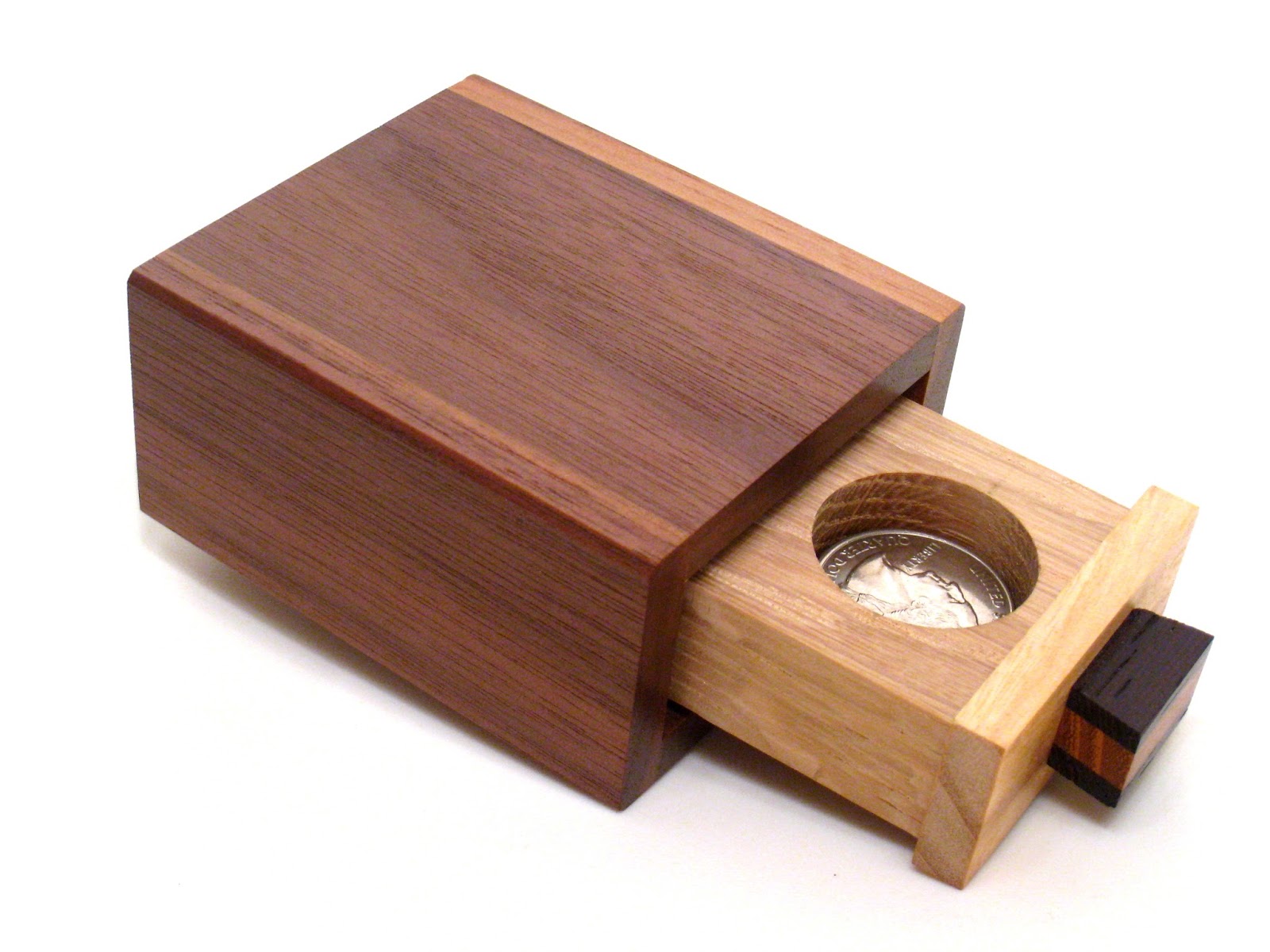
Locked Drawer

Name
Sandfield's Locked Drawer Puzzle.

Designer
Robert E Sandfield and Kathleen Malcolmson.

This is the unsolved state!

Manufacturer
Kathleen Malcolmson

Type & Classification
Puzzle Box; Sequential Discovery

Dimensions
7.8cm (Length) x 6.5cm (Width) x 3.8cm (Height).

Materials & Construction
Walnut, Prima Vera and White Oak. Construction, fit and finish is excellent with slight bevelling on the exterior box to minimise sharp edges. Nice size with an attractive colour contrast between the handle, drawer and outer box. Overall, aesthetically very pleasing. It comes with its own drawstring pouch which is a nice touch.

IPP
The Locked Drawer was Robert Sandfield's Exchange Puzzle during IPP30 held at Hakone, Japan. in July 2010.

Overview

I had read Allard's review of this puzzle late last year and wanted one. The opportunity came along when I found Robert Sandfield selling several of these Locked Drawers during this year's IPP33 Puzzle Party. Although relatively expensive, I picked up one with little hesitation. This was also the first puzzle I bought during the Puzzle Party.

The Locked Draw is somewhat different from the Japanese style boxes with multiple sliding panels or other trick opening ones because it incorporates a sequential discovery aspect as well. Meaning that the puzzle has to be solved in a particular order of steps and using the tools that come together with the puzzle. No other external implements or tools are necessary.


The object of the Locked Drawer is NOT to open the drawer (as most people would assume looking at the box) but rather to figure out how to close the drawer once its been opened. To open is simple, nothing puzzling about it; just pull the drawer open normally and it will reveal a circular cavity that contains a US$0.25 coin. Pull the puzzle fully out and the drawer click locks. Here is where the puzzling begins; ie pushing the drawer back in again.

I took about six steps to get the drawer "unlocked" and then back into the closed position, which is the reset/ unsolved stage. There is no force whatsoever required to solve the Locked Drawer. A very clever and rather interesting trick to the whole mechanism.

Difficulty Level
For the total novice, he/she is likely to be stuck for quite a long time. But for the experienced puzzler, not overly difficult with enough challenge to make the puzzle fun and entertaining. This is the sort of puzzle that gives you mini "a-ha" moments to let you know you are on the right track until the final step when you know you have reached the goal. Easily solvable repeatedly once you know the solution. Nothing finicky about the Locked Drawer; everything works as intended.

Summary
For lovers of Sequential Discovery puzzles and/or puzzle boxes generally, a definite must-have for the collection.

Wednesday, 7 August 2013

IPP33 - Day 2 - Sunday 4 August (Puzzle Party & Awards Dinner)

What: IPP33 (International Puzzle Party 2013)

Where: Tokyo, Japan. Held at the Hilton Narita, Tokyo

Day 2 - Sunday 4 August 2013 - Puzzle Party

The Puzzle Party is the one item on the agenda that every IPP participant looks forward to (maybe even more than the Puzzle Exchange). Today is the day where participants "set up shop" and sell their puzzles for other participants to buy, be it brand new ones, pre-loved ones or leftover puzzles from the previous day's Exchange.

Not all IPP participants have puzzles to sell. Me for instance; I had wanted to bring several copies of my Ball In Cylinder No 1s to the IPP but my fabricator could not finish making them in time for this trip. So like many other participants, I was quite happy to see what I could pick up at the party. The sale started at 9am sharp but by 8:45am, there were already quite a number of folks milling around the entrance, all eager to spend their cash.

Like the Puzzle Exchange, rows of tables were reserved for the puzzle sellers who laid out all their wares. When the doors opened at 9am, I sauntered in with the rest and scanned the entire room looking to see if there are any rare puzzles not available on the market. As this was my first IPP, perhaps I didn't have enough experience. I should have strategized my approach a bit more to make sure I covered all the necessary ground so that I didn't miss out on something that I really wanted. Yes, the veteran IPP members somehow knew which tables to head for and where the gems were to be found.

Over the course of the next four hours or so, I visited row after row of puzzles on display, bought puzzles that I fancied and chatted with different puzzle sellers and designers along the way. The Puzzle Party is like a upscale flea market. What a wonderful way to spend a Sunday morning and money!

One very valuable lesson I learnt from this IPP is to bring enough cash to pay for the puzzles, particularly the local currency, in this case, Japanese Yen. By enough cash I mean bring lots of it! Halfway through, I had run out of Yen but thankfully Roxanne Wong was kind enough to loan me some (from her huge stash) to continue my shopping spree (thanks Rox!)

Tom van der Zanden

Vinco Obsivac of Vin & Co Puzzles

The folks from Torito

Jerry Slocum talking to a puzzler seller.
The lady seated on the left in red is Roxanne Wong

Oskar van Deventer & JinHoo Ahn (winner of the IPP32 Grand Jury Prize for the
Double G, now the Hanayama Cast G&G)

Robert Sandfield (in the foreground are money puzzles)

Koshi & Yuko Arai (Koshi was the winner of the IPP32
Jury Honorable Mention for his Heptagon 48)

Hendrik Haak

Gennady Yarkovoy

Me and Marcel Gillen 

Left: Timo Jokitalo; Right: Vesa Timonen & Jo Traynor

Left: Rene Dawir; Right: Carlo Gitt

Naoki Shibuya

By about 1:30pm in the afternoon, the Puzzle Party was almost over and most sellers had packed up their leftover puzzles and were leaving. Here's my haul from the Puzzle Party with several from the previous day's Exchange.


Judging the Design Entries

For me it was off to the adjacent room to continue with the judging of the puzzle design competition entries which had started on Friday evening. All the entry puzzle designs are laid out on tables with instruction and solution sheets. IPP33 participants get to play/puzzle with them and vote for their favourite designs. Below are some of the pictures of the judging (and puzzling) in progress over the course of the three days.


Mark Pawliger trying to figure out my Ball In Cylinder No1


From Left: Roxanne Wong, Allard Walker & Steven Chin


Judging ended at 3pm on Sunday 4 August and votes were cast and collated. Next, to pass the time until the Awards Dinner, I headed to the side of the hall where there was an exhibition of puzzles from Hanayama. These were not your usual off-the-shelf Hanayama puzzles but the displays included prototypes, early models, gold puzzles, impossible objects made from Hanayama puzzles etc, the majority of which most puzzlers have never seen before.


Impossible Object; 7 Cast Loops in a bottle


My favourite; 4 Cast Boxes linked together

The Lectures

Sunday afternoon also saw several lectures on Hanayama Cast Puzzles including one by Oskar van Deventer on how the Cooksey Maze inspired his many future puzzle designs for which he is famous for today.


The lectures ended around 5:45pm and I took an hour's nap before washing up and heading for the Awards Dinner. A Powerpoint show was set up in the dining hall to display all the various puzzle design competition entries. There were a total of 60 designs entered for IPP33 this year. Here are the list of entries and award winners. The Puzzler's Award went to fellow Singaporean Goh Pit Khiam for his Dancing Shoes puzzle.


My 15 seconds of fame during the Awards Dinner


Future IPP participant on the lower right!

Me with George Bell, Brian Pletcher, Allard Walker & Stephen Chin
The Renegades Forum members
Back Row From Left: Stephen Chin, Oskar van Deventer
Scott Elliot, George Bell, Brian Pletcher, Nick Baxter
Front Row From Left: Brian Young, Roxanne Wong, Allard Walker
Iwahiro Iwasawa, Chairman of the IPP33 Organising Committee with
his Appreciation Puzzle by Wayne Daniels