Wednesday, 7 August 2013

IPP33 - Day 2 - Sunday 4 August (Puzzle Party & Awards Dinner)

What: IPP33 (International Puzzle Party 2013)

Where: Tokyo, Japan. Held at the Hilton Narita, Tokyo

Day 2 - Sunday 4 August 2013 - Puzzle Party

The Puzzle Party is the one item on the agenda that every IPP participant looks forward to (maybe even more than the Puzzle Exchange). Today is the day where participants "set up shop" and sell their puzzles for other participants to buy, be it brand new ones, pre-loved ones or leftover puzzles from the previous day's Exchange.

Not all IPP participants have puzzles to sell. Me for instance; I had wanted to bring several copies of my Ball In Cylinder No 1s to the IPP but my fabricator could not finish making them in time for this trip. So like many other participants, I was quite happy to see what I could pick up at the party. The sale started at 9am sharp but by 8:45am, there were already quite a number of folks milling around the entrance, all eager to spend their cash.

Like the Puzzle Exchange, rows of tables were reserved for the puzzle sellers who laid out all their wares. When the doors opened at 9am, I sauntered in with the rest and scanned the entire room looking to see if there are any rare puzzles not available on the market. As this was my first IPP, perhaps I didn't have enough experience. I should have strategized my approach a bit more to make sure I covered all the necessary ground so that I didn't miss out on something that I really wanted. Yes, the veteran IPP members somehow knew which tables to head for and where the gems were to be found.

Over the course of the next four hours or so, I visited row after row of puzzles on display, bought puzzles that I fancied and chatted with different puzzle sellers and designers along the way. The Puzzle Party is like a upscale flea market. What a wonderful way to spend a Sunday morning and money!

One very valuable lesson I learnt from this IPP is to bring enough cash to pay for the puzzles, particularly the local currency, in this case, Japanese Yen. By enough cash I mean bring lots of it! Halfway through, I had run out of Yen but thankfully Roxanne Wong was kind enough to loan me some (from her huge stash) to continue my shopping spree (thanks Rox!)

Tom van der Zanden

Vinco Obsivac of Vin & Co Puzzles

The folks from Torito

Jerry Slocum talking to a puzzler seller.
The lady seated on the left in red is Roxanne Wong

Oskar van Deventer & JinHoo Ahn (winner of the IPP32 Grand Jury Prize for the
Double G, now the Hanayama Cast G&G)

Robert Sandfield (in the foreground are money puzzles)

Koshi & Yuko Arai (Koshi was the winner of the IPP32
Jury Honorable Mention for his Heptagon 48)

Hendrik Haak

Gennady Yarkovoy

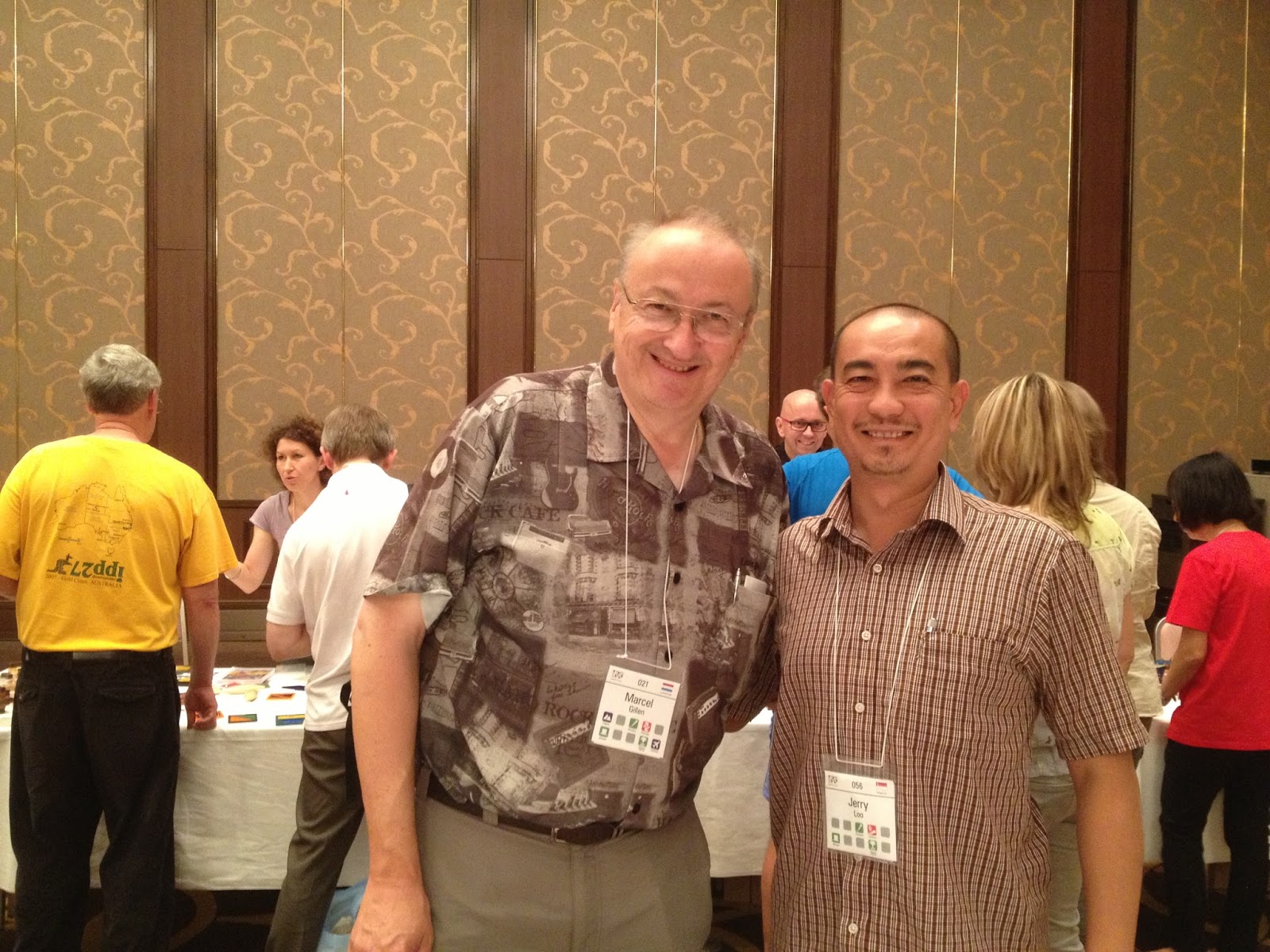
Me and Marcel Gillen 

Left: Timo Jokitalo; Right: Vesa Timonen & Jo Traynor

Left: Rene Dawir; Right: Carlo Gitt

Naoki Shibuya

By about 1:30pm in the afternoon, the Puzzle Party was almost over and most sellers had packed up their leftover puzzles and were leaving. Here's my haul from the Puzzle Party with several from the previous day's Exchange.


Judging the Design Entries

For me it was off to the adjacent room to continue with the judging of the puzzle design competition entries which had started on Friday evening. All the entry puzzle designs are laid out on tables with instruction and solution sheets. IPP33 participants get to play/puzzle with them and vote for their favourite designs. Below are some of the pictures of the judging (and puzzling) in progress over the course of the three days.


Mark Pawliger trying to figure out my Ball In Cylinder No1


From Left: Roxanne Wong, Allard Walker & Steven Chin


Judging ended at 3pm on Sunday 4 August and votes were cast and collated. Next, to pass the time until the Awards Dinner, I headed to the side of the hall where there was an exhibition of puzzles from Hanayama. These were not your usual off-the-shelf Hanayama puzzles but the displays included prototypes, early models, gold puzzles, impossible objects made from Hanayama puzzles etc, the majority of which most puzzlers have never seen before.


Impossible Object; 7 Cast Loops in a bottle


My favourite; 4 Cast Boxes linked together

The Lectures

Sunday afternoon also saw several lectures on Hanayama Cast Puzzles including one by Oskar van Deventer on how the Cooksey Maze inspired his many future puzzle designs for which he is famous for today.


The lectures ended around 5:45pm and I took an hour's nap before washing up and heading for the Awards Dinner. A Powerpoint show was set up in the dining hall to display all the various puzzle design competition entries. There were a total of 60 designs entered for IPP33 this year. Here are the list of entries and award winners. The Puzzler's Award went to fellow Singaporean Goh Pit Khiam for his Dancing Shoes puzzle.


My 15 seconds of fame during the Awards Dinner


Future IPP participant on the lower right!

Me with George Bell, Brian Pletcher, Allard Walker & Stephen Chin
The Renegades Forum members
Back Row From Left: Stephen Chin, Oskar van Deventer
Scott Elliot, George Bell, Brian Pletcher, Nick Baxter
Front Row From Left: Brian Young, Roxanne Wong, Allard Walker
Iwahiro Iwasawa, Chairman of the IPP33 Organising Committee with
his Appreciation Puzzle by Wayne Daniels 

Tuesday, 6 August 2013

IPP33 - Day 1 - Saturday 3 August (Puzzle Exchange)

 What: IPP33 (International Puzzle Party 2013)

Where: Tokyo, Japan. Held at the Hilton Narita, Tokyo

Day 1 - Saturday 3 August 2013 - Puzzle Exchange

Today was the big puzzle exchange day. This is the day where 65 puzzlers (out of the nearly 180 or so participants at IPP33) exchanged puzzles with each other. After the exchange, an Exchanger would go home with 64 new puzzles (minus his own puzzle of course). These were puzzles that are totally new designs and not available anywhere prior to the Exchange.

It takes place in a large hall where rows of tables are set up. Each puzzle exchanger is allocated a table with a placard with his/her name written on it. At 9am, the exchange begins and exchangers and their exchange assistants start moving around the large room looking for other puzzlers to exchange their puzzles with. A lot of movement of bodies everywhere. A round table is set up on one side of the room and atop is a copy of each exchange puzzle for the event.


I was invited by Diniar Namdarian to be his Exchange Assistant. Under the regulations of the IPP, one had to be an Exchange Assistant first before becoming an puzzle Exchanger at subsequent IPPs. At 9:15am, Diniar had still not showed up and I was beginning to get worried whether he would turn up. Five minutes later he strolls in; apparently he had arrived from central Tokyo where he was staying. We pick up his exchange puzzles and arrange them neatly on the table, ready to do the exchange.

During the exchange, each puzzler would describe his puzzle and its objective to the other person who would do the same thereafter. I helped Diniar carry his puzzles, keep track who we exchanged with and was also his photographer. Excellent way to see the different exchange puzzles first hand at close range. With 64 other puzzlers to exchange with, the whole exercise took over 4 hours.

Me with Dinair Namdarian just before we started the exchange with the rest.
In his palm is my Ball In Cylinder No 2 in limited edition copper and I
am holding his exchange puzzle, a sliding block puzzle called Clouds & Sheep.

With Allard Walker.
(Thanks Allard for the gift of your Exchange Puzzle)
With Brian Pletcher

With Roxanne Wong

With Lee Yee Dian from Malaysia

With puzzle designer Oscar van Deventer

With Jerry Slocum
Edi Nagata with his Exchange Assistant, his daughter
Tsugumitsu Noji with his Impossible Object Exchange Puzzle

IPP33 - Day 0 - Friday 2 August

What: IPP33 (International Puzzle Party 2013)

Where: Tokyo, Japan. Held at the Hilton Narita, 15-20mins from Narita International Airport

Day 0- Friday 2 August 2013 (Free & Easy)

This was my first ever IPP! I had arrived in Tokyo the previous evening and Wil Strijbos had suggested the few of us to head to town for a Karakuri exhibition and sale at a large local department store called TOBU at Ikebukuro, Tokyo. As we were all staying at the Narita Hilton (which is a short distance away from Narita International Airport, Japan's main airport), we took a shuttle bus from the hotel to the airport and caught the Japan Rail express train to Ikebukuro, well over an hour away. And being puzzlers, we all promptly started puzzling away to pass the time during the ride.

Allard Walker laughing at George Bell's struggle to solve one of Neil Hutchison's wooden puzzles
Wil Strijbos & Hendrik Haak
John Moores all smiles after being the first to solve the Star puzzle

Me trying to find my way with the Screw Cube Puzzle by Roger
...still couldn't solve it by the time the train reached the station
Arriving at Ikebukuro station, we promptly found our way to TOBU and headed to where the Karakuri display was. It was not at all what we expected. Instead of an exhibition of hundreds of Karakuri boxes and puzzles we were hoping for, it turned out to be only small display of around 30 or so items, all which were for sale. The good thing was that all on display were samples one could play with before buying. Very rare indeed where sale of puzzles are concerned.

The Karakuri display puzzle samples at TOBU department store, where 
customers can play with them before deciding to buy
Everyone trying out the puzzles. From left George Bell, Hendrik Haak,
John Moores, Allard Walker and Marc Pawliger
The cosy (and inexpensive) sushi joint where we had lunch
Dessert time: Look at all the plates of sushi consumed! Hendrik Haak all smiles
after eating raw fish for the first time
After lunch we headed for Tokyu Hands, an amazing store that not only sells puzzles and toys but a huge number of other items including electronic goods, gadgets, puzzles, science project kits, household, outdoor, hobby, health & beauty and lifestyle products, many of which all of us have never seen before elsewhere. Their slogan is "When You Visit, You Find What You Want". A real gem in the city and a definitely "must-visit" place if you ever come to Tokyo. Here, several of us bought some Hanayama Cast puzzles including the recent Cast G&G as well as other items before heading back to our hotel for the IPP33 Founder's Reception in the evening. More to come.....

Wednesday, 24 July 2013

Hanayama Cast Delta

Name
Cast Delta

Designer
Kyoo Wong (Thanks to fellow puzzle blogger Roxanne Wong for this info). Why is it called Delta? Well it is shaped like the fourth letter of the Greek alphabet.


Manufacturer
Hanayama. Available from the traditional online puzzle retailers like PuzzleMaster. But Ebay does have several sellers dealing in Hanayama puzzles and some are really very good value for money, particularly if you buy several different ones at a time, which makes the combined shipping really worthwhile. I got mine for US$10.50 together with four other puzzles in the series.

Type & Classification
Interlocking; take-part

Dimensions
Triangular shaped, each side approximately 5.6cm with a thickness of 1cm.

Materials & Construction
Made of brass. Quality of construction, finish and fit is overall very good. It is finished with an aged bronzed look which I like very much, similar to the Cast News I reviewed a while back. The appearance gives the puzzle a high quality appearance, as compared to some of the other Hanayama ones with a shiny chrome/gold look the latter which in my opinion, is just not as nice.


Overview
I am not a hard core fan of Hanayama puzzles but there some designs I would just have to get simply because its made of metal (and I am a sucker for metal puzzles) and the puzzle is aesthetically pleasing, which the Delta is.

The Delta consist of 3 identical shaped pieces interlocked and the object of course is to separate the three. When you start playing with it, you will find that you can separate the three pieces apart to some extent, and even see some of the insides. You roughly know what you need to do. However this is not enough to give you a good idea how the pieces are to come apart.

It took me the whole evening of pulling and tugging before I finally managed to disengage the three pieces. Basically a lot of trial and error. Some dexterity is also needed. I won't say what else is also needed so as not to leave any unnecessary spoiler.

Difficulty Level
Hanayama rates the Delta at 3-stars but I think it should be more like 4. Simply because repeat solving is still very difficult even though I know the solution and the steps needed. It took me another evening before I got it unlocked again the second time. I don't know, It may well be because I am not doing it right?

Summary
Nice well-made puzzle that is easily pocket-able. But can be very frustrating and tedious because its not easily re-solvable. Constant practice would certainly help.

Thursday, 4 July 2013

One Fish Another Fish

Name
One Fish Another Fish

Designer
Serhiy Grabarchuk. One of his many numerous sliding puzzle designs (see here). Serhiy also designed the Cast Coaster for Hanayama.


Start Position

Finished Position...well sort of...the lower  left  corner
blue tile is actually supposed to be on the top left corner)
Manufacturer
Diniar Namdarian.


Type & Classification
Sliding

Dimensions
15.1 cm (Height) x 12.1cm (Width) x 1.0 cm (Depth).

Materials & Construction
Entire puzzle is made of acrylic (plexiglass). Construction fit and finish is very good as the puzzle pieces are laser cut to tight tolerances.


Overview
The One Fish Another Fish came to me courtesy of Diniar Namdarian, puzzle designer and collector (thank you Diniar). From the design, you can tell why its called the name its called. The very good combination of colours for the pieces consisting of orange, blue and yellow enclosed by a white tray gives the puzzle a very bright, cheerful and attractive appearance.

Initially one would not think its a very difficult sliding puzzle given that its only 11 moving pieces (one space is left empty). This is what what I thought too (after my most difficult encounter with my Cat & Dog sliding puzzle, which still remains unsolved).

Well I should have remembered after so much puzzling that a puzzle that looks simple usually isn't and true enough as I started playing, I realised that not every single piece will move in every direction when it came to the corners. This clever restriction limits the movements of the pieces and makes the puzzle far more challenging than it looks.

I took a good forty five minutes with trying all sorts of moves before arriving at the "finished" position ie the reverse image of the fish...but alas, still not quite there. But I was happy with my personal result and didn't go further.

Difficulty Level
Moderately difficult. Moving the quarter-circle shaped pieces to their intended locations do require some forward planning of sorts since movements may be restricted now and again at the corners.

Summary
Overall a nice well-made sliding puzzle that provides enough challenge (and one that does not take a lot of time to complete). Good for puzzlers that don't have much experience with sliding puzzles (like me). I should have started with this one instead of the Cat & Dog.

Wednesday, 26 June 2013

Tetradyma

Name
Tetradyma

Designer
Yavuz Demirhan. For more information on his other puzzle designs, click here.


Manufacturer
Pelikan from the Czech Republic

Type & Classification
Interlocking burr

Dimensions
6.4 cm (Height) x 6.4 cm (Width) x 6.4 cm (Depth).

Materials & Construction
The entire puzzle is made of Wenge wood, giving it a very dark appearance. Construction is very good with light bevelling of the edges for a nicer feel. Fit was a bit on the tight side perhaps due to the humidity, remaining even so after several days in a camera dry box . But things loosened up considerably after some playing and now the pieces slide smoothly but snugly. It's sturdy and would not come apart on its own.


Overview
This a one of a great number of puzzles from super-prolific Turkish designer, Yavuz Demirhan who I understand has done over 150 puzzle designs! I have bought a host of his other puzzles and will get round to them in due course.

The Tetradyma came to me assembled . Comprising of four identical pieces that interlock to form a cube, the object is to firstly figure out how to disassemble the pieces and thereafter put everything back together.  At first, I was wondering if my puzzle was jammed; because no matter how much I pressed and pushed the sides and edges of the puzzle, nothing seemed to budge.

I actually resorted to knocking the puzzle on a piece of rug on the floor to try to loosen things. After a couple of hard knocks, one of the edges began to move ever so slightly and I was well on my way. It didn't take me too long to disassemble the puzzle but assembly was more tricky. Although only four pieces, the pieces are shaped irregularly and being all of the same colour, trying to fit them back together proved to be far more challenging than taking apart. After a while of fiddling, I managed to manoeuvre (if this is the right term to use) the last piece back into its place before sliding the puzzle back into its solved cube state.

Difficulty Level
Easy-ish to moderate difficulty; but that's because it came assembled. I would imagine it to be far more challenging if it came disassembled and you have to first figure out the solved shape. In this instance, I didn't have to resort to Burr Tools :-)

Summary
This in my view is a great puzzle for puzzlers who (like moi) cannot handle those "twenty-something-moves-to-remove-the-first-piece" type interlocking burrs. Relatively easy to take apart  but with a bit more effort required to put together. Nice!

Friday, 21 June 2013

Hedgehog In The Cage

Name
Hedgehog In The Cage - GEN
Hedgehog In The Cage - BEARING

Designer
The inventor of this puzzle is Clarence A. Worrall and dates back to 1896. Subsequent to him, a number of variations of this puzzle have come about including a cast version from Hanayama called the Cast Cage. Eureka came out with its own version called "Man The Torpedo"  while I also acquired one from Wil Strijbos called "Aluminium Hedgehog In Cage" which I am not sure where he sourced from.

Various materials are used in the making of these puzzles apart from aluminium and these include wood and plastic. All versions are based on the same principle; solving the puzzle requires the removal of a trapped object ie "hedghog" through the gaps/holes of its "cage". The two newest versions reviewed here are from Radek Micopulos.

Hedgehog GEN on the left and BEARING on the right

Manufacturer
Radek Micopulos. From his online store. The GEN cost 549 Czech Crowns (US$28) while the BEARING is 599 (US$30.50). The web store is in Czech language but Google Translate should do the job.

Reasonably priced puzzles but the only let down is that you cannot use PayPal to pay! I had to resort to doing a telegraphic bank transfer of funds to Radek to purchase the puzzles and this added about an extra US$30 to the total cost.

For more information and the history of the hedgehog, prototypes and other examples, check out the following:-
http://www.rademic.cz/
http://www.jezcivkleci.cz/

Type & Classification
Take-Apart/Disentanglement

Dimensions
GEN - 7.4cm (H) x 4.8cm (Diameter)
BEARING - 7.5cm x 4.8cm (Diameter)

Materials & Construction
Both puzzles are made from aluminium throughout; the cage and hedgehog. Machine cut (most likely computerised CNC) with both polished and matt surfaces, the quality, fit and finish is excellent. Very well made with a really solid heavy feeling in the hand, particulary the BEARING.


Overview
The GEN and BEARING attracted my attention for two reasons. Firstly as mentioned, they are very high quality metal puzzles (yes, I am a sucker for metal puzzles). Secondly, both are unusual variations of the "standard" design. The GEN has diagonal gaps/slots instead of the usual vertical slots which gives it a rather different and (I think more interesting) look.

Also what is interesting about the GEN is that the method of solving is totally different from the normal hedgehogs. While not difficult to solve (I managed it in under two minutes), it does provide a different twist to the puzzle

The BEARING is solved in the traditional way (more challenging than the GEN) but what makes it stand out from the rest is the affixing of ball bearings (hence the name BEARING) to the top and bottom of the puzzle. Functionally the ball bearings serve no purpose (Clue: has nothing to do with the solution) but their addition lends the puzzle a very cool industrial and machine-like appearance.

Difficult Level
GEN is relatively easy while BEARING is more challenging (especially if you have never solved a hedgehog before)

From Left- Aluminium Hedgehog In Cage, Hedgehog BEARING,
Hedgehog GEN, Man The Torpedo & the super-sized XL Hedgehog In Cage

Summary
If you like metal puzzles like me, especially high quality and well-made ones, then both the GEN and BEARING are must-buys for collectors. For the casual puzzler, it is not overly challenging to put people off. For the prices I paid, it also represents excellent value for money; as the quality is far beyond some of the other typical cheaper-feel mass produced metal puzzles.

Tuesday, 18 June 2013

2-In-1 (2013 Edition)

Name
2-In-1

Designer
Oskar Van Deventer. Check out Oskar's puzzle wiki; quite amazing the number of puzzles he has designed including eleven commercially available Hanayama Cast puzzles.


Manufacturer
Eric Fuller. From www.cubicdissection.com for US$75. Currently sold out.

Type & Classification
Interlock burr

Dimensions
8.6 cm (Height) x 8.6 cm (Width) x 8.6 cm (Depth).

Materials & Construction
A stunning twelve different exotic hardwoods; Purpleheart, Yellowheart, Ash, Grandillo, Chakte Cok (I am not sure if this is the correct spelling?), Canarywood, Paduak, Wenge, Maple, Mahogany, Sapele, Bubinga. One of the most colourful wooden puzzles I have come across. Construction, fit and finish is excellent.

As they say the devil is in the details and each of the twelve pieces all have slightly bevelled edges on their external facings to up the quality quotient as well as making them smooth to touch. Which was a good thing also because in the course of trying to solve the puzzle, I dropped a piece here and there on my work desk occasionally and if it had been a sharp edge or corner, the piece would have been dented or dinged.


Overview
According to Eric, the first 2-In-1s were made some 7 years ago and this is part of a new batch made this year. Comprising of 12 pieces (of which some are identical), the object of course is to fit all the pieces together to form the result shown in the photo above. I had a look at the first version but that one doesn't seem as good looking as the current one. And this later version is also less expensive!

The puzzle came unassembled, so you can imagine how difficult this was going to be. I thought I could get started by matching the colours of the pieces to those in the photo on Eric's website or in any case at least get the general orientation of the pieces right. Alas, it was not to be so easy. While some of the pieces like the maple, purpleheart and yellowheart were pretty obvious to match, the rest was not so easy. It also occurred to me that Eric may have have cut identical pieces using different hardwoods so that no two puzzles were alike.

Added to the challenge was the fact that I had to grapple with 12 loose pieces and it got really difficult trying to trial and error fit more than 5 or 6 pieces at a time. Each time I thought I made some progress, I got stuck and had to take apart everything again. As mentioned in the puzzle's description, the way the pieces are cut leave open spaces concealed within the puzzle that can result in many false solutions. Well, how many false solutions to me was quite academic since after a good nearly a full day of trying, I decided to throw in the towel and resort to my favourite puzzle friend...yep...Burr Tools. But using the software is no walk in the park either for this 2-In-1 as other puzzlers may wish to testify. (Eric, can you please photograph your puzzles from different angles, thanks!).

Difficulty Level
Extremely difficult! Made more so by the fact that the 2-In-1 is shipped unassembled.

Summary
A real bitch to solve (well I wouldn't really know since I did it with the help of a computer programme). But once done, a beautiful puzzle to look at with the myriad of contrasting colours. Large enough to display really well, this one!

Wednesday, 5 June 2013

Vectes / Ghidorah

Name
Vectes / Ghidorah

Designer
Ghidorah - Yavuz Demirhan
Vectes - Alfons Eyckmans

Ghidorah
Vectes

Manufacturer
Eric Fuller. Puzzle(s) were from www.cubicdissection.com for US$89. Currently sold out.

Type & Classification
Both are interlocking burrs

Dimensions
Vectes - 8.8 cm (Height) x 8.8 cm (Width) x 8.8 cm (Depth).
Ghidorah - 6.6 cm (Height) x 6.6 cm (Width) x 6.6 cm (Depth).

Materials & Construction
Walnut, Canarywood and Yellowheart. Quality of construction, fit and finish is of the usual Eric Fuller excellent standards. Very tight tolerances and pieces moved smoothly, but when left out in the open, was not really affected by the humidity and this is due to Eric making them a "looser fit" to begin with.

Overview
This puzzle is rather unusual because its really "two" puzzles combined into one. Both the designers of the Vectes and Ghidorah puzzles had co-incidentally designed a "cage" which was identical for their pieces to fit into. So I suppose you can say I got two puzzles for the price of one; well... more like one and a half puzzles since there was only one cage supplied.

Eric says the Ghidorah is the "warm up" puzzle, meaning its suppose to be easier and the one you should begin with of the two. The Ghidorah has a "simpler" 22.3.4 solution, in that it requires (only) 22 moves to remove the first piece, while the more difficult Vectes has a 37.2.3 solution; 37 moves for the first piece to be extracted from the cage. I am not sure how even the Ghidorah can be considered easier (not easy), not for me at least.

Vectes / Ghidorah with a common cage

The puzzle came disassembled and so it was not a matter of getting the first piece out but rather figuring how to insert the pieces into the cage correctly and solve the puzzle. Using the photo on Eric's website, I tried to see what I could do. But as in interlocking puzzles of this nature, they are usually way beyond me almost always all the time. Without any luck on Ghidorah after quite a while, I didn't even try to attempt the harder Vectes.

But luckily I have learnt to use Burrtools and this as usual came in very handy indeed. However, because the puzzle came unsolved, I had some initial difficulty trying to get the drawings rendered right with the programme. I could only rely on photos of the puzzles in their solved state, not the actual puzzles themselves. So even using the software here was a bit of a challenge.

Difficulty Level
Just two words - Extremely difficult! Made more so by the fact that they are shipped unassembled.

Summary
For me, they are more a collector's puzzles than something that I will play. As one well known puzzle designer has commented, there are puzzle collectors and there are puzzlers solvers, and the two are sometimes mutually exclusive. I definitely fall into the former category.

If anyone wants the Burrtools files for these two puzzles, please feel free to PM me via my profile email.

Friday, 24 May 2013

Elephant


Name
Elephant

Designer
Jakub Dvorak & Jaroslav Svejkovsky; Pelikan, from the Czech Republic.


Manufacturer
Pelikan. Apart from many of their own designs including the Egg, reviewed in this blog, they also manufacture numerous wooden puzzles from various other well known puzzle designers.

Type & Classification
Interlocking

Dimensions
13.4 cm (Length) x 11 cm (Width) x 10 cm (Height).


Materials & Construction
The puzzle comprises of two different types of hard woods for colour contrast; the lighter which is Ash and darker Acacia Overall quality, construction, fit and finish is very good. Everything is precisely cut and all the pieces fit nicely and snugly.


Overview
The Elephant consist of 11 pieces of various shapes and sizes which interlock to form the shape of an elephant. There is some order tho' to disassembling the pieces and the reverse is required to put everything back together again. The contrasting colours of the pieces however aid in the solving.

Creating a puzzle shaped like an elephant appears to be rather popular as there are several other burr/interlocking Elephant puzzles around; the Kumiki Elephant and Little Game Hunter by Robert Yarger, Burrlephant by Jerry McFarland and Umeko by Yoh Kakuda.

Difficulty Level
Fun and easy but the way some of the pieces are shaped makes it a wee bit slightly tricky. Almost like a burr but definitely no Burr Tools required here.

Summary
Physically a fairly large and heavy puzzle which also makes for a decent display piece.

Wednesday, 15 May 2013

Four Cross Twelve


Name
Four Cross Twelve

Designer
Guy Brette


Manufacturer
Eric Fuller. Puzzle was from www.cubicdissection.com for US$69. Currently sold out.

Type & Classification
Interlocking Burr

Dimensions
7.5 cm (Height) x 5.7 cm (Width) x 5.7 cm (Depth).

Materials & Construction
Maple and Purpleheart for the twelve pieces. Quality of construction, fit and finish is excellent. In fact the tolerances on my copy were so tight that after a few days left untouched in the room, a couple of the pieces were of a much tighter fit than what I would have liked. But a day in my camera dry box and everything was back to normal.

Overview
This puzzle allowed me to properly learn Burr Tools for the first time. For this I wish to thank puzzle designer Goh Pit Khiam for his help in teaching me how to use the software. I spent the good part of an afternoon at Goh's home not only looking at the over two hundred or so puzzles in his collection (many which are burrs and packing puzzles; and a number of which are his own designs) but also managed to sit down with him to having hands-on practice on how to define and form the pieces and use the programme solver.

One of Goh Pit Khiam's several puzzle cabinets.
This one above has door seals and an internal
heating rod to reduce humidity to prevent puzzle lock-ups
Left on my own, I would never have been able to figure out how to assemble the pieces together (yes, Eric shipped them unassembled). I used the photo of the Four Cross Twelve on his website to try to figure out things. But since I am so bad at this type of burr puzzles, as usual I got nowhere and patience is not exactly my forte.

Difficulty Level
Extremely! According to Eric, he says its "also quite difficult with a whopping level 9.9.9 solution. I'd call it the crown jewel of this update in terms of difficulty and appearance."  It takes nine moves to remove the first piece! Burrtools indicates there are 96 solutions to the Four Cross Twelve.

Summary
Hmm...having now learnt BurrTools, I am considering looking for the more interesting and rare interlocking burrs to acquire. Until recently (with my rather excessive horde of Pelikan made puzzles), I have hardly collected many burrs, packing or similar sort puzzles. But I think all that is set to change. While I am very unlikely to be able to solve any decent burr on my own, I am more than happy with the thrill I get taking apart and putting together one following the animated movements of this wonderful computer programme.

Wednesday, 8 May 2013

4 Street Elbows


Name
4 Street Elbows

Designer
Saul Bobroff


Manufacturer
Saul Bobroff. Puzzle available commercially from Eureka Puzzles for US$85.

Type & Classification
Impossible Object

Dimensions
6.2 cm (Length) x 6.2 cm (Width) x 2.2 cm (Height).

Materials & Construction
All four pieces of plumbing street elbows made of iron. Quality of construction is very good and the puzzle is coated with a sealant to prevent rusting. Wooden display stand included.

IPP
The 4 Street Elbows was Saul Bobroff's Exchange Puzzle during IPP28 held in Prague, Czech Republic in August 2008.

References
See http://www.puzzle-place.com/wiki/Impossible_Street_Elbows

Overview
The 4 Street Elbows is in reality an "impossible object". I had come by this "puzzle" through a puzzle exchange with Saul; my Ball In Cylinder No.1 for his Street Elbows. Consisting of four standard looking plumbing elbows, they are joined (and held together) by the screw threads of each elbow. Meaning to say that the pieces have not been joined by welding, glueing, force-fitting etc. When it first arrived, I was wondering how to solve it and whether in fact it was meant to be solved.

Like all impossible objects, it looks unsolvable. I did a check with Saul and he informed me that the puzzle is "solved already". I took it to mean that its really not meant to be solved in any way. Personally I am not sure if I want to try to dis-assemble it...it looks like some heavy duty tool might be needed for this task but I won't take the risk. I might just break something in the process.

Difficulty Level
Saul also mentioned that there is only one person who has removed and the elbows and put everything back into the solved state. Now I wonder who that person might be?

Summary
Not a puzzle for solving by any means, but something to be admired for its uniqueness and physical incredibility. Definitely worth collecting though.

Also by Saul Bobroff - "Too-Tite"...Impossible Object. Tennis ball in a bottle.
A gift from Saul, thank you very much.


Saturday, 20 April 2013

Tern Key


Name
Tern Key

Designer
Goh Pit Khiam


Manufacturer
Sold by Eric Fuller's Cubicdissection in 2009 for $49. Currently not available. New batch of Tern Keys expected to be released in the coming months.

Type & Classification
Sequential movement and take-apart.

Dimensions
14cm (Length) 9.6cm (Width) x 1.3cm (Height).

Materials & Construction
Acrylic, white nylon and stainless steel. The unit that is featured in this review is an initial production copy given by Eric to Goh, which will lead to a fresh batch that he will be making for release sometime soon. Construction fit and finish is excellent as per the usual Eric Fuller standards. The preision laser cutting has been carried out to very exacting tolerances. The sliding pieces all move smoothly although occasionally a piece may get a bit stuck but it takes just a slight tug to get things going again. Overall you have the look and feel of a high quality expensive puzzle.

Overview
Tern Key was another puzzle that was loaned to me by fellow Singaporean and puzzle designer Goh Pit Khiam who to-date has designed around sixty puzzles, many of which have been produced and are now in the hands of puzzlers and collectors worldwide.

The Tern Key is similar to the La Cerradura Doble by Robrecht Louage reviewed earlier in this blog, but both have different methods of solving.

The Tern Key is also a "harder" version of Goh's earlier wooden Key Puzzle (Eric will also likely be releasing the Key Puzzle in acrylic format together with the Tern Key). As Eric described during the first release of this puzzle... "The original Key Puzzle used a binary locking mechanism. Tern Key ups the ante with a trinary implementation, yielding a hefty 134 move solution with four locks!...."


I have never played with the earlier Key Puzzle so I jumped straight into the deeper end with the Tern Key. The object of the Tern Key is to slide the U-shaped key out the right side of the puzzle. The key is locked in place by four "locks" formed by sliders. One has to manoeuvre the sliders of each of the locks left, right, up and/or down to unblock and release the key. The locks cannot be worked on individually one at a time as the movement of sliders of one lock will either restrict or allow the movement of the sliders of an adjacent lock.

Given the interplay of the sliders and locks, one is required to think a number of steps ahead during the solving process. There were several times I found myself almost at the finish, only to be blocked by the last lock and I have to retrace my steps back to the beginning and start over again.

Although there are 134 steps needed to extract the key, a number of these are repetitive. Whether I really made 134 moves I honestly wouldn't know. My main aim was just to get the key out!

Difficulty Level
Very challenging but not unduly difficult. Took me the better part of a couple of hours to remove the key.

Summary
A very enjoyable puzzle and I had great fun with it. You can see clearly all that is happening through the transparent acrylic as you go about the solving process. You get a sense of achievement as you pass each lock and then that a-ha moment when you finally free the U-shaped key. Definitely worth acquiring both from the quality standpoint and puzzling perspective.

Friday, 19 April 2013

a-ha! Straight Arrow / Rectangular Jam

Update 23 October 2017 - Dear Reader, please check out my new puzzle blog and e-store at http://mechanical-puzzles.com

Name
a-ha! Straight Arrow (also known as Rectangular Jam)

Designer
Hirokazu Iwasawa


Manufacturer
ThinkFun. Puzzle cost $4.99. Also available from Amazon at $6.83. The wooden version (known as Rectangular Jam) costs 19.15EUR from Finnish online puzzle retailer Sloyd.

Type & Classification
Sliding puzzle

Dimensions
8.2cm (Length) 8.2cm (Width) x 2.5cm (Height).

Materials & Construction
Entire puzzle and pieces are made of sturdy plastic, could be ABS resin. Well made, solid and durable.

IPP
The Rectangular Jam was Hirokazu Iwasawa's puzzle design competition entry at IPP25 in Helsinki, Finland in 2005. It won the Judges' Honourable Mention. Iwasawa, who has also won several awards at various IPPs for his designs, is the man behind the AlCyl (Blue Cylinder) and Tritalon, both reviewed earlier in this blog.


Overview
This puzzle was loaned to me by fellow Singaporean and prolific puzzle designer Goh Pit Khiam whom I had the pleasure of meeting and having dinner with a couple days ago.

While it looks small and simple with only four pieces in a tray, this is quite a devious little creature. The object is to slide the green arrow out of the slot on the side of the tray without lifting the arrow or any of the rectangular pieces off the tray. Given the size of the pieces and their positions in the tray, it looks to be physically impossible. When I first played with it, I thought it was impossible too.

But obviously there is a solution and I might add a rather elegant (in Goh's words) and simple one really. Nice trick to it. Once you have figured the necessary moves, you can solve the puzzle in about under 20 seconds.

Difficulty Level
Challenging but not too difficult. Something that is likely to take minutes (or perhaps hours) to solve rather than days.... which is the type I like.

Summary
A good quality and fun pocket-sized puzzle. In plastic, it is very good value for money also.