Showing posts with label Hirokazu Iwasawa. Show all posts

Tuesday, 4 October 2016

Zipper

Can two ordinary ordinary zippers that are joined together become a real mechanical puzzle? Well in the genius hands of Hirokazu Iwasawa, they definitely can! And here it is... 
 

Hirokazu (or Hiro) is very well known for what I call his "offbeat" designs. Yes he does design regular looking and playable puzzles too such the well known Odd Puzzle, Alcyl, Tritalon and the Jam Series but he also has a hidden talent for coming up with unique puzzles that most would not imagine possible; that is using everyday objects like the zippers shown here and choosing non-typical materials such as cloth and fabric. 

Many in the puzzle community will remember his extremely popular Square In The Bag which won the IPP32 Puzzlers' Award and his subsequent CorRECTly In The Bag. Amazing how he is able to think up such unusual and unique puzzle designs that actually work.

Zipper was Hiro's IPP36 exchange puzzle in Tokyo this past August. Made of two zippers joined together, the puzzle provides two challenges. 

1. Completely zip up one of the two colour zippers 
2. Zip up both zippers completely. 

My puzzler friend Khuong An Nguyen has suggested that Hiro may have been inspired by or based his Zipper design on the "Mobius Strip". Click here to find out what this is...a rather interesting read.

The Zipper measures about 29 cm and comes with two seperate zipper pulls. My copy is a green-yellow version though there are other colour combinations for sale. Quality wise the zipper is above average as the two zippers are physically glued together and can come apart if too much force is used or if you try to peel them apart. The zipper itself has already been pre-twisted so it's not just a simple task of finding the opening ends and zipping them up. 

For some strange reason in my search for the solution to the first challenge, I actually discovered and solved the second challenge. Physically as you examine the zippers, it does not look possible to zip both zippers together at the same time but in typical Hiro fashion, the solution is definitely out there and apart from eliciting my amazement, it's actually a pretty elegant solution in the final state. 

From the puzzling perspective, Zipper is not a very difficult puzzle to solve but presents a challenge that requires some thinking and close visual examination. You must not allow yourself to think that it is impossible physically, which was my initial experience with CorRECTly In The Bag.  Mentally reinforce to yourself that it is indeed solvable and there is a way to do it without resorting to force or tearing the zippers apart...You'll be surprised.   

All in, a great (exchange) puzzle that is very far removed from the norm and Zipper can be enjoyed by both seasoned and novice puzzlers alike. In fact non-puzzlers will probably have fun with it too since some thinking out of the box is required as is typical of Hiro's puzzles of this nature. 

Zipper is manufactured by DYLAN-KOBO in Japan. Currently it appears that the Zipper is not listed and available. Best to contact the site owner MINE (Mineyuki Uyematsu). MINE ships internationally.

Wednesday, 3 August 2016

Pentagon Jam

This is the fourth puzzle I played with in the Jam Series. From what I know there are 5 puzzles in the series and they are produced by different sellers, some under different names and using a variety of materials including plastic, wood and MDF board. 


The 5 designs are:-

1. Hexangular Jam
2. Rightangle Jam
3. Triangle Jam
4. Rectangle Jam
5. Pentagon Jam

[Edit 3 Aug 16: I have just been informed that there is a "Yen In The Jam" which was made as an exchanged puzzle for Dutch Cube Day 2014; thanks to Michel van Ipenburg for the info] 

I have already reviewed the Hexangular, Rightangle and Rectangle Jams previously. All were designed by Hirokazu Iwasawa who has produced unique and award winning puzzles like Square In The Bag and ODD Puzzle.  

Like the rest of the Jam puzzles, the object requires the puzzler to remove a single piece (our of several) through a opening slot on the front side of the tray (without lifting any of the pieces off the tray). 

My copy of Pentagon Jam came to me courtesy of fellow puzzle designer and collector Frederic Boucher a while back. You may have come across his works such as Artefacts and his popular Marble Cake. This copy is a "CD Case" version in plastic. In fact, I received 3 other CD puzzles from Frederic as well! This range appears to be retailed by a company called Chronos of Japan.

The Pentagon Jam took me a short while to figure out and like all the Jam puzzles, you need to manipulate the pieces within the tray to make room for the piece in question to be removed. Rotations galore here and I counted about 10 to 11 moves to extract the red piece. But all the moves and the solution for this puzzle are rather elegant. Also, no force whatsoever is needed. It is not easy at all but if you have played with one or two of the Jam puzzles, you will have some idea how to go about solving it. This version is nice and compact and I would assume also inexpensive. Great puzzles the Jam series they are! The rest of the CDs I have are shown in the photos below. I have yet to solve the Triangle Jam.


Yen In The Jam (photo courtesy of Michel van Ipenburg)


Monday, 25 April 2016

Slide X

Name
Slide X

Designer
Yasuhiro Hashimoto


Manufacturer & Availability
Produced by DYLAN-Kobo (PUZZLE of MINE). Copies may still be available.

Type & Classification
Sliding Block Puzzle

Dimensions
7.6cm x 9.8cm x 0.4cm


Materials & Construction
Laser cut acrylic. Very precisely cut with sharp edges, resulting in an excellent quality puzzle.  Tolerances are just nice and the combo colours of red, white, blue and black make the puzzle stand out.

Overview
Slide X was Iwahiro's (Hirokazu Iwasawa) IPP35 Exchange Puzzle in Ottawa, Canada last year. 

There are a total of 8 pieces; 4 white rectangles and 4 black "L" pieces. Together they cover a substantial part of the red tray.

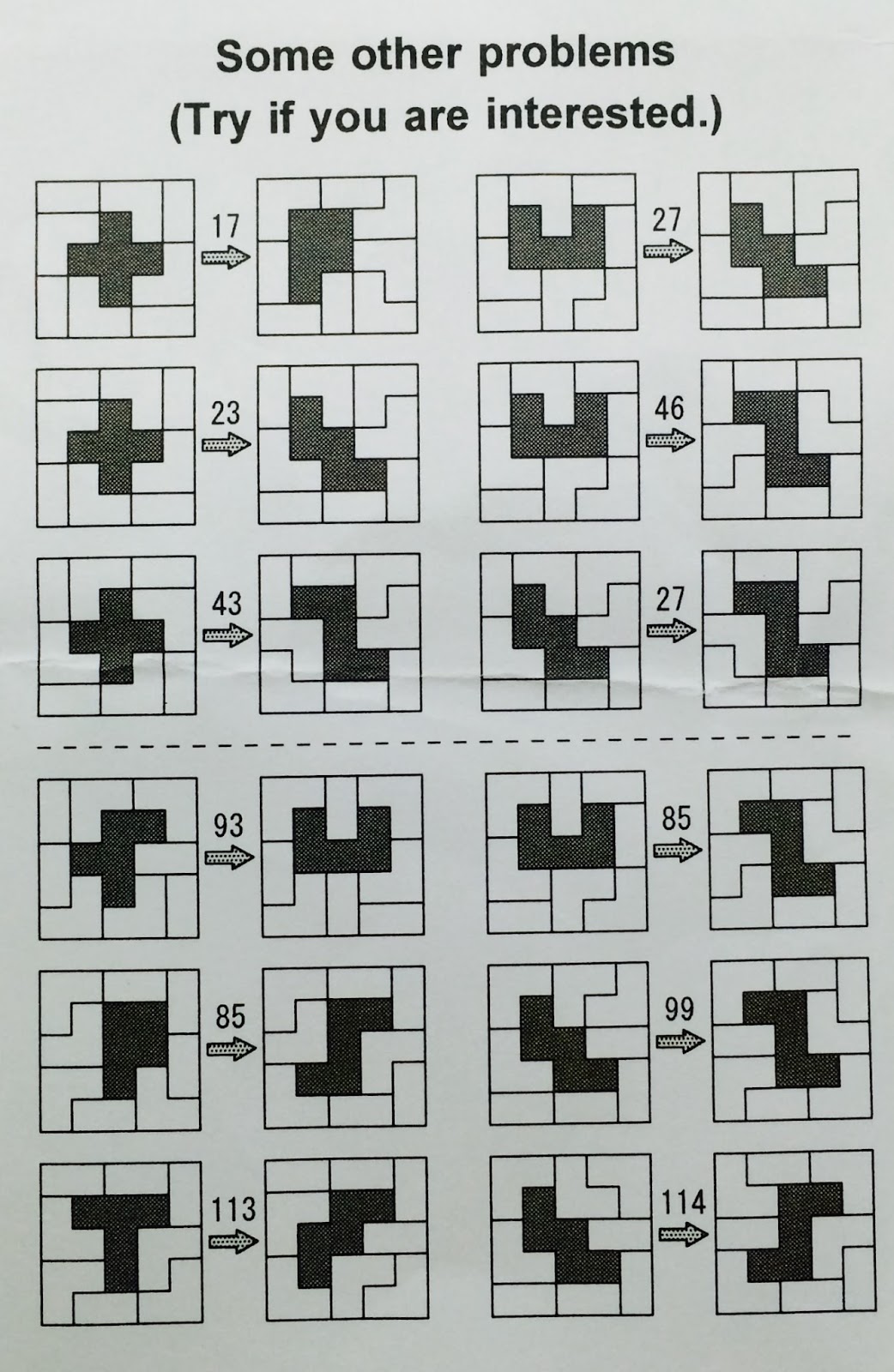
This is a sliding block puzzle with a bit of difference. Instead of moving the pieces from a start position to an end position as what most puzzlers are used to, the challenge is to form various silhouette shapes. A great and unusal design concept nonetheless!


The main challenge consist of a warm-up "practice run" (see photo) to change the silhouette of a "red cross" to a "U". This one takes 14 moves. Not a lot of moves but because now you are focusing on the "U" shape, the puzzle is harder than the 14 moves would suggest (at least for me). So what I did was to focus my attention on where the pieces should end up and tried to ignore the "U". 

Now for the main problem which requires a minimum of 48 moves, the instructions do not come showing the end position of the individual pieces. So the starting point is probably to pack the pieces into the tray to see how the "T" is formed. And then figure it out from there. A photo would certainly help! In any event, it was too difficult for me and I gave up after a number of tries. 8 pieces to slide is really no joke. But I did succeed in one of the other easier challenges on the separate problem sheet.


Difficulty
There are a total of 14 challenges in all with increasing levels of difficulty, ranging from 14 to 114 moves! I am not good at sliding puzzles. Notwithstanding, I think this one is really difficult especially for the higher level challenges. Definitely a sliding puzzle not to be missed by die-hard sliding puzzle enthusiasts.

Sunday, 30 August 2015

4M Puzzle

This 4M puzzle came to me courtesy of its designer Hirokasu Iwasawa at IPP35 in Canada early this month.


You can see from the photo why its called the 4M puzzle (or MMMM Puzzle). The object is to pack the 4Ms into the box and cover the opening completely flat with the lid.

My copy is made of MDF (medium density fibre) board, very hard, like wood but at a fraction of the cost, to keep the cost of the puzzle affordable. Although it may not crafted from exotic hardwoods, nonetheless construction, fit and finish is very good. For a puzzle like the 4M, the material chosen works well and the puzzle functions as intended.

If you have played with any of Hiro's puzzles which include the award winning "Odd Puzzle" and the "Jam" series of puzzles, you will know there is always a neat trick involved and its not that simple as it appears.


Dimension-wise, you will discover that trying to put the pieces straight in wouldn't work and slanting all the pieces in randomly won't either. As mentioned, there is a technique of packing the pieces and the solution is what puzzlers would term "elegant". Once all the pieces go in as intended, the lid closes nicely.

A great design from Hiro and from the puzzling perspective, provides a very nice but not too difficult challenge. Definitely worth acquiring. If available in exotic woods, better still.

Saul Symonds has done an interview with Hiro on how the latter created the 4M Puzzle which makes for interesting reading.

The 4M is available from Puzzlemaster.

Sunday, 15 February 2015

Hexangular Jam

This Valentine's Day weekend I was playing with another of Hirokazu Iwasawa's (Iwahiro) Jam puzzles. This time the Hexangular Jam. A gift from a puzzling friend who lives in Japan. I really like this Jam puzzle series; they look so deceptively simple with pieces cut into simple shapes, yet its anything but simple. However, its not so frustratingly difficult either. Even if you are new to Jam puzzles, with a bit of persistence, you will eventually be able to solve them.


Start Position

My copy is the original MDF version (a number of later copies are made of acrylic or plastic and some of the versions make use of CD cases). Although made of MDF, the construction fit and finish is very good with Iwahiro's signature burnt into the wood.

Like the previous two Jam puzzles reviewed earlier, the Rightangular Jam and Rectangular Jam, the Hexangular Jam involves getting the yellow hex shaped piece out through the slit at the front side of the tray. However, blocking its exit are three other similar hex shaped pieces.

Puzzlers familiar with the Jam puzzle series would know that there is a "trick" to all the Jam puzzles which provides a very elegant solution. No different here. Don't know the trick and you can end up taking an hour (or more) instead of a few minutes.

Tuesday, 25 November 2014

Rightangular Jam & Japanese Puzzle Box

These two puzzles were gifts from a puzzling friend of mine who lives in Japan. A big thank to Frederic Boucher (hope you are reading this)

The first is Rightangular Jam, designed by Hirokazu Iwasawa who entered it for the IPP24 Puzzle Design Competition. Iwasawa, as you may already know, gave the puzzling community such award winning puzzles as the ODD Puzzle and Square In The Bag.

Start Position


Constructed from MDF for the tray and three of the triangles (the blue triangle is wood), this version is made for the broader market. The Rightangular Jam is part of a series of three puzzles of the same genre (albeit different solutions and varying levels of difficulty). The other two are Rectangular Jam and Triangular Jam. 

The object is to get the blue triangle out of the tray through a narrow slit on one of the sides from the starting position as shown above. Its like a sliding block puzzle except here you are allowed to slide the pieces in any manner, diagonal etc, not just rectilinear, so long as none of the pieces are lifted off the tray

I found this one pretty challenging and took a good hour or so to figure out the moves. Its certainly harder than the Rectangular Jam. But a really nice and "elegant" solution; no force required. 

The second puzzle is a Japanese puzzle box or "14 Step Mame Yosegi Traditional Japanese Puzzle Box". For the history and more information about Japanese puzzle boxes, click here.  My puzzle box is "mame" (ie miniature; it measures only 4.3cm x 3.2cm x 2.7cm) with a Yosegi design.


In terms of difficulty, not difficult even though it has 14 steps. Once you discover the pattern of moves of the box, you are well on your way. Mine even came with a little "reward" in the form of a cute wooden cube (love the tiny criss-cross design!)


Friday, 29 August 2014

Aroma

This puzzle came to me courtesy of Hirokazu Iwasawa ("Iwahiro") and is called Aroma. 

Iwahiro has a number of well known puzzle designs to his name including two IPP awarding winning ones; the  "ODD Puzzle" and Square In The Bag.


 I obtained this during the IPP34 puzzle party and I should have asked him why it bears such an unusual name, but I didn't.

Aroma was Iwahiro's IPP30 Exchange Puzzle. Made of a very hard and solid type of plastic, and I mean this one is really very very solid, the puzzle is sized around 7.7cm x 6.7cm x 2.3cm. Fit and finish is very good. Tight tolerances.


It is a co-ordinate motion puzzle and the object is to fit the 3 identical pieces flush (sideways) into the hexagonal frame. I played with the puzzle while on the flight back to Singapore after IPP34 in London. I thought it would take me longer to figure this one out but several minutes was all I needed. Not difficult but a nice fun solve.

Sunday, 8 June 2014

T4-III (Tea For 3) / Square In the Bag

Recently when Mineyuki Uyematsu (Mine) made available the T4 and Square-In-The-Bag puzzles, I hitched an order through puzzle designer Goh Pit Khiam to save on some shipping costs and ordered the T4-III and Square In The Bag.

T4-III (Tea For 3)

I had found Mine's T4-II (Tea For 2) pretty fun and challenging. Check out my review here.

Like the T4-II, the T4-III is a 3D packing puzzle and dimensionally the same size as its cousin, at 7.6cm square and 3cm tall. The box is walnut and the 4 pieces are Yellowheart and Purpleheart. Excellent construction and quality overall with good contrasting coloured woods used.


The object is to place all 4 pieces (T-shaped...hence the name!) inside the box. It would have been an easy puzzle if not for the fact that the box has an acrylic cover with a cut-out which the pieces have to go through.

As I already have experience solving the T4-II, I sort of knew how things would operate with the T4-III. It took me several minutes and I got all 4 pieces into the box. Compared with the T4-II, I would say the T4-III is more challenging. However, its not so unduly difficult that it would frustrate. You need to know how to orientate the pieces correctly first (outside of the box) to assess how they would fit inside and then figure which pieces to go inside first (yes, there is a proper sequence here).

Square In The Bag

Last year, I had the chance to borrow and play with Hirokazu Iwasawa's CorRECTly In The Bag, the rectangular version of the puzzle.  


What I have said in my review about CorRECTly In The Bag will be applicable here. Square In The Bag is offered in 3 versions, with the price differentials dependent on the quality and design of the cloth bag provided. The one in the photo is the most expensive of the three with a geometric pattern design and red inner lining.The wood square is a checkered design and both bag and square are beautifully made.


I already knew the solution so took me less than 30 seconds to solve this one. Square In The Bag is one of those puzzles that looks impossible to solve, yet when you solve it (or see the solution happening before your eyes), its incredible and the a-ha moment is really great!

For those living in Europe/USA, you may wish to contact UK based Satomi Beattie of CU-Japan for availability and order of these puzzles.

Sunday, 6 April 2014

ODD Puzzle

Name
ODD Puzzle

Designer
Hirokazu Iwasawa. For more of Iwasawa's designs, click here.


Manufacturer
Torito of Japan. Retailed by Satomi Beattie of CU-Japan who's based in the United Kingdom. 

Type & Classification

3D Packing

Dimensions
8.9cm (Length) x 8.9cm (Width) x 5.0cm (Height). 

Materials & Construction
MDF Board for the box. A light coloured type of wood (looks like rubber wood) for the pieces Construction, fit and finish is overall good. This is the mass market version. There is also a high end version made of exotic hardwoods which was available for a time.

IPP
The ODD Puzzle won the Puzzle Of The Year award at IPP28 held in Prague, Czech Republic in 2008.

Overview
This one has a strange name. It's called the ODD. And it's called that because of the shape of the 3 pieces. They resemble the alphabets O.D.D (look carefully...see it now?).

The object of the ODD is to place all 3 pieces into the box without any of the pieces sticking out. For a 3-piece packing puzzle, one might wonder how difficult this can be, but believe me, it took me a good portion of an evening to figure this one out. The top of the box has a rectangular cut-out to insert the pieces, and this restriction makes the puzzle tough!

Each of the pieces can be inserted into the box, but usually when one is inside, neither of the other two can be inserted, or if both can be inserted, one is usually sticking a bit out. I had an idea what needed to be done and in fact my method was correct. However it was the way of execution that was wrong (in the opposite) that got me stuck for a while, until I tried what I thought was impossible but actually not.

Without giving any clues or spoilers, suffice to say you have to insert the pieces in such a manner that will eventually see all 3 flush inside the box. I might like to add that the ODD has a pretty elegant solution....and no force is required. I have not added a photo of the solved state here as this gives too much of a hint. But if you are struggling with the ODD, feel free to contact me for help.

Difficulty Level
Not your typical packing puzzle. Very challenging and you need to think about the end result of how the 3 pieces will sit correctly in the box and plan your way towards that. But once you solve it, it is easily re-solvable.

Summary

What's neat about the ODD is that physically, it looks deceptively really simple with just 3 pieces and a box... but a real challenge to boot. A really great packing puzzle and well deserving of it's IPP28 award. If you can't afford the high end version (if any is still available), then this one here will do just fine for a nice challenge.

Tuesday, 24 September 2013

CorRECTly In The Bag

Update 23 October 2017 - Dear Reader, please check out my new puzzle blog and e-store at http://mechanical-puzzles.com

Name
CorRECTly In The Bag

Designer
Hirokazu Iwasawa

Manufacturer
Mineyuki Uyematsu. Not available currently.

Type & Classification
Put-Together; 3D assembly

Dimensions
Bag - 18.5cm (Length) x 7.8cm (width)
Rectangle - 12cm (Length) x 9 (width)

Materials & Construction
Bag is made of a high quality cloth adorned with a dragonfly motif with a red inner lining. The rectangle is cut from a cross-section of four different woods joined together giving it a very nice checker board finish.

IPP
CorRECTly In The Bag is a variation of Iwasawa's earlier design, the Square In The Bag which won the Puzzlers' Award at IPP32 in Washington, USA last year.


Overview
I like Hirokazu Iwasawa's puzzle designs very much and in fact own two of his metal puzzles, the Alcyl and Tritalon, both reviewed earlier in this blog. I also had the opporunity to meet him at IPP33 in Tokyo, Japan just this August where he was Chairman of the IPP33 Organising Committee.

This CorRECTly In The Bag was kindly loaned to me by puzzle collector Lee Yee Dian of Malaysia, who happened to be in Singapore recently. Yee Dian had come with Maki Kaji (the Godfather of Sudoku) who was in town to meet some of the local Mensa club members. It was at this Mensa gathering (no, I am not a member cos I am not that smart!) that I first handled the puzzle. Puzzle designer Goh Pit Khiam was also present and had a bash at the puzzle. At IPP33 I had missed out on buying the puzzle sold by Mineyuki Uyematsu which were all snapped up almost immediately once the Puzzle Party began.

The object of the puzzle is to cover fully the entire rectangle with the cloth bag, leaving no gaps. No force is needed, otherwise the cloth bag may tear. Impossible you might say...and this is what I though too when I first looked at the puzzle. It looked like an impossible object at first glance.

I fiddled with the puzzle for quite a while before stumbling on the solution. This is one of those puzzles that give you the A-ha rush feeling once you solve it. The bag can and does cover the whole rectangle; really quite amazing! Even a few of the Mensa members couldn't quite figure out the solution. And these are folks that have an IQ of above 148.

What was even more surprising was that when I got home and showed my wife the puzzle and asked her to try it, she solved it in under five minutes while I went to take a shower. When I got out of the bath, the rectangle was all covered up sitting on the coffee table, with my wife giving me that nonchalant "its-really-no-big-deal" look. Or is it because women know some things about fabric while we men don't. Maybe we puzzlers just think too much while puzzling, that's why some of us (like moi) take ages to solve puzzles, or worse still, need to refer to the solution.

Difficulty Level
Not unduly difficult but provides a very good challenge. Given enough time, however you will eventually figure it out.

Summary
Whether its the CorRECTly In The Bag or Square In The Bag, it really is a very clever design, using non-traditional materials. The very fact that it looks so innocuously simple and the solution is so elegant truly makes this a very unique and wonderful puzzle.

I have heard that people who can't get their hands on this puzzle have resorted to making it themselves. Not difficult I would imagine so long as you have the right dimensions (see mine above but don't blame me if it doesn't turn out right). Also, access to a good seamstress. And for the rectangle (which can be substituted with acrylic or some other easily obtainable material). You may want to contact fellow blogger Roxanne Wong who has blogged about the Square version and has the specs for you to self-make one.

Personally I am considering making myself one as well since I would have to return the puzzle to Yee Dian the next time we meet. Hmm...let me see, how about 6061 Aluminium for the rectangle and calf leather for the bag...now wouldn't that be quite cool!

Friday, 19 April 2013

a-ha! Straight Arrow / Rectangular Jam

Update 23 October 2017 - Dear Reader, please check out my new puzzle blog and e-store at http://mechanical-puzzles.com

Name
a-ha! Straight Arrow (also known as Rectangular Jam)

Designer
Hirokazu Iwasawa


Manufacturer
ThinkFun. Puzzle cost $4.99. Also available from Amazon at $6.83. The wooden version (known as Rectangular Jam) costs 19.15EUR from Finnish online puzzle retailer Sloyd.

Type & Classification
Sliding puzzle

Dimensions
8.2cm (Length) 8.2cm (Width) x 2.5cm (Height).

Materials & Construction
Entire puzzle and pieces are made of sturdy plastic, could be ABS resin. Well made, solid and durable.

IPP
The Rectangular Jam was Hirokazu Iwasawa's puzzle design competition entry at IPP25 in Helsinki, Finland in 2005. It won the Judges' Honourable Mention. Iwasawa, who has also won several awards at various IPPs for his designs, is the man behind the AlCyl (Blue Cylinder) and Tritalon, both reviewed earlier in this blog.


Overview
This puzzle was loaned to me by fellow Singaporean and prolific puzzle designer Goh Pit Khiam whom I had the pleasure of meeting and having dinner with a couple days ago.

While it looks small and simple with only four pieces in a tray, this is quite a devious little creature. The object is to slide the green arrow out of the slot on the side of the tray without lifting the arrow or any of the rectangular pieces off the tray. Given the size of the pieces and their positions in the tray, it looks to be physically impossible. When I first played with it, I thought it was impossible too.

But obviously there is a solution and I might add a rather elegant (in Goh's words) and simple one really. Nice trick to it. Once you have figured the necessary moves, you can solve the puzzle in about under 20 seconds.

Difficulty Level
Challenging but not too difficult. Something that is likely to take minutes (or perhaps hours) to solve rather than days.... which is the type I like.

Summary
A good quality and fun pocket-sized puzzle. In plastic, it is very good value for money also.

Monday, 15 October 2012

AlCyl / Blue Cylinder

Update 23 October 2017 - Dear Reader, please check out my new puzzle blog and e-store at http://mechanical-puzzles.com

The AlCyl (alternatively called the Blue Cylinder) came to me from Wil Strijbos. It first made its appearance in 2009 but for the last couple of years, I searched for it everywhere but could never find one, not even in the puzzle auctions that take place now and again. Well, finally, just not too long ago, Wil made some available for sale and I quickly grab the chance to put in an order for one.


The AlCyl (I didn't know what "AlCyl" meant), but I was informed by 4 very experienced puzzlers (see below comments), 3 of whom are also well-known puzzle bloggers; Oli, Allard and Kevin, that it's a combination of Aluminium + Cylinder = AlCyl, thanks guys... gosh I am dense! It was designed by Hirokazu Iwasawa, who also gave us the triangular-shaped Tritalon, which was reviewed earlier in this blog.

The puzzle measures about 6cm tall and 4.8cm across in diameter. It is made of aluminium and anodised blue and looks very much like a Revomaze Blue Extreme with the ends lopped off. Construction, fit and finish of the AlCyl is very good and the puzzle feels solid.

AlCyl next to the Revomaze Extreme Blue
The object of the puzzle is to open the AlCyl and remove a 1-yen coin inside. This is not at all a difficult puzzle but perhaps could be considered a bit tricky, especially for non-puzzlers. The solution requires 3 steps. Not hard to figure out once you start playing with it for a while. I opened the AlCyl and extracted the coin in just a minute or two. There is enough space inside the AlCyl for more than a 1-yen coin....in fact you could put quite a lot of small(ish) items such as jewellery, rings, money etc.

However do be gentle if you are going to open and close the AlCyl often... assuming you are going to use it as a repository for things. Its tough looking exterior does belie its slightly more delicate interior construction.

From a puzzling perspective, the AlCyl may not really be value for money; but well worth the price if you are looking for a rare, hard to find and high quality collector's item.

Tuesday, 17 July 2012

Tritalon

Update 23 October 2017 - Dear Reader, please check out my new puzzle blog and e-store at http://mechanical-puzzles.com

This puzzle came to me courtesy of Wil Strijbos. A rather unusual looking puzzle, it is designed by Hirokazu Iwasawa.


The Tritalon is a triangular-shaped puzzle made up of a further 3 smaller odd-ish shaped triangular units joined together by 3 rods. Together the 3 smaller triangles hold in place a Chinese one Yuan coin. The triangles are made of aluminium while the rods are steel. Dimensionally the Tritalon is 8cm long on each side. Construction, fit and finish is very good and all edges and corners are bevelled slightly and smooth to the touch.


The object of the puzzle is to remove the coin in the centre. This puzzle was delivered to my office and later the same evening while on the way home from work, I was stuck in a traffic jam and decided to pass the time puzzling with the Tritalon in my car. This is of course something I would not advise anyone to do while driving. (WARNING: Do not solve puzzles and drive and the same time, it is VERY DANGEROUS!....You may drop and lose parts in the car!!!). It took me a bit of fiddling to figure out how the mechanism works and I got the coin out after about 15 minutes...thankfully without dropping it into some nook or cranny.

While not a difficult puzzle, the Tritalon is no walk in the park either. I let a non-puzzling friend play with it but he gave up after one evening. All in, an unusual design and given it's rather nice all metal construction, it is a nice collectable as well.