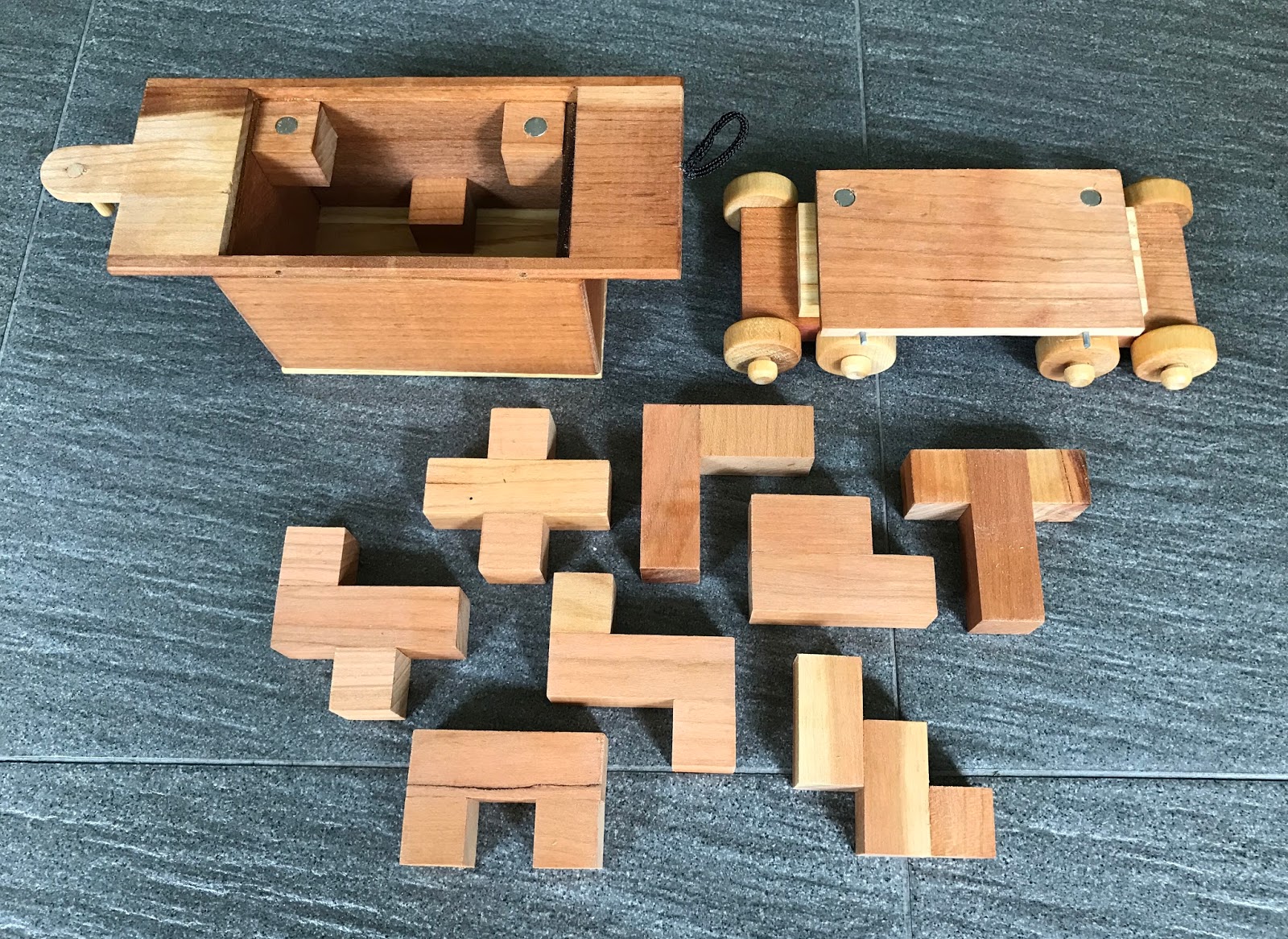
Frederic Boucher's new design, the Anti-Gravity Box reviewed.
http://mechanical-puzzles.com/anti-gravity-box/
Showing posts with label packing. Show all posts
Friday, 13 July 2018
Thursday, 28 June 2018
NEW Puzzles For Sale!
Dear Puzzlers
I have added the following new puzzles in limited quantities for sale on my website. Click link below.
1. L(8)tice-2 available in 4 colours (Green, Orange, Black & Clear)
2. Jurassic Pack Ver.2
3. Alpha Pack
Saturday, 12 May 2018
Double Feature
Saul Bobroff's IPP37 Exchange Puzzle, the Double Feature designed by Stewart Coffin reviewed.
http://mechanical-puzzles.com/double-feature-stewart-coffin/
Friday, 13 April 2018
Currency R&R
Currency R&R, "modded" by Frans De Vreugd for his IPP37 Exchange Puzzle. Nice but very challenging packing puzzle with five different challenges.
Monday, 9 April 2018
Gridlock at the Arc De Triomphe
Anti slide puzzle designed by Brian Young, Junichi Yananose and William Hu. Difficult and I still have not found the solution to it...
http://mechanical-puzzles.com/anti-slide-puzzle/
Saturday, 24 February 2018
Yet Another Clover Puzzle & Chorazin
Two new puzzle reviews posted.
Yet Another Clover Puzzle by Rik Van Grol
http://mechanical-puzzles.com/yet-another-clover-puzzle/
Chorazin by Yael Meron
http://mechanical-puzzles.com/chorazin-puzzle-inspired-synagogue/
Yet Another Clover Puzzle by Rik Van Grol
http://mechanical-puzzles.com/yet-another-clover-puzzle/
Chorazin by Yael Meron
http://mechanical-puzzles.com/chorazin-puzzle-inspired-synagogue/
Tuesday, 9 January 2018
Puzzles Crafted By Eric Fuller For Sale
I have listed a number of puzzles shown below from my collection, made by Eric Fuller for sale on my puzzle site
http://mechanical-puzzles.com/product-category/private-collection/
Please feel free to check them out.
http://mechanical-puzzles.com/product-category/private-collection/
Please feel free to check them out.
Wednesday, 15 November 2017
Tuesday, 20 June 2017
Chequered Cube
I have known Neil Hutchison for the last several years and also met him on a couple of occasions during past IPPs. Chequered Cube was Neil's IPP34 Exchange Puzzle in London in 2014 and the first puzzle design from him in my collection. Neil, also know as "The Juggler" in the puzzle community, is an excellent woodworker and also has his own blog site, where he posts puzzle stuff now and again, but unfortunately not often enough!
Chequered Cube came in a smallish nice fitting cardboard box and when I first opened the lid, I thought it was some kind of burr or interlocking puzzle made out of at most half a dozen or so pieces squeezed into a 5cm-sized package.
Little did I know that as I spilled out the contents, the burr was not actually a burr but a diminutive 3D cube packing puzzle comprising a staggering 13 separate parts made of various dark (walnut) and light (maple) pieces glued together.
The pieces are all precisely cut with sharp edges, and fit together incredibly well and the quality of the workmanship is astounding. I am truly impressed how Neil was able to produce the minimum 100 copies needed for the Exchange.
The object of the puzzle is take apart the cube and re-assemble it into a 2x2 checkerboard cube. According to the instructions, there are four ways to put together the cube but only one solution for the checkerboard pattern on the sides.
While this was a beautifully made puzzle and all those 13 pieces were lovely to touch, the difficulty quotient was totally out of my league. Even just trying to put the pieces back together to form a cube (without checkerboard pattern) proved to be too difficult for me. I simply could not handle that many pieces, the shape they are in, with all their notches and grooves made me want to faint with confusion. But lets get real here...any puzzle with over a dozen pieces (and designed by an experienced puzzler) would unlikely ever be a walk in the park, would it?
![]() |
| Solved State |
After much effort and time, I decided to find the solution via Burr Tools. For those of you puzzlers out there who have problems with this sort of puzzles or interlocking/burrs etc, trust me, its still fun, thrilling (and challenging) just to configure the puzzle in Burr Tools to find a solution. Yes....a bit of a lame consolation! Using Burr Tools with the relevant colour constraints, the programme came up with the solution on how to form the Chequered Cube with a checkerboard pattern on all six sides and I was able to put the cube back together in no time.
Chequered Cube is a fine work of art for a puzzle with great attention to detail. For those of you who are die-hard fans of 3D packing puzzles, well, this is one you should try to get from Neil. Not sure if he has any left but he can certainly be contacted via his blog site. I just wished that he had also made a matching wooden box to house the pieces...now this would have been so cool!
Saturday, 20 May 2017
Checking In
Steward Coffin's designs are typically not known to be easy and my puzzle of choice this weekend was no different.In fact it is probably one of the harder ones I have played with, considering the amount of time it took me to solve. This puzzle was Jerry Slocum's IPP34 Exchange Puzzle called "Checking In" and its Coffin's design #223.
Checking In was made by Brian Young of Mr Puzzle and comprises of Western Australian Jarrah for the tray and a combo of Jarrah and Queensland Silver Ash for the eight pieces. The puzzle measures about 10cm x 10cm x 1.5cm. According to Brian, this design has never been made before so its the first time design #223 has been produced. As usual, quality and construction is very good and the pieces with its two-tone colours looks fabulous.
The puzzle comes "semi-solved" and the goal is to fit one of the pieces packaged at the bottom of the frame flat into the tray together with the rest of the other seven pieces. Not only that but to also form a checkerboard pattern as well. Each of the eight pieces consist of dark and light squares and half squares (triangles) glued together. One look and it is obvious right from beginning that this one wasn't going to be easy. The pieces don't look like they can all fit into the tray. And the fact that its eight pieces already ups the the difficulty quotient by a few notches.
I spent around two hours or so over several sessions trying to figure this one out. At first, random sort of packing, but usually this won't work when there are a large number of pieces. Then I tried logical deduction/reasoning, which I would say helps to some extent for this puzzle. Many a times, it was always the last one or two pieces that couldn't fit. But eventually the a-ha moment came when I adjusted the last few pieces and the tray accepted the last piece nicely...and in a checker board pattern too! A rather "interesting" solution I might add!
Not at all easy but not unduly frustrating either...although I would imagine that those who don't often play with packing puzzles could spend hours on Checking In and get no where. Mr Puzzle rates it a 6/10 for difficulty but I think it deserves a 6.5 or 7. If you are into packing puzzles (and given this is a Coffin design which is not easily available), Checking In should be on your must-have list. Available only from Mr Puzzle at a price of A$50/-
For anyone who might want to take a look at the solution, please PM me via my blog email here.
Checking In was made by Brian Young of Mr Puzzle and comprises of Western Australian Jarrah for the tray and a combo of Jarrah and Queensland Silver Ash for the eight pieces. The puzzle measures about 10cm x 10cm x 1.5cm. According to Brian, this design has never been made before so its the first time design #223 has been produced. As usual, quality and construction is very good and the pieces with its two-tone colours looks fabulous.
The puzzle comes "semi-solved" and the goal is to fit one of the pieces packaged at the bottom of the frame flat into the tray together with the rest of the other seven pieces. Not only that but to also form a checkerboard pattern as well. Each of the eight pieces consist of dark and light squares and half squares (triangles) glued together. One look and it is obvious right from beginning that this one wasn't going to be easy. The pieces don't look like they can all fit into the tray. And the fact that its eight pieces already ups the the difficulty quotient by a few notches.
I spent around two hours or so over several sessions trying to figure this one out. At first, random sort of packing, but usually this won't work when there are a large number of pieces. Then I tried logical deduction/reasoning, which I would say helps to some extent for this puzzle. Many a times, it was always the last one or two pieces that couldn't fit. But eventually the a-ha moment came when I adjusted the last few pieces and the tray accepted the last piece nicely...and in a checker board pattern too! A rather "interesting" solution I might add!
Not at all easy but not unduly frustrating either...although I would imagine that those who don't often play with packing puzzles could spend hours on Checking In and get no where. Mr Puzzle rates it a 6/10 for difficulty but I think it deserves a 6.5 or 7. If you are into packing puzzles (and given this is a Coffin design which is not easily available), Checking In should be on your must-have list. Available only from Mr Puzzle at a price of A$50/-
For anyone who might want to take a look at the solution, please PM me via my blog email here.
Wednesday, 10 May 2017
Dutch Souvenir Pack
This cute and quirky glass jar containing colourful clogs comes courtesy of Rob Hegge, who designed and produced the Dutch Souvenir Pack (DSP) as his PP36 exchange puzzle.
The Dutch wooden clogs or Klompen are from the Netherlands and many are sold as tourist souvenirs. The jar is an ordinary looking glass jar with an airtight lid that locks; the type where you can fill it with jellybeans for kids. As far as the clogs are concerned, they appear to be those that can be easily bought off the street.
The DSP is a "3D" packing puzzle, if I can use such a definition and comes with 4 challenges, ranging from relatively easy to impossible:-
1. after removing the clogs and ball, place all 3 pairs of clogs into the bottle;
2. Same as above but close the lid
3. Same as 2 above but all the clogs must be below the lowest metal ring of the locking mechanism.
4. Same as 2 but include the rubber ball inside.
I solved challenges 1 to 3 but had absolutely no luck with 4. #3 was a tad more difficult since the the clogs had to occupy the correct position inside the jar below the lowest ring; hence some serious packing was needed, bu still manageable.
#4 was quite impossible for me! In fact it does look quite like an impossible object. I shall wait for the solution to appear in the IPP36 souvenir booklet to find out how to pack the ball in with the clogs.
As far as packing puzzles go, this one wins the prize for originality and aesthetics... and very appropriate as a (Dutch) souvenir, which doubles as a nice puzzle too!
The Dutch wooden clogs or Klompen are from the Netherlands and many are sold as tourist souvenirs. The jar is an ordinary looking glass jar with an airtight lid that locks; the type where you can fill it with jellybeans for kids. As far as the clogs are concerned, they appear to be those that can be easily bought off the street.
The DSP is a "3D" packing puzzle, if I can use such a definition and comes with 4 challenges, ranging from relatively easy to impossible:-
1. after removing the clogs and ball, place all 3 pairs of clogs into the bottle;
2. Same as above but close the lid
3. Same as 2 above but all the clogs must be below the lowest metal ring of the locking mechanism.
4. Same as 2 but include the rubber ball inside.
I solved challenges 1 to 3 but had absolutely no luck with 4. #3 was a tad more difficult since the the clogs had to occupy the correct position inside the jar below the lowest ring; hence some serious packing was needed, bu still manageable.
#4 was quite impossible for me! In fact it does look quite like an impossible object. I shall wait for the solution to appear in the IPP36 souvenir booklet to find out how to pack the ball in with the clogs.
As far as packing puzzles go, this one wins the prize for originality and aesthetics... and very appropriate as a (Dutch) souvenir, which doubles as a nice puzzle too!
Wednesday, 3 May 2017
The 3/4 Pack Puzzle
I have had several Dick Hess puzzles in my collection for some time now and he has designed and produced quite a number including both packing, sliding block and entanglement ones. I thought I would start off with something of his that is more manageable and the 3/4 Pack Puzzle fits the bill just right.
The 3/4 Pack Puzzle was Dick's IPP36 exchange puzzle in Kyoto last year. Its a 2D tray packing puzzle with six 3/4 discs. Manufactured by Walt Hoppe, it is made from laser cut Cherry wood and measures about 12.7cm x 9cm x 0.9cm. The tray and pieces are precision cut with tight tolerances. It even has a slot for one of discs for ease of storage when not in play
Typically for puzzles like this, where the fit is just right, I would place it in a dry box to make sure there is no expansion of the pieces due to the high humidity, which is what I did. One never knows if the inability to solve could have been due to expanded pieces which can't fit where it should.
The object is to place all six 3/4 discs flat into the square cavity. The puzzle comes with the solution sheet which shows that there are actually 8 ways to pack the pieces in. This explains why I didn't have too much trouble with this packing puzzle! But of the 8 ways (plus flipped pieces), only two are optimum (best) solutions and the rest go in descending order thereafter from 2nd, 3rd, 4th and 5th best solutions. I am proud to say my first attempt was actually one of the two "best" solutions!
The 3/4 Pack Puzzle is not too difficult and this is one of those packing puzzles that you can lay out all the pieces in the tray and slowly manipulate the pieces bit by bit to ensure every piece will fit inside. However, aside from the challenge perspective, I guess what's significant is also the math behind the design and the very precise manufacture of each and every copy to ensure that the puzzle works properly as intended. For those keen on the 3/4 Pack Puzzle or other Dick Hess puzzles, please PM me via my blog site email.
The 3/4 Pack Puzzle was Dick's IPP36 exchange puzzle in Kyoto last year. Its a 2D tray packing puzzle with six 3/4 discs. Manufactured by Walt Hoppe, it is made from laser cut Cherry wood and measures about 12.7cm x 9cm x 0.9cm. The tray and pieces are precision cut with tight tolerances. It even has a slot for one of discs for ease of storage when not in play
Typically for puzzles like this, where the fit is just right, I would place it in a dry box to make sure there is no expansion of the pieces due to the high humidity, which is what I did. One never knows if the inability to solve could have been due to expanded pieces which can't fit where it should.
The object is to place all six 3/4 discs flat into the square cavity. The puzzle comes with the solution sheet which shows that there are actually 8 ways to pack the pieces in. This explains why I didn't have too much trouble with this packing puzzle! But of the 8 ways (plus flipped pieces), only two are optimum (best) solutions and the rest go in descending order thereafter from 2nd, 3rd, 4th and 5th best solutions. I am proud to say my first attempt was actually one of the two "best" solutions!
The 3/4 Pack Puzzle is not too difficult and this is one of those packing puzzles that you can lay out all the pieces in the tray and slowly manipulate the pieces bit by bit to ensure every piece will fit inside. However, aside from the challenge perspective, I guess what's significant is also the math behind the design and the very precise manufacture of each and every copy to ensure that the puzzle works properly as intended. For those keen on the 3/4 Pack Puzzle or other Dick Hess puzzles, please PM me via my blog site email.
Friday, 7 April 2017
Pack Your Passport
American Eitan Cher's IPP36 Exchange Puzzle, Pack Your Passport is IMHO one of the nicest looking 2D packing puzzles I have come across, and believe me, I have quite a large number in my collection, and none of them come close!
The goals are simple and clear, use all 10 pieces to form the maple leaf of the Canadian flag and the second challenge is to use the same 10 pieces to form the sun of the Japanese flag. Believe me, both challenges are very difficult, since there are 10 pieces involved and in the case of the Japanese flag, there is only one solution. Quite a design feat, I might add.
This is a meticulously crafted puzzle that measures 13cm x 9.5cm x 1.7cm, about the size of a real passport. It consists of a number of layers of acrylic glued together to form a two-page "passport" with the covers held together by rubber bands. The puzzle including the 10 irregular pieces that come with it are precision laser cut and the entire package smacks of high quality. As I understand, Eitan has access to a number of laser cutting machines at his disposal, hence his ability to ensure quality control over the final product.
Not only is the puzzle beautiful to look at and feel, the design concept of the puzzle also deserves commendation. IPP35 was hosted in Canada and IPP36 in Japan. Pack Your Passport was designed by Rex Perez of the Philippines and aligns itself very well thematically. On the first page of the "passport" is the Canadian flag with a cut-out of a maple leaf; detach and flip it over and you see the Japanese flag with a cut-out of the sun. the second layer stores the 10 loose pieces which are neatly stored in their own slots.
The goals are simple and clear, use all 10 pieces to form the maple leaf of the Canadian flag and the second challenge is to use the same 10 pieces to form the sun of the Japanese flag. Believe me, both challenges are very difficult, since there are 10 pieces involved and in the case of the Japanese flag, there is only one solution. Quite a design feat, I might add.
I struggled with the Canadian flag for a couple of days before I decided I needed help and promptly shot a message to Rex for a clue. Quick was his reply (he too couldn't solve it sometimes!) and he indicated to me where one of the 10 pieces was suppose to fit within the cut-out. With this, I was able to solve the puzzle during the next hour or so. Next I tried the Japanese flag but as of the date of this post, I have still not solve this one. Still waiting for Rex to forward a clue.
Between the two challenges, the Canadian flag is the easier one, since careful observation will reveal that there are a couple of pieces that can only fit (or not) in certain places within the cut-out and this reduces the level of difficulty somewhat, but perhaps still not enough!
For packing puzzle lovers that also demand top-notch quality, Pack Your Passport is a must-have. From what I can tell, it is commercially available from http://www.puzzle-shop.de.
Thursday, 23 February 2017
Trainspotting
Now here's an interesting series of packing puzzles that I received during the course of three puzzle exchanges since 2014.
These are fine works with wheels that spin, a simple coupler cum loop system to link train cars at both ends of each car and lids that are laser etched with the puzzle and IPP exchange details etc. The size of the train cars vary a bit but is pretty large and hefty with an average size of around 18cm x 10cm x 7cm. And all use just one type of wood (although I am not sure what it is).
These are none other than Henry Strout's creations. The only other puzzle I have from Henry is his nice Flower String Puzzle. From what I understand, Henry started doing this series of train packing puzzles for exchange since 2013 and will finish off his series in 2018. Apparently, he's got another car/tender and an engine to complete (if anyone has more accurate information or otherwise, please PM me).
These are fine works with wheels that spin, a simple coupler cum loop system to link train cars at both ends of each car and lids that are laser etched with the puzzle and IPP exchange details etc. The size of the train cars vary a bit but is pretty large and hefty with an average size of around 18cm x 10cm x 7cm. And all use just one type of wood (although I am not sure what it is).
All the puzzles bear the same style/theme...namely to pack anywhere between 8-10 irregular shaped block pieces into a train "car". Levels of difficulty also vary since each of the train cars or box contain different number of pieces and within each car, there are some protrusions or fixed restraining piece, which makes the puzzle that much harder.
Each of the train packing puzzles have been/will be either designed by Henry himself, or someone else. As I joined the Puzzle Exchange only in 2014, I missed out on the earlier first train puzzle. What I have are the train puzzles for the last three years:-
IPP34
Sphinks Cargo Car
Designed by Brian Young (a.k.a Mr Puzzle Australia),
Pack 6 pieces into the box
IPP35
Cutler Freight Car
Designed by Bill Cutler
Pack 10 pieces into the box
IPP36
Henry's Cargo Car
Designed by Henry Strout
Pack 8 pieces into the box
In terms of difficulty, lets just say these are not so easy as they seem. In fact they are pretty challenging. The hardest I think would be the Cutler Freight Car with its 10 pieces and easiest is the Sphinks Cargo Car with only 6 pieces (I know because I was able to solve the latter) and in between Henry's Cargo Car.
A nice idea to create a series of related puzzles for exchange. And for anyone who enjoys trains and/or packing puzzles, this will be an interesting addition to your collection, that is if you can get the complete set.
Labels:
3D packing,
3D-assembly,
assembly,
Bill Cutler,
Brian Young,
dis-assembly,
Henry Strout,
interlocking,
IPP34,
IPP35,
IPP36,
packing,
put-together,
Puzzle Exchange,
sequential movement,
take-apart,
wood
Friday, 27 January 2017
9 Blocks Box & 9 Blocks Cube
Update 23 October 2017 - Dear Reader, please check out my new puzzle blog and e-store at http://mechanical-puzzles.com
I thought I would start my 401st post here with a brief mention of the above two puzzles, which lucky me, has been made into four different versions with four different sizes. First off, the 9 Blocks Box; this is a design I did in late 2015 which was produced several months later by Eric Fuller in a limited edition run of 50 copies for sale.
The 9 Blocks Box comprised of a rectangular box and the object was to fit 9 irregular shaped pieces into it. It has a unique solution. I spent a fair amount of time trying to design all the blocks to be different from each other but in the end, I could only managed to do so with 7 of them while two of the pieces had to remain identical.
Eric's version of the 9 Blocks Box was small and constructed to fit a pocket. I think small is a bit of an understatement; it was Lilliputian. Each puzzle measured a diminutive 3.4 cm all round! Made of Holly, Zebrawood and Macassar Eboy, it was rather cute and certainly didn't go unnoticed, which saw all 50 copies sold out within a day after it was listed on his site. He also fashioned the box to have a cover that "locked" magnetically to keep the pieces in place (even in an unsolved state; quite clever I must say) and dimensionally the shape also became more of a cube as opposed to the original rectangular design.
A couple of months later, my puzzler friend Frederic Boucher made a limited run of just 5 copies (of which I received #1). He also upped the ante by machining the 9 pieces in gorgeous aluminium. Frederic's version was a real beauty and came with a wooden box with slanted corners and packaged in a plastic container to boot. He too, as I understand sold out all his copies after pictures of it were posted on Facebook.
I thought I would start my 401st post here with a brief mention of the above two puzzles, which lucky me, has been made into four different versions with four different sizes. First off, the 9 Blocks Box; this is a design I did in late 2015 which was produced several months later by Eric Fuller in a limited edition run of 50 copies for sale.
![]() |
| From Left: 9 Blocks Box (made by Eric Fuller), 9 Blocks Box (made by Frederic Boucher), 9 Blocks Cube (made by Eric Fuller) and 9 Blocks Cube (made by Tom Lensch) |
Eric's version of the 9 Blocks Box was small and constructed to fit a pocket. I think small is a bit of an understatement; it was Lilliputian. Each puzzle measured a diminutive 3.4 cm all round! Made of Holly, Zebrawood and Macassar Eboy, it was rather cute and certainly didn't go unnoticed, which saw all 50 copies sold out within a day after it was listed on his site. He also fashioned the box to have a cover that "locked" magnetically to keep the pieces in place (even in an unsolved state; quite clever I must say) and dimensionally the shape also became more of a cube as opposed to the original rectangular design.
A couple of months later, my puzzler friend Frederic Boucher made a limited run of just 5 copies (of which I received #1). He also upped the ante by machining the 9 pieces in gorgeous aluminium. Frederic's version was a real beauty and came with a wooden box with slanted corners and packaged in a plastic container to boot. He too, as I understand sold out all his copies after pictures of it were posted on Facebook.
Sometime later, Primitivo Familar Ramos from Spain took my design and scaled up the original rectangular box to result in a cube. As a consequence, he was also able to resize the 9 blocks such that now, no two pieces were identical. We jointly entered this version, the 9 Blocks Cube for the IPP36 Nob Yoshigaha Design Competition in Japan last year.
The first working copies of the 9 blocks Cube produced for the competition were crafted by Tom Lensch. Our competition puzzle was huge! Each cube measured 12.6cm x 12.6cm x 11.4cm. Heavy and rather difficult to lug around. The box was made of Maple while the pieces Mahogany. We didn't win any prizes at IPP36 but this modified design again attracted Mr Fuller, who subsequently went on to produce 150 copies which formed the first release of his "Limited Edition" series via his upgraded website. Eric's interpretation of the 9 Blocks Cube was made of Maple, Walnut and Purple Heart with a much more manageable size of 7.3cm cube. As of the date of this post, there are still copies available at a very affordable US$37.
Labels:
3D packing,
assembly,
Design Competition,
dis-assembly,
Eric Fuller,
Frederic Boucher,
IPP36,
Nob Yoshigahara,
packing,
Primitivo F Ramos,
put-together,
take-apart,
Tom Lensch,
wood
Sunday, 6 November 2016
2016 8 August
There are packing puzzles and there are packing puzzles. And 2D packing puzzles come in all shapes and styles. Aside from the typical standard "fit X number of pieces" into the tray version, there are those which require the puzzler to find a symmetrical shape, an anti-slide formation or in the case of the "2016 8 August" puzzle here, leave a certain designated portion of the tray uncovered.
"8 August" is not just a packing puzzle, but it also bears a theme...it is a calendar packing puzzle, but more on that later...
This puzzle is Rikishi (Lixy) Ramada's IPP36 Exchange Puzzle. It is made from precision laser cut acrylic for both the tray and pieces and fits nicely into a standard CD case as part of the packaging. The details, text, numerals etc and instructions are beautifully etched onto the top and inside surfaces of the tray. A very high quality piece indeed.
The object of the puzzle is to cover up the tray with all the 6 given pieces but leaving a single date open. Since there are 31 days in August, there are 31 challenges here. What is interesting is also that each of the 6 pieces is a pentomino (ie shape made up of 5 square units) selected from the total of 12 possible flat pentomino configurations.
The design and shape of the tray provides 155 ways to pack the 6 pieces into the box, but for each date to be left uncovered, this will vary from date to date. The easiest challenge is the date 26th August, which has 22 solutions while 7 dates in the calendar have a unique solution. And of course the rest of the dates in between have varying number of solutions (see photo). Quite amazing how Lixy managed to find a combination of 6 pentomino pieces which can reveal any one of the 31 dates in the tray! Lixy had probably also chosen the month of August for his puzzle to coincide with IPP36 which officially ran from 5th to 7th August 2016.
I tried 26th August and it was pretty easy (given there are 22 possibilities) and next I tried my own birthday (9th August). 9th August has 5 solutions and this took me a bit longer to find. When it came to the dates with only 1 solution, well, you can guess....
8 August is not only interesting and fun as a packing puzzle (with not too many pieces), but there are varying levels of challenges inherently built in which can test the novice and the expert alike and anyone else in between. And If you ignore the year and the days and just focused on the dates, this puzzle can actually be turned into a perpetual calendar.
This puzzle is Rikishi (Lixy) Ramada's IPP36 Exchange Puzzle. It is made from precision laser cut acrylic for both the tray and pieces and fits nicely into a standard CD case as part of the packaging. The details, text, numerals etc and instructions are beautifully etched onto the top and inside surfaces of the tray. A very high quality piece indeed.
The object of the puzzle is to cover up the tray with all the 6 given pieces but leaving a single date open. Since there are 31 days in August, there are 31 challenges here. What is interesting is also that each of the 6 pieces is a pentomino (ie shape made up of 5 square units) selected from the total of 12 possible flat pentomino configurations.
The design and shape of the tray provides 155 ways to pack the 6 pieces into the box, but for each date to be left uncovered, this will vary from date to date. The easiest challenge is the date 26th August, which has 22 solutions while 7 dates in the calendar have a unique solution. And of course the rest of the dates in between have varying number of solutions (see photo). Quite amazing how Lixy managed to find a combination of 6 pentomino pieces which can reveal any one of the 31 dates in the tray! Lixy had probably also chosen the month of August for his puzzle to coincide with IPP36 which officially ran from 5th to 7th August 2016.
I tried 26th August and it was pretty easy (given there are 22 possibilities) and next I tried my own birthday (9th August). 9th August has 5 solutions and this took me a bit longer to find. When it came to the dates with only 1 solution, well, you can guess....
8 August is not only interesting and fun as a packing puzzle (with not too many pieces), but there are varying levels of challenges inherently built in which can test the novice and the expert alike and anyone else in between. And If you ignore the year and the days and just focused on the dates, this puzzle can actually be turned into a perpetual calendar.
Subscribe to:
Posts (Atom)