Showing posts with label IPP34. Show all posts

Tuesday, 20 June 2017

Chequered Cube

I have known Neil Hutchison for the last several years and also met him on a couple of occasions during past IPPs. Chequered Cube was Neil's IPP34 Exchange Puzzle in London in 2014 and the first puzzle design from him in my collection. Neil, also know as "The Juggler" in the puzzle community, is an excellent woodworker and also has his own blog site, where he posts puzzle stuff now and again, but unfortunately not often enough!


Chequered Cube came in a smallish nice fitting cardboard box and when I first opened the lid, I thought it was some kind of burr or interlocking puzzle made out of at most half a dozen or so pieces squeezed into a 5cm-sized package.

Little did I know that as I spilled out the contents, the burr was not actually a burr but a diminutive 3D cube packing puzzle comprising a staggering 13 separate parts made of various dark (walnut) and light (maple) pieces glued together.


The pieces are all precisely cut with sharp edges, and fit together incredibly well and the quality of the workmanship is astounding. I am truly impressed how Neil was able to produce the minimum 100 copies needed for the Exchange.


The object of the puzzle is take apart the cube and re-assemble it into a 2x2 checkerboard cube. According to the instructions, there are four ways to put together the cube but only one solution for the checkerboard pattern on the sides.

While this was a beautifully made puzzle and all those 13 pieces were lovely to touch, the difficulty quotient was totally out of my league. Even just trying to put the pieces back together to form a cube (without checkerboard pattern) proved to be too difficult for me. I simply could not handle that many pieces, the shape they are in, with all their notches and grooves made me want to faint with confusion. But lets get real here...any puzzle with over a dozen pieces (and designed by an experienced puzzler) would unlikely ever be a walk in the park, would it?

Solved State
After much effort and time, I decided to find the solution via Burr Tools. For those of you puzzlers out there who have problems with this sort of puzzles or interlocking/burrs etc, trust me, its still fun, thrilling (and challenging) just to configure the puzzle in Burr Tools to find a solution. Yes....a bit of a lame consolation! Using Burr Tools with the relevant colour constraints, the programme came up with the solution on how to form the Chequered Cube with a checkerboard pattern on all six sides and I was able to put the cube back together in no time.

Chequered Cube is a fine work of art for a puzzle with great attention to detail. For those of you who are die-hard fans of 3D packing puzzles, well, this is one you should try to get from Neil. Not sure if he has any left but he can certainly be contacted via his blog site. I just wished that he had also made a matching wooden box to house the pieces...now this would have been so cool!

Wednesday, 24 May 2017

Tel Arad

The 'Tel Arad' is perhaps one of the more unusual puzzles I have come across. Certainly its a category of puzzles you don't see everyday, although it does remind me of the snake cube/snake man type puzzle. 

This is the brainchild and creation of Yael Meron (Ms) from Israel, with whom I had to pleasure of exchanging puzzles with at IPP34 in London in 2014. 


The name of the puzzle (according to Yael) "is inspired by the ancient Israelite city of Arad, located west of the Dead Sea. The site is a Tel, which is a type of archaeological mound created by layers of human settlements over centuries"  For more info on Tel Arad, click here.


The puzzle which is produced by Yael herself consist of 9 acrylic squares (3 of each size) which is bound together by bands. The object is to stack the squares, one inside another in three layers. The puzzle in the solved state measures 5cm x 5cm x 2cm. Now these are not rubber bands that stretch, otherwise the puzzle won't be much of challenge but rather the bands are 'non-stretchable" and they hold the squares together (quite tightly) as shown in the photo.


The starting position is as shown per the accompanying instructions (and in the photo of the puzzle) and the puzzler must stack the squares as per the solved position. Stacking the squares would obviously require the folding of one square over another, the smaller squares going into the bigger ones and so on. Simple to say, but the puzzle is actually much more difficult than it looks. Initially I was pretty gentle with the folding and twisting as I was not sure how much stress the bands can withstand without breaking. After a bit of fiddling, I realised that if you don't apply brute force, the bands are actually quite strong.

Random trying here and there may help but some logical thinking will help you solve the puzzle faster and reduce the chances of wear and possible tear of the bands. 

Definitely a rather unusual puzzle indeed and one which results in an elegant solution that surprises, and also no undue force whatsoever is needed (although wriggling is permitted to turn the squares held by the bands). The difficulty level is just right for an exchange puzzle.

As far as I can tell, this puzzle being a private exchange puzzle, is not available anywhere except perhaps from the designer. PM me if anyone is interested to acquire one and I will link you up with Yael Meron.

Update 25 Feb 2018 - I played with Yael's IPP37 Exchange Puzzle "Chorazin" and I was certainly not disappointed. 

Saturday, 20 May 2017

Checking In

Steward Coffin's designs are typically not known to be easy and my puzzle of choice this weekend was no different.In fact it is probably one of the harder ones I have played with, considering the amount of time it took me to solve. This puzzle was Jerry Slocum's IPP34 Exchange Puzzle called "Checking In" and its Coffin's design #223.


Checking In was made by Brian Young of Mr Puzzle and comprises of Western Australian Jarrah for the tray and a combo of Jarrah and Queensland Silver Ash for the eight pieces. The puzzle measures about 10cm x 10cm x 1.5cm. According to Brian, this design has never been made before so its the first time design #223 has been produced. As usual, quality and construction is very good and the pieces with its two-tone colours looks fabulous.

The puzzle comes "semi-solved" and the goal is to fit one of the pieces packaged at the bottom of the frame flat into the tray together with the rest of the other seven pieces. Not only that but to also form a checkerboard pattern as well. Each of the eight pieces consist of dark and light squares and half squares (triangles) glued together. One look and it is obvious right from beginning that this one wasn't going to be easy. The pieces don't look like they can all fit into the tray. And the fact that its eight pieces already ups the the difficulty quotient by a few notches. 

I spent around two hours or so over several sessions trying to figure this one out. At first, random sort of packing, but usually this won't work when there are a large number of pieces. Then I tried logical deduction/reasoning, which I would say helps to some extent for this puzzle. Many a times, it was always the last one or two pieces that couldn't fit. But eventually the a-ha moment came when I adjusted the last few pieces and the tray accepted the last piece nicely...and in a checker board pattern too! A rather "interesting" solution I might add!

Not at all easy but not unduly frustrating either...although I would imagine that those who don't often play with packing puzzles could spend hours on Checking In and get no where. Mr Puzzle rates it a 6/10 for difficulty but I think it deserves a 6.5 or 7. If you are into packing puzzles (and given this is a Coffin design which is not easily available), Checking In should be on your must-have list. Available only from Mr Puzzle at a price of A$50/- 

For anyone who might want to take a look at the solution, please PM me via my blog email here.


Sunday, 14 May 2017

Keys To The Kingdom

Update 24 October 2017 - Dear Reader, please check out my new puzzle blog and e-store at http://mechanical-puzzles.com

I am really hopeless at disentanglement wire puzzles, that's why I rarely, if ever buy any for my collection. However, now and again, I do get a couple during the IPP Puzzle Exchange. Occasionally I would look at the wire puzzles I have and decide if I should give one a go.


Well, Dick Hess' IPP34 exchange puzzle, Keys To The Kingdom caught my eye. And moreover, it didn't look that complicated and entangled, unlike some of the other string/wire puzzles I have come across. 


The Keys has not one but two (really four smaller separate) challenges. The first two consist of removing the two "key" from the upper squarish loop and the second is to join both keys into the lower circular loop.


Like many wire puzzles, the Keys at the beginning look like a bit of a jumbled mess impossible to take apart. But you know physically it is doable. But to my (pleasant) surprise, I actually managed to solve the first challenge of removing the two keys frustration free! Of course being lousy and inexperienced at such puzzles, I am am sure I took much longer than a seasoned wire puzzle expert. I was beginning to like wire puzzles already.


However, what took me about 20 minutes to solve the first challenge, I failed to replicate to the second task. Sadly I spend a good part of a whole afternoon without success. Finally I threw in the towel and referred to Dick's accompanying solution. However, despite the text and diagrams presented, which admittedly I did not fully quite comprehend, I still couldn't figure out how to link both keys to the bottom loop. I will have to drop Dick a note to ask for a better explanation.

No doubt I didn't solve the Keys completely, I still think it is a good wire puzzle to have because it not only provides two challenges but also allows a puzzler to have a couple of A-ha moments for the (easier) first challenge.

Thursday, 23 February 2017

Trainspotting

Now here's an interesting series of packing puzzles that I received during the course of three puzzle exchanges since 2014.


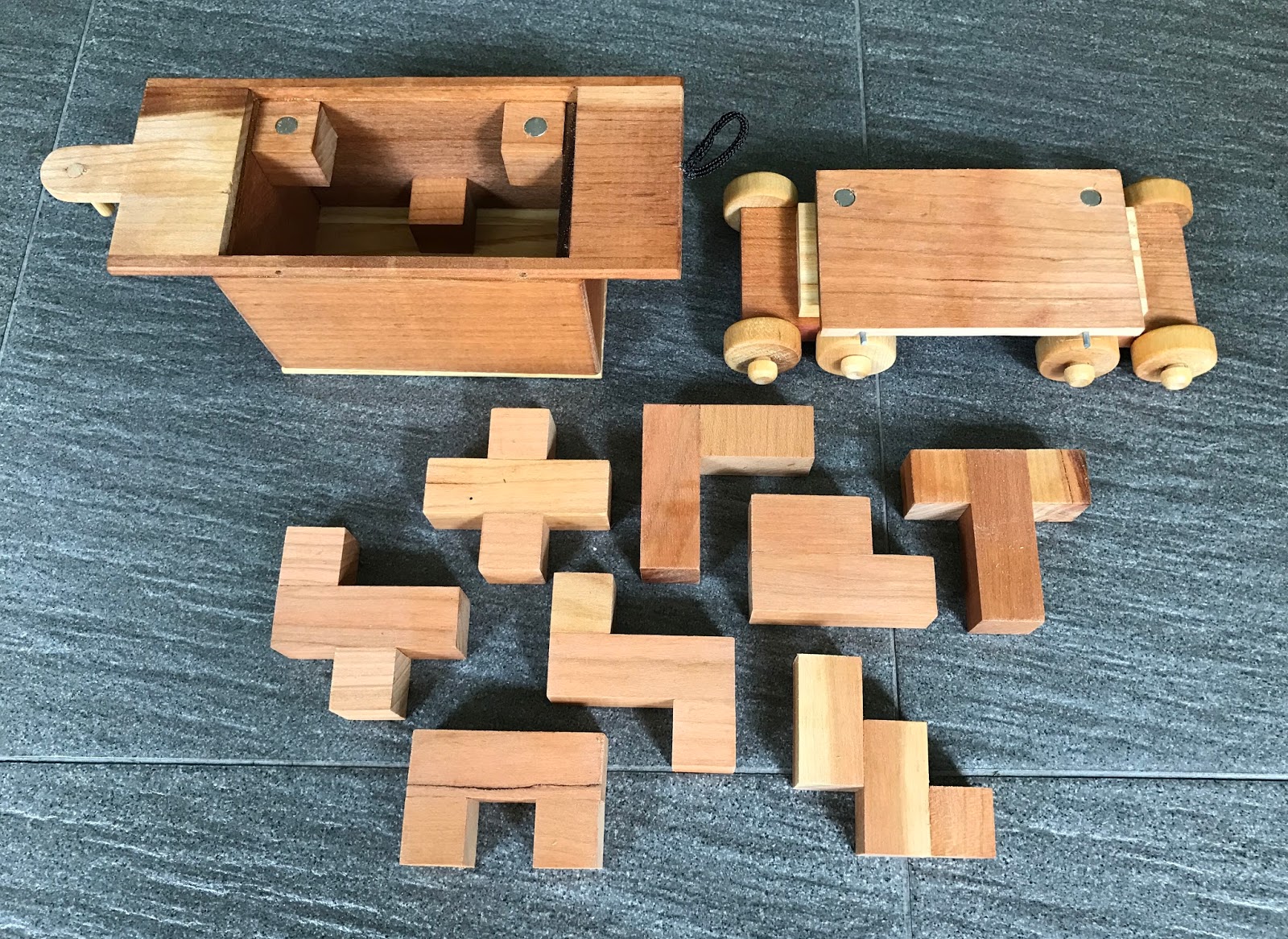
These are none other than Henry Strout's creations. The only other puzzle I have from Henry is his nice Flower String Puzzle. From what I understand, Henry started doing this series of train packing puzzles for exchange since 2013 and will finish off his series in 2018. Apparently, he's got another car/tender and an engine to complete (if anyone has more accurate information or otherwise, please PM me). 


These are fine works with wheels that spin, a simple coupler cum loop system to link train cars at both ends of each car and lids that are laser etched with the puzzle and IPP exchange details etc. The size of the train cars vary a bit but is pretty large and hefty with an average size of around 18cm x 10cm x 7cm. And all use just one type of wood (although I am not sure what it is).

All the puzzles bear the same style/theme...namely to pack anywhere between 8-10 irregular shaped block pieces into a train "car". Levels of difficulty also vary since each of the train cars or box contain different number of pieces and within each car, there are some protrusions or fixed restraining piece, which makes the puzzle that much harder. 

Each of the train packing puzzles have been/will be either designed by Henry himself, or someone else. As I joined the Puzzle Exchange only in 2014, I missed out on the earlier first train puzzle. What I have are the train puzzles for the last three years:-

IPP34
Sphinks Cargo Car
Designed by Brian Young (a.k.a Mr Puzzle Australia), 
Pack 6 pieces into the box


IPP35
Cutler Freight Car
Designed by Bill Cutler
Pack 10 pieces into the box


IPP36
Henry's Cargo Car
Designed by Henry Strout
Pack 8 pieces into the box


In terms of difficulty, lets just say these are not so easy as they seem. In fact they are pretty challenging. The hardest I think would be the Cutler Freight Car with its 10 pieces and easiest is the Sphinks Cargo Car with only 6 pieces (I know because I was able to solve the latter) and in between Henry's Cargo Car.

A nice idea to create a series of related puzzles for exchange. And for anyone who enjoys trains and/or packing puzzles, this will be an interesting addition to your collection, that is if you can get the complete set.


Monday, 30 January 2017

3 Pentagons

This past weekend, I played with Japanese puzzler/designer Koshi Arai's 3 Pentagons. The object of the puzzle is to lay the pentagon shaped (5 sided) pieces on a flat surface and form a symmetric shape. 


For this puzzle, there were not one but three solutions and Koshi had in fact (generously) shown one of the symmetric shape solutions on the instructions that came with the puzzle. The task is figuring out the remaining two. 

This is the 1st symmetrical shape solution provided by Koahi Arai
3 Pentagons was not only Koshi's IPP34 Exchange Puzzle but he also entered it for the Puzzle Design competition. His exchange version is finely made of an exotic (dark) wood (cocobolo?) and all the pieces precisely cut. 

Unless you know the meaning of "symmetrical shape", you won't even know where to begin. There are typically two types of symmetrical shapes possible, one is mirror or line symmetry and the other is rotational symmetry. In most (if not all) of these symmetrical shape type puzzles, usually the object is to find a mirror/line symmetrical shape, which is the case here.

It took me several sessions over two days to find the two solutions. What makes the puzzle so difficult is that the three pieces are pretty similar in shape (and size) to each other and this sets up a huge number of possible combinations for joining the pieces side to side; yet only three symmetrical shapes exist. What an incredible design! I am very sure there is some complicated mathematics to all this but sorry folks, I am not capable of explaining any of it here...all I know is that I tried all sorts of ways to put the pieces together and eventually got the results I wanted.

Overall a very challenging puzzle indeed and a good thing that Koshi revealed one solution at least! If anyone wants to know the other two solution shapes, please contact me via my blog email.

Wednesday, 21 September 2016

Cast Lock

The Cast Lock is one of Hanayama's recent offerings and based on the 2014 IPP34 award winning competition entry design "Cassette" of Jin-Hoo Ann from Korea. 


Shaped like a small padlock, the puzzle measures about 4.3cm x 3.1cm x 2.1cm. It consists of 4 aluminium pieces of which two "elongated" rings with notches form the shackle while the other two form the body of the lock. The objective here is to dismantle the lock into four pieces and put it back together again. Quality of construction, fit and finish is very good and there is certain "looseness" of the puzzle which I believe is intended for easy movement of the pieces. While the rings can swivel around the body of the lock pretty easily, the disassembly is anything but that.


I don't have many Hanayama cast puzzles in my collection and for those that I own, I have managed to solve most of them without any help (well, I don't have many of the really difficult ones anyway!). But sadly, this lock eluded me despite several days of on-off playing. I managed to get past what I would consider the second stage and thereafter remained stuck. And stuck for a long time. Finally I threw in the towel and checked out the video solution which some kind soul had placed on YouTube. Looking at the movements which are serial and sequential in nature, I would not have been able to solve the Cast Lock on my own. The number of twist and turns and precise moves required to un-shackle the lock is pretty confusing and mind-boggling to say the least.


This is a very difficult puzzle to take apart and Hanayama rates it 5 out of 6 stars (I think it should be a 6 out of 6). It has stumped quite a number of puzzlers since it came to the market but I know of one puzzler, blogger Kevin Sadler who has managed to solve it. Check out his review here. 

Jin-Hoo Ahn has really designed a gem. As I looked the individual pieces, they don't look that complicated but yet the sum of the four parts result in a very challenging puzzle requiring a lot of effort to solve. This is one of those prime examples of "less is more"? If you want a really difficult take-apart puzzle, the Cast Lock is one that will provide a lot of value for money. Outside of Japan, its presently available from PuzzleMaster of Canada.

Sunday, 10 July 2016

Square Dissection

I don't normally spend too much time on a single puzzle, because I have many puzzles in my collection (a lot of them Exchange Puzzles) that I have yet to go through. From my last count from two exchanges, I have still over 140 more which are untouched. I know there are those who persist with a single puzzle for weeks at an end, eg Kevin Sadler and I truly respect their efforts! But I am not one of them. 


But Square Dissection got more than my usual fair share of attention because firstly I quite like packing puzzles and secondly, I also enjoy designing them and producing working copies in plexiglass for myself or for sale. So when I selected Nick Baxter's Square Dissection from my stash, which was his IPP34 Exchange Puzzle, and thinking to myself that its JUST 9 ordinary rectangles into a tray, I decided to test my solving powers on his design....and failed quite miserably!

First the specs...the tray measures 9.5cm x 9.5cm x 0.6cm. The pieces are all rectangles with differing measurements for each like 18x20, 24x25 etc. These are not actual measurements but unit values of the length x width of the pieces. Both tray and pieces are made of translucent red and green acrylic/plexiglass. Everything is laser cut to perfection...and tight tolerances are indeed needed for this puzzle! 

The goal is to place all the 9 green rectangles into the tray with none of the pieces sticking out. Your regular 2D tray packing puzzle right? Yes, but nothing regular about it. In fact after trying for several days on and off and not getting anywhere (there is always just one last piece that refuses to go in), I did what I usually advocate; that is to ask the designer for help. Nick came back with a series of questions which were actually hints on the solve. Needless to say, these hints were lost on me and another round of email exchanges resulted in yet more hints. Still no luck and a couple of weeks later, I threw in the towel and asked for the solution. Damn...everything fits so easily and nicely into the tray! Actually there is a bit more to this puzzle that meets the eye but I shan't mention anything more here as I don't want to have any spoilers for those who may still be tearing their hair out over the Square Dissection.

This puzzle may look innocuously ordinary, but there is a lot of "mathematics" behind the design and IMHO, very difficult and challenging. According to Nick, there are 23,224,320 ways to lay the pieces in a 3x3 format but only one will enable the correct fit inside the tray. And before I forget, don't waste your time with Burr Tools, it won't work.

For hardcore packing fans, this is a must have! Dave Holt, hope you are reading this. Go for one!


Tuesday, 28 June 2016

Maker Faire 2016

Last Sunday I spent a nice afternoon at Maker Faire 2016 which was held on the grounds of the Singapore University Of Technology & Design. I was invited by David Ang of Cubewerkz to share his table to showcase some of my own puzzle designs. In preparation for this event, I had produced a number of copies each of five of my 2D packing puzzle designs plus one from Rex Rossano Perez. I also added two other designs I had produced from last year; Goh Pit Khiam's Triple Play (my exchange puzzle for IPP34) as well as my SG50 puzzle.

Clockwise from top right corner - Turtles, 4 Ducks & A Duckling (my IPP35 Exchange Puzzle), Digi-Hex, Jurassic Pack, No Pushing (by Rex Rossano Perez) and Double Happiness

From Left - Goh Pit Khiam's Triple Play and SG50

The table David had was rather small and he had piles of twisties for sale, including a number of scientific and educational toys as well. But I was extremely fortunate that the table next to ours was vacant; the vendor/maker who rented it had decided not to show up, so I gamely shifted my puzzles over and created more breathing space for both David and myself. 


The fair started at 10am in the morning and ended at 6pm in the evening. However, I had sold out all of my puzzles by around 4:30pm in the afternoon and had to "close shop" for the day. It was a very interesting day as I interacted with the folks who visited my table and tried their hand at puzzling. For many it was the first time they had come across mechanical puzzles, let alone 2D packing puzzles. 

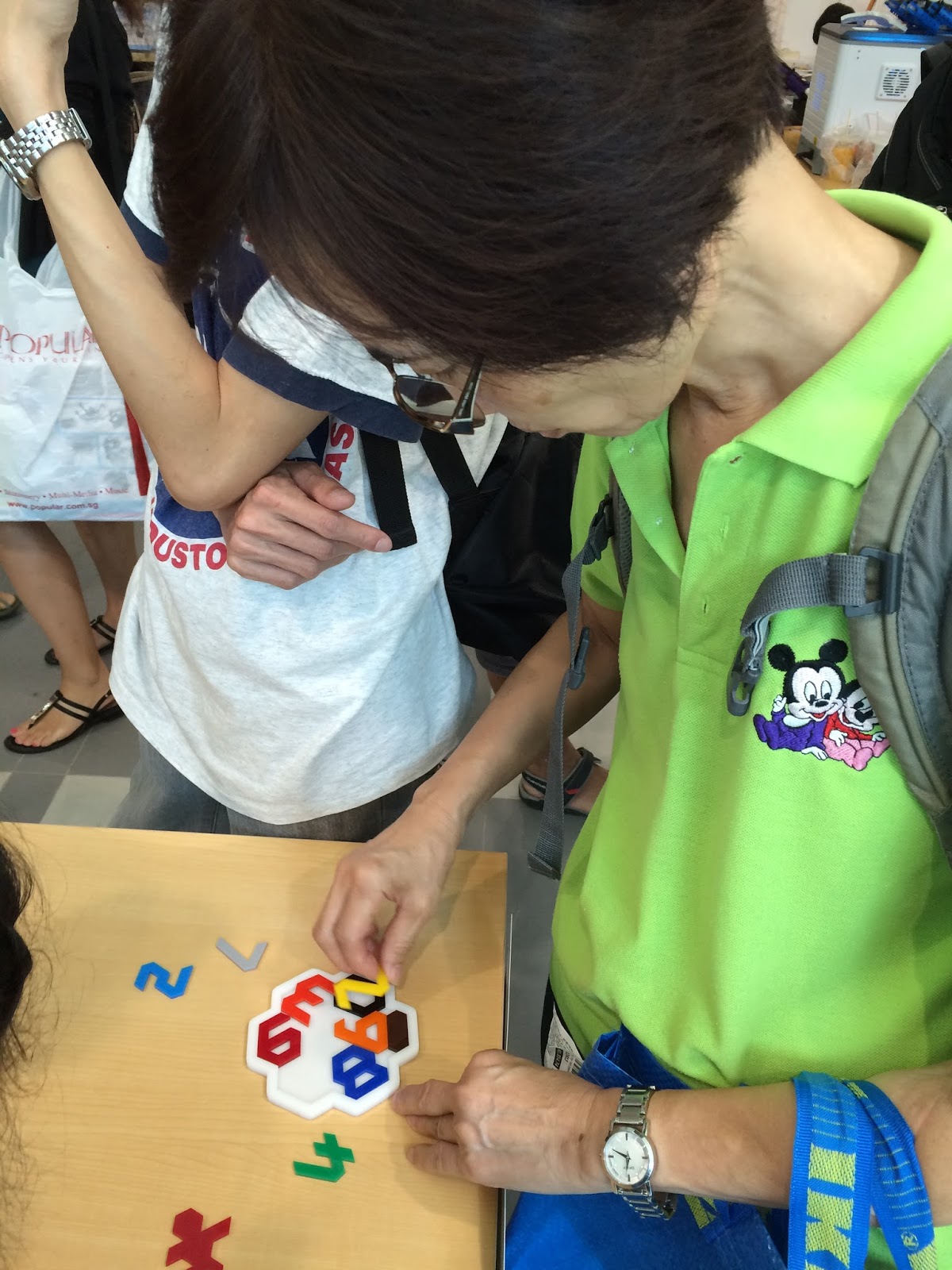
Surprising (or perhaps not so surprisingly, the majority of people that visited my table and played with the puzzles were kids and youths, some as young as 4 years old. Many of the children were probably fascinated with the colourful pieces I had purposely created along the animals theme. Without doubt my Jurassic Pack was one of the most popular, a 4 piece packing puzzle with a dinosaur theme. Some kids stood in front of my table for over an hour tirelessly trying to figure out the solutions. In terms of adult puzzlers, there were very few, less than ten or so who showed any keen interest, including a 67 year old grandma who was rather intrigued by my 4 Ducks & A Duckling. Most of the adults who were there were there just to pay for my puzzles for their kids! Now I am now wondering if there is a kid's market out there for puzzles in Singapore? Something I will definitely look into.

I am currently producing more copies of the above puzzles to fulfill some back-orders I received at the fair. If anyone is interested to buy any of the above, please PM me. 

Saturday, 18 June 2016

Push Box - Two

This weekend's puzzle play was "Push Box-Two" designed and made by IPP34 award winning neurologist Dr. Simon Nightingale from the UK.


Push Box-Two is made entirely from Corian again and I really like the choice of material because it gives the puzzle the smooth cool feeling of stone/concrete; and weighty too. Only drawback is that it might crack and break if dropped from too high up. Push Box-Two is physically similar to Simon's IPP34 exchange puzzle, the "Push Box". 

But it is of a different colour this time, a sort of a light beige. And of course the mechanism is different from its predecessor. It measures the same 6.3cm all round and the object is to open the spring loaded drawer. Very well made and high quality.

Again I have to admit that I managed to open the box without really fully understanding how the mechanism works although I know there are bits of moving parts (ie sounds like ball bearings) inside causing a rattling noise which keeps the "drawer" locked in place. 


Simon had previously sent me the solution to his earlier Push Box so I had a slight inkling as to the method of solve for Push Box-Two. But this didn't help much and I spent a bit of time turning and tilting the box and pushing here and there, a lot at random, before the box suddenly popped open. The drawer doesn't come out all the way (unfortunately) so there is no way I can inspect the internals of the puzzle. Unless of course I crack open the puzzle which would be a silly thing to do of course. 

Tuesday, 31 May 2016

Star Beams

This cute and colourful puzzle came courtesy of Dutchman Oskar van Deventer during the IPP34 Puzzle Exchange in London in 2014. But its an old design which dates back to 1989.


Oskar is one of the rarer prolific designers who is comfortable with both puzzle genres; the twisties and non-twisties and amongst the non-twisties, he has designed over a dozen of the Hanayama Cast puzzles to-date including the Cast Twist and Cast Nutcase. He has also designed some unusual ones that include his Boston Subway and Snakes In A Plane.

Star Beams is an interlocking puzzle consisting of six "beams" produced by 3D printing. Overall quality is good. As described on Oskar's Shapeway shop:-

"The puzzle has six pentagram-shaped beams that are woven through each other. It was in 1989 that Oskar discovered this geometry. It is based on the geometry of a regular dodecahedron (with twelve pentagonal faces). When each of the six axes is offset a bit, this nice tetrahedral geometry results" 

The entire assembly is held together by one beam that cuts through four others.


The object of course is to take it apart and put it back together. Don't let the cute and colourful form factor fool you. While its not difficult to figure out how to take it apart and I got this done rather quickly, the putting together proved impossible for me. Even with the aid of photographs taken along the way, I had a lot of difficulty trying to assemble the lot. The notches and grooves are precisely cut and if you mesh the beams together the wrong way, you have to re-start. Of course given that the puzzle is rather small (each beam is 5cm) made it very fiddly and difficult to handle as well.

Check out Oskar's youtube video of the Star Beams (too bad it doesn't show the solve). Its available from Shapeways for US$38.43 as well as Puzzlemaster, the latter much cheaper at CA$29.99. 

Thursday, 26 May 2016

Octassembly

Here's a second puzzle I played with designed by Bill Sheckels and exchanged by Norton Starr (what a cool name! And nice guy too!) at IPP34 in London two years ago. The earlier one was the Packed Pyramid, this one's called Octassembly.


This puzzle comprises 6 odd shaped pieces made from Zebrawood with a very nice stripey surface. There are three different shapes and each has one identical pair. All nicely cut! The object here is to form an Octahedron. Now if you don't know what an octahedron is, like I didn't at the beginning, you probably won't know even where to start nor what to do. I know its got something to do with eight tho'. Thanks to the internet....this is an octahedron. Basically two 4-sided pyramids joined together at the bottom.


From the puzzling point of view, its not too difficult...once you know what shape you need to form. But the way the pieces have been cut (and I am sure there is some mathematical aspect to this...don't ask me what it is) make it a tad tricky. Quite amazing how the odd looking pieces can form a symmetrical 3D object.

Overall a really nice good quality shape-forming puzzle that is just the right level of difficulty for an Exchange Puzzle, something you can solve in minutes rather than hours. PM me if anyone wants to see the photo solution

For anyone interested, the Octassembly, is available from Bill via his Etsy puzzle shop mentioned above. And it cost US$21/-

Sunday, 3 April 2016

Ladybird

Name
Ladybird


Designer
Robrecht Louage. Designed in 2014. For his other puzzles including his IPP31 award winning 4 Steps Visible Lock, click here.

Manufacturer & Availability
Produced in collaboration with collector Michel Van Ipenburg. There may still be some copies available from either gentlemen. PM me if you are keen to get a copy.


Type & Classification
Sequential movement; route finding.

Dimensions
16cm (incl the antennae) x 11.5cm x 1.5cm

Materials & Construction
Acrylic, tespa, steel screws and a 1 Euro coin. Construction fit and finish is excellent and all the parts move smoothly with no jamming. 


Overview

Robrecht is very well know for his "remove-the-coin" maze puzzles. And the best part is when you buy one of his puzzles, you get a 1 Euro discount! 

Unlike his other trapped coin puzzles, the Ladybird ups the ante in terms of sophistication of design and aesthetics. This time Robrecht encapsulates his puzzle within a ladybird design. 

Another main difference is that the Ladybird allows for some visibility of the maze route, hence you can see and feel your own progress. However, the Ladybird is no easier because the puzzle involves a double layer maze.

The goal is to navigate two pins (connected to the two antennae) along both maze channels, by manipulating the two maze plates either clockwise or the opposite. Upon successful completion, you are rewarded with the 1 Euro coin that leaves through the circular cut-out on the top cover.


Difficulty

Moderate difficulty but tricky at times. The starting steps gives you a feel of what you need to do. I found that somewhere about a fifth along the way, If you do not get both pins in their right respective positions within the maze channels, you will find yourself stuck much later on and this would require an almost full backtrack. If you are lucky and get it right near the beginning, navigation becomes quite a breeze for a majority of the way. It took me a couple of attempts and one or two backtracks to finally extract the coin. 

Overall a fun puzzle and one of those that once you pick it up, you won't want to put it down until the coin comes out. Done correctly, it doesn't take too long to solve and reset. A really beautiful and interesting looking puzzle.

Wednesday, 2 March 2016

Twelve Bow Ties

Name
Twelve Bow Ties


Designer
Wayne Daniel

Manufacturer & Availability
Produced by Wayne Daniel


Type & Classification
Interlocking Solid

Dimensions
5cm x 5cm x 5cm

Materials & Construction
All wood and what appears to be cherry and walnut, the latter for the bow ties. Very well made with fine attention to detail and cutting, for such a small puzzle. Everything slides smoothly as intended.


Overview
Twelve Bow Ties was Marti Reils' IPP34 Exchange Puzzle in London. This puzzle takes the shape of a polyhedron with 12 faces and is known as a dodecahedron. Each face is itself a pentagon. 

The object of the puzzle is to take it apart and put it back together. The puzzle comprises of 8 pieces (with 2 sets of 4 congruent pieces each). Each of the pieces has grooves, notches and "bow tie" protrusions and the pieces slide and interlock against each other in the most amazing way. At first glance, you may even mistake it for an impossible object but not really, as the puzzle can be taken apart from different angles and directions depending on on which face of the puzzle you start from. 

Difficulty Level
Given the way its been cut, can be a bit tricky to put back together, if you totally scramble the pieces. The puzzle first splits into half and then into quarters and so on, so its best to try to remember which pair of pieces go together. 


Friday, 26 February 2016

Baffling Bolted Book

Name
Baffling Bolted Book ("BBB")


Designer
Louis Coolen & Adin Townsend

Manufacturer & Availability
Produced by Allard Walker (but all 3 gents had a hand in doing the modding and fittings with Louis doing most of the work!)

Type & Classification
Trick Opening/Take-Apart/2D Packing

Dimensions
18.2cm x 12cm x 3.8cm 

Materials & Construction
The puzzle is actually a box which has been made to resemble a book and I believe the box is commercially available. Made of plywood with canvas wrapping. The 2D packing puzzle is laser cut acrylic.


Overview
This is one of the more unusual looking (and rather large in size) puzzles at the IPP34 Puzzle Exchange and it was fellow puzzle blogger Allard Walker's exchange puzzle. The BBB follows the theme of his previous year's (IPP33) exchange puzzle the Conjuring Conundrum where an available object (in the case of the BBB, a box-book) is fashioned and modified into a working mechanical puzzle. 

Like the Conjuring Conundrum, the BBB offers two challenges. The first and easier (not easy) task is to open the box. The second is to use three pieces stuffed in a bag inside the box to make a line-symmetrical shape in a frame that is attached to the underside of the lid.

This is a sequential discovery puzzle where you are required to use whatever's in the puzzle (eg; tools etc) to solve it. No external implements or tools are allowed. To open the box requires approximate 7-8 steps. After about 3 steps, the lid opens partially and you get to have a bit of a glimpse of the inside. An a-ha moment! You can just about see a cloth bag and a card which holds the acrylic pieces for the second challenge but not more. From here, the difficulty increases. Not easy moving forward and it does require you to do some thinking how to use what's within the box to progress further. The next 4-5 steps if executed correctly will release the lid fully and bring you to the second challenge, forming a line-symmetrical shape inside the frame.


In case you are wondering what's a line symmetrical shape...simply put is this...if you draw a straight line over the shape you have formed with the three pieces and if the shape is the correct intended shape, you will get a mirror image on the left and right side of the line. Although its only three pieces, this 2D packing challenge is tough because you not only have to firstly form a symmetrical shape, but you need to form one that fits inside the parallelogram shaped frame. There are several symmetrical shapes to be found but only one which will fit inside the frame. Here is what makes the second challenge so very difficult, despite only having three pieces. Took me a while to figure this part out. I will not link the solution here but will provide it via email upon request.

Difficulty Level
For sequential discovery puzzle lovers, this is a pretty good one with some tricks here and there. Need to be careful or might miss some things. Not overly difficult but by no means easy either. For the 2D packing challenge, very difficult and can be a real pain! Not that many symmetrical type puzzles out there and this one is really a toughie.


Summary
A very nice, unusual and well executed exchange puzzle which provides two challenges in one puzzle. The BBB is available in limited quantities from puzzle purveyor Wil Strijbos. The 2D packing challenge is also available as a standalone puzzle (called the Symmple Puzzle; what an understatement! and designed by Adin Townsend) and available from Louis Coolen.