Showing posts with label IPP33. Show all posts

Saturday, 22 July 2017

Sliced Puzzle Ball

The Sliced Puzzle Ball (SPB) designed by Vesa Timonen is probably one of the smallest interlocking puzzles around and certainly the smallest in my collection. 


I had met Vesa the first time during IPP33 in Tokyo, Japan and he was really very kind to gift his SPB (his Exchange Puzzle) to me. Measuring only a micro 16mm in diameter, it consist of 6 flat "board burr" pieces with curved edges and when joined together becomes a perfectly round ball. The SPB comes with its own nice little felt-lined gift box.

Sliced Puzzle Ball next to Cast Loop
In case you don't know who Vesa Timonen is, he is a well-known designer of a number of Hanayama Cast Series puzzles including the Infinity and the famous Loop. I also have one of his less common (but unusual) puzzle called the Onion.

My copy is made by Shapeways out of white and pink dyed nylon. The SPB is currently also available (at a much larger size of about 3+cm) for sale together with some of Vesa's other puzzles listed.


When I first played with it back in 2014, I struggled with the solution and couldn't figure how to disassemble it without breaking anything...it seemed so fragile! Needless to say, the handling of such a tiny puzzle was extremely fiddly and I kept dropping it out of my fingers.  I emailed him for a solution but Vesa didn't have a step by step one instead he directed me to his Shapeways listing which showed the 6 pieces separate in an exploded view. He also indicated that some force may be necessary for the initial move. Even with that, somehow things appeared to be stuck and I couldn't take the ball apart. 


Fast forward 3 years later and this second time round, I gave the SPB another go. I finally managed to take it apart, albeit with some force... the nylon is surprisingly resilient! Thankfully nothing broke. Putting it back together was unexpectedly much easier and strangely it didn't require any force...the pieces "just slid together" back into the shape of a ball, once the pieces were in their correct orientations and positions.

I tried to configure the puzzle using Burr Tools but the programme didn't come up with any solution. Again, not sure if I got the specs correct into Burr Tools. Maybe that's why the need for some force!

Thursday, 9 March 2017

Urashima's Box

The Karakuri Creation Group from Hakone, Japan is very well known for their fabulous and superb quality wooden puzzles and puzzle boxes. Equally well-known is that every year in the weeks leading up to Christmas, they will ship out their "Christmas Presents" to those who have joined the "Karakuri Club" and pre-ordered puzzles from a panel of designers, as early as the beginning of the year. 


The puzzler selects the designer(s) of his choice, but would not know what sort of puzzle he/she will receive from their selected designer(s) until it arrives. It's a "surprise" to say the least! Not a cheap affair as well considering each puzzle is about US$100/- and there are usually an average of about 8 presents available per year. A full set will set you back about US$800/-. 

For the rest of the year, the Karakuri Group designers release various designs and these puzzles can range anywhere from US$125/- to well over US$1,000/- a pop. Expensive would be somewhat of an understatement, but the design concept, theme, craftsmanship and attention to detail is simply incredible. Take a look around their site and you would know what I mean. From a puzzling perspective, some puzzles are pretty simple and provide little challenge for seasoned puzzlers but some designers like Hiroshi Iwahara create extremely challenging pieces.   

Aside from exquisitely crafted puzzles, Karakuri also retails wooden puzzle kits. The one shown here is the Urashima's Box, which I purchased during IPP33 in Tokyo several years ago. I have had it for quite a while and totally forgotten about it until recently.


The kid is made of plywood and while there is nothing exotic about plywood, the pieces are very well cut and precise. It has even got a nice woody scent to it. It costs only about 2,000 Yen (US$17.50) but the quality is very good.

The kit comes un-assembled of course and this one has 16 pieces including the string. When fully assembled, it is a trick opening box. everything you need is in the kit except glue and here I used an inexpensive wood glue called Wessbond White Glue which dried quickly and gave good results. Smears and stains were easily cleaned off with a damp tissue. There is no need to go for epoxy and other fancy glues for this sort of work.

Although the instructions are all in Japanese, the diagrams are easy enough to understand for the assembly of the box and no translation needed. It took me no more than half an hour or so to glue all the parts together and another 6-7 hours or so for the glue to dry properly. The finished product was strong, sturdy and nice to look at, especially with the ribbon tied.

I don't think I need to explain the object of the box here and from photos i think you can quite guess how the mechanics of the puzzle works. So if you can't afford or don't want to shell out the dollars for the ala carte puzzles on their Michelin-starred menu, you can still own a Karakuri puzzle...get a kit! They are great fun and relatively easy to build and will astound your non-puzzling friends for sure!

Wednesday, 15 June 2016

Heat Wave

As I was trawling through my box of IPP35 Exchange Puzzles (hoping to find something interesting and not too difficult to play with), I came across Yee Dian Lee's puzzle called Heat Wave. 


My prototype on the left and Yee Dian Lee's Exchange Puzzle on the right

Heat Wave is one of many 2D packing puzzle designs from Goh Pit Khiam. Goh has designed a number of 2D and 3D packing puzzles including some award winning ones such as the IPP33 Puzzlers' Award Dancing Shoes as well as two Honourable Jury Mentions during IPP35 for his Road Blocks and Number Blocks. Very prolific indeed!

Prior to receiving Yee Dian Lee's puzzle, I had already obtained Goh's Heat Wave design a couple of years earlier and with his permission had laser cut a prototype copy for myself based on an even earlier prototype wooden laser cut copy made by Walter Hoppe for Goh. In keeping with the name of the puzzle, I chose bright yellow and red acrylic for my copy!

Goh's original version has 5 pieces which has to be fitted into the tray that has a covering on the top with a square hole that the pieces have to go through. Lee's exchange version is the same design, except that his has an additional small square 6th piece and Lee's top covering has dimensionally smaller square hole than the original design. Lee's version also has a transparent cover to better let you see how the pieces form up inside the tray.


Beautifully laser cut and great attention to detail
with the pieces each having their own slots at the back

Heat wave is not an easy puzzle at all and I needed Goh's help to solve his version back then. Hmm...maybe things may have been less frustrating if I had used a clear cover instead. Lets just say its not your typical packing puzzle (those who have played with Goh's puzzles would know what I mean) and a number of "unusual" moves are required to fit all 5 pieces into the tray underneath the cover. Can't say more without any spoilers.

With a transparent cover, I feel Lee's version is a tad easier since you can see your progress or mistakes as you move along. Although it's actually meant to be harder than the original. But to be fair, I had played with the prototype previously. A newcomer may find it very challenging indeed. And as Heat Wave was one of my earlier packing puzzles from Goh, it did give me the experience necessary to later solve his other packing puzzles such as Retrofit and Fusion.

A great (and difficult) packing puzzle, unfortunately none commercially available except Lee may have some spare copies left over from his Exchange.


Wednesday, 27 April 2016

Chain Store

Name
Chain Store

Designer
Goh Pit Khiam


Manufacturer & Availability
Crafted by Tom Lensch. Limited copies may be available but I can't be sure. PM me if interested.

Type & Classification
3D Packing

Dimensions
Box is 5cm x 5.7cm x 6cm. Each of the links in the chain is 4.7cm x 3.1cm x 0.8cm.

Materials & Construction
Box is yellowheart while the chain links are cherry. Excellent construction, fit and finish. Tolerances are just right and everything fits nicely.  

Overview
Chain Store is an old design from Goh Pit Khiam and it wasn't until recently that working copies of the puzzle were produced. The goal is simple; to fit the chain links (which are all interconnected and you can't separate them) into the box flush with the top. Hence the very appropriate name "Chain" - "store". It's been described by John Rausch as a "one piece packing puzzle"...well, quite literally true isn't it?

The links when stretched out look rather long and it is obvious that you can't just stuff them into the box. Because of the tight tolerances, any attempt to force in the links would most certainly result in jamming (and probably damage as well). According to Goh, there is only one solution to pack the links in. Sorry but Burr Tools doesn't work here (even with the "grouping" function).

It is clear that the links must somehow be grouped together in a certain way to take up the smallest and correct size footprint in order to fit into the box just nicely. The links can be rotated in different ways and this is a necessary part of the solving process. But this arranging and grouping of the links is no walk in the park, despite only 5 pieces. In fact it is darn right difficult and I found myself trying a great number of combinations to no avail. Always, one link would be protruding a bit and refuse to go in the box. This puzzle requires you to solve the links outside the box before insertion.

Difficulty
Very challenging puzzle. I don't know whether it was just my lucky day or not, but I managed to solve it in about 40 minutes. Got the 5 links all in their correct positions and popped it into the box. Still, I can imagine some puzzlers would take much longer than that. At the request of Goh, I have not placed a link here to the photo solution. 

Summary
Goh has designed a number of challenging and interesting packing puzzles, including IPP award winning ones such as Dancing Shoes and Road Blocks. But Chain Store is perhaps the most unusual and unique amongst them. A fabulous puzzle with a great design concept.  A must-have in any collection.

Sunday, 10 April 2016

Of Symmetry And Shapes

This weekend's puzzle play consisted of Symmetrick from Vesa Timonen of Finland and Four Triangles Five Shapes from Emrehan Halici of Turkey. 

Symmetrick

Symmetrick was a Top 10 Vote Getter during the IPP33 Puzzle Design Competition in Japan. It was also Vesa's exchange puzzle during IPP32 the previous year. In case you didn't know, vesa is a very prolific designer with a number of Hanayama Cast puzzle designs to his name.

Comprising of just two irregular shaped pieces made of Finnish Curly Birch wood in a raw finish, the goal here is to form a symmetrical shape. The instructions are clear....to place the two pieces on a flat surface to form a symmetrical shape...no tricks, no silhouette, hole in centre and the like.


One would wonder how difficult can that be with just two pieces right? Wrong...it is in fact a rather difficult puzzle, more so if you don't even understand what a symmetrical shape refers to. 

During IPP33 itself, I had already seen quite a number of puzzlers in the competition room trying to figure this one out.... and many couldn't solve it even by the end of the event. All round it received a lot of positive comments. I took about a couple of hours before hitting the jackpot. Please PM me if you would like to see the solution...it's really quite unexpected.

Symmetrick IMHO is really an example of a great puzzle design, so simple and innocuous looking with just two pieces, yet very challenging. For those who love this sort of shape forming puzzles, its a must have. Available from Mr Puzzle Of Australia and Sloyd of Finland.

Four Triangles Five Shapes

This puzzle came courtesy of Emrehan Halici. I had a privilege of meeting Emrehan the second time during IPP35 in Ottawa last year and his Four Triangles Five Shapes (FTFS) was his exchange puzzle to me.

The FTFS is made of 3mm red laser cut acrylic. The four pieces comprise of four triangles of different shapes. Nicely cut and pretty large pieces so easy to handle.


There are five different tasks here (hence the name "five shapes"). Using all the triangles to make the following shapes:-

1. 3 different Pararellograms
2. An Isoceles triangle
3. A Square

I was able to make just one of the parallelograms, the isoceles triangle and the square...or so I thought. I shot an email to Emrehan for the solutions to the other two parallelograms and when he replied I was in for a shock; I had only gotten the square correct!

How difficult is the FTFS? Well, I only managed to solve one of the five shapes, despite just four pieces. I would rate it as very challenging indeed. As this one is an exchange puzzle, it's only available from the designer (assuming he has any left), so please PM me if you would like to get a copy and I will link you up with Emrehan.

Monday, 28 March 2016

Pyramida

Name
Pyramida


Designer
Frederic Boucher

Manufacturer & Availability
Produced by Frederic in 2012. May still be available in limited quantities. For anyone interested please PM me.


Type & Classification
Dexterity


You rarely find this sort of detailed instructions with a puzzle

Dimensions
8.5cm x 8.5cm x 2.7cm

Materials & Construction
Aluminium, glass, cherry wood, steel. Very well crafted and put together and Frederic has chosen glass instead of acrylic for the cover, which adds a touch of class to the puzzle.

Overview

It would be an understatement to say that Frederic Boucher is a versatile designer. While there are designers who focus and are good at one category of puzzles, burrs for example, Frederic has designed puzzles in several categories including burrs, packing, impossible objects and dexterity puzzles. 


This is my second dexterity puzzle from Frederic after his Manholes 55 the latter which was his IPP33 Puzzle Design Competition Entry.

The Pyramida has one simple task; Arrange the 10 marbles (4 green and 6 red) inside the box to form pyramids of different colour configurations. The puzzle comes with a total of 36 challenges. For 12 of the 36 challenges, 2 reds and a green are swapped with 2 yellows and a blue that comes extra with the puzzle. You will need to unscrew the glass cover to do this, but fear not; Frederic also supplies a screw driver and extra screws and printed instructions (although' in Japanese) for the task. What great attention to details!

Difficulty

While some of the 36 challenges look easier than the others, even the easier looking ones are not. It may look simple to swirl the marbles around inside the box to try to achieve the desired colour pyramid but believe me, it is anything but that. The marbles don't behave like you want them to. I only succeeded in getting a couple of the challenges right. The marbles are much more difficult to stay atop one another thank you think. A gentle touch is definitely an advantage for play here.

I can only imagine the ones involving the yellow and blue marbles are even more difficult given there are now 4 different colours inside the box.


Challenge #33 which I managed to solve
Summary

For anyone who enjoys dexterity puzzles, this one is a must-have. Not just a single challenge as in most of the dexterity puzzles out, but 36. And all in one very attractive and superb quality package. 


Thursday, 21 January 2016

Fusion

Name
Fusion


Designer
Goh Pit Khiam. 

Manufacturer & Availability
My copy was made by Eric Fuller. A total of 39 copies were made and sold for $57 each. Currently none available.

Type & Classification
2D packing 

Dimensions
3.8in x 3.8in x 0.8in

Materials & Construction
The tray is made of Maple while the pieces are Yellowheart, Bubinga, Paduak and Walnut. The tray has a top and bottom transparent acrylic cover. Construction and quality as usual is first rate with everything precisely and accurately cut.


No spoiler here showing the solved state, since the
challenge is to pack the pieces into the tray
Overview
This is another Goh Pit Khiam classic, following the likes of Retrofit and the IPP33 award winning Dancing Shoes. Puzzlers who have played with Goh's packing puzzles know that they are always in for a surprise since Goh's packing puzzles are anything but the typical.

The object is to pack the 5 pieces (4 which are identical) into the tray. The tray has a clear cover with a square hole the size which is just enough for each of the pieces to go through.

Difficulty Level
IMHO, more than moderately difficult but very tricky. Fusion is by far the most challenging of the three, as compared to Retrofit and Dancing Shoes. It took me a while to figure this one out. For anyone who has not experienced a Goh packing puzzle, he/she may take a really long time to solve Fusion, or not even at all. Again, some thinking outside the box (tray) is necessary here but ultimately, what needs to be done is inside the tray that matters.

Summary
Some folks are good at designing high level burrs while others are good at designing packing puzzles. Fusion is another great design from someone who manages to do both well. 

Wednesday, 2 December 2015

Here's A Sharp Looking Puzzle!

If there was an award at IPP35 for an Exchange Puzzle with the most original design, I think it should go to David Litwin's "Straight Up".


The "Straight Up" looks just like a real traditional shaving razor and comes nicely packaged in an attractive box too. Its made of laser cut acrylic and David has chosen a pearlescent finish for the handle to give it an authentic look. Very nicely made indeed!


As you might guess, the object is to unfold the "razor" and expose the "blade". Not that simple, because the blade is restrained in its handle by a locking mechanism. To unlock the blade fully, you need to navigate a" maze" (forming the words IPP) cut into the blade. This took me a couple of minutes of trying before I got it out; because you can't really see clearly all that's happening within, although you know what's there and needs to be done.


Notice anything special about the maze?
To return the blade to its folded position, its the reverse but I found this step a tad harder even though now all is exposed and you can see how the blade is to be locked back into position and what goes where. A bit of dexterity here and there is also required.

Overall, not that difficult to solve with some trying, and certainly not as challenging as David's previous (IPP33) Exchange Puzzle, a packing puzzle called City Block. But very unusual, neat idea and a "sharp" looker!

Friday, 16 October 2015

Yee Dian Lee - Puzzle Books Collector Extraordinaire

Its always nice to get together with fellow puzzlers/collectors and last week while I was in Kuala Lumpur, Malaysia for business, I had the pleasure of having dinner with Yee Dian Lee at his home and spending a great evening with him talking about puzzles and admiring his extensive collection.


The puzzle den is actually longer than what the photo shows
Some of you puzzlers would know Yee Dian pretty well, especially those who have attended past IPPs. Yee Dian attended his first IPP at IPP12 in Tokyo in 1992, over twenty three years ago. Since then he has not missed a single IPP to-date! I had met Yee Dian the first time over three years ago at IPP33 in Japan and since then we have regularly kept in touch. it was only now that I paid a visit to his home and see vast puzzle and puzzle books collection.

Yee Dian is an Electrical Engineer by training and graduated from Osaka University, Japan. Professionally he a corporate trainer working mainly with various Malaysian government departments. Apart from mechanical puzzles, Yee Dian is also the Testing Procter for the Malaysian Mensa as well as Secretary of the Malaysian Sudoku Society. 

I was hosted to a sumptious dinner by Yee Dian and his lovely wife, the meal home-cooked by Yee Dian's mother-in-law. Thereafter I spent the rest of the evening in his puzzle room. As I ascended halfway to his puzzle room, Yee Dian's puzzle vessel collection greeted me. It occupies an entire wall and the cabinet houses several puzzle vessels/pots from all over the world. What a sight to behold!

Puzzle vessels galore!
Yee Dian's puzzle den occupies the better portion of the third floor of his three storey house with both sides lined with shelves from floor to ceiling. The right shelves comprise mainly of puzzles and some books while the left are almost all puzzle books. I have never seen so many puzzle books in my life!

His IPP Exchange Puzzles, which number over 2,000 are not in the same puzzle den; there is just not enough space for them. Instead they are kept in boxes (all marked and numbered by year/country) which line one side of the corridor leading to his daughter's bedroom. 

Yee Dian does not just collect mechanical puzzles (his main interests being puzzle vessels and interlocking) but also focuses on puzzle books. While his mechanical puzzle collection numbers several thousand (he says he has lost count), his puzzle book collection is well over 5,000 titles! They are in several languages including English, Japanese and Chinese. 

Outside of Japan, Yee Dian has the largest private collection of puzzle books in South East Asia. A real treasure trove of puzzle literature acquired over many years with each and every title/details recorded meticulously. His passion is hunting for rare puzzle books both on the internet and when he travels abroad.


All puzzle books here
To go through just his mechanical puzzles alone, it would probably take a whole week. Yee Dian recounted to me that there was once a European collector (a pretty well know name in the puzzle community whom I shall keep anonymous) who visited some years back; he had spent three days in the puzzle den only coming out for meals and toilet breaks. Yee Dian welcomes any puzzler visiting Malaysia to drop by his home for a visit. Nowadays I go to Malaysia for business quite regularly. I am already looking forward to my next trip!

Well, enough said, I will let the photos do the rest of the talking....

Ultra rare puzzle books on this shelf


Notice some of the wooden puzzle boxes at the lower right?
These were from Akio Kamei before he became famous


Yee Dian and I exchanging gifts. 
I received a very nice puzzle vessel (a wine pot) 
which will be the subject of a future blog post

Sunday, 13 September 2015

Helical Burr

The Helical Burr was Derek Bosch's second "cylindrical" burr design. Prior to the Helical, he had the Tubular Burr. Subsequent to it, he came up with the Hellical Burr which by various accounts is horrendously difficult and his fourth design, the W(h)orl(e)d Burr. Being in the puzzle community I was aware when each of them hit the market. I am lousy at burrs and since I am not even good at the normal square ones, I gave the miss on these cylindrical burrs at that time. But when I saw several of them being displayed for sale on Steve Nicholls' table during the IPP35 Puzzle Party and how beautiful and colourful they looked, I just had to go for one and chose the easiest of the lot, the Helical Burr.


Derek's Helical Burr also won him the Jury's Grand Prize at IPP33 in Japan in 2013. At that time, the competition puzzle was in prototype form made of SLS nylon and didn't look that great. But the copy that I have today was 3D printed by Steve and looks gorgeous in red and black. Not only that, its larger than the prototype, well made and feels very solid with a textured finish for better grip. In fact while playing with it, once I dropped it several feet onto my tiled balcony floor but nothing cracked or broke; 3D plastic is pretty tough! In terms of the movement of the pieces, while the sliding is not as smooth as wood for sure, the puzzle functions very well and I did not experience any jamming of any sort.

The Helical Burr comprises of four pieces. Two of the larger "spiraling" pieces (if this is the correct term) wrap around two internal "cock-screw" shaped pieces. Like a normal burr puzzle, you need to manipulate the various pieces to extract the first piece. And like a normal burr, you need to push and pull the different pieces to find out which piece makes the opening move. In this case, because its cylindrical, the pushing, pulling and twisting move the pieces up and down, instead of up/down and left/right. And because the Helical Burr does not behave like the latter, with spirals and rotations, it makes it even more confusing.


Is it difficult? Of course! But I tackled the Helical Burr by slowly studying the moves and trying to see how the four pieces interact with each other. My method was to use the ends, "notches" and various parts of both the larger outer pieces and internal pieces as reference points ie at which point the twisting should stop, where the ends of the pieces meet at which stage, how the first piece goes out/in first etc There is a sequence here. This is important especially during the reassembly which is in the reverse order. Without careful observation initially, chances are putting the pieces back together will really be very painful. Careful play at the take-apart stage will yield dividends later on. 

By my count, it takes about eleven moves (assuming one continuous rotation is one move) to remove the first piece. After that the rest comes out fairly easily. It is fortunate that Steve did not print all the pieces in a single colour otherwise I think the Helical Burr would have been an even more difficult puzzle. The two-tone colours not only add to the overall aesthetics but actually aids in the solving as well. There is also an alternative solution which is easier and I stumbled upon it half way, but I didn't try to experiment further with that path; the intended solution here is already tough enough to figure out.

An awesome puzzle I would say; incredible how Derek designed it cylinder shaped to function like a burr with multiple movements and dead ends if you get the sequence of the moves wrong. From Kevin Sadler's review of the other two later designs, and the Hellical Burr which takes over forty moves, I am not sure I want to try those anytime soon.

To get a copy of the Helical, Hellical or W(h)orl(e)d Burrs, you may wish to contact Steve through his site. Each puzzle being individually printed, he may be able to provide custom colours for you as well.


Sunday, 10 May 2015

Marble Cake

Now here's an interesting packing puzzle I played with over the weekend. It's called the Marble Cake and is the brainchild of my puzzle friend Frederic Boucher. Not only did he design the puzzle, he also made it....without using any wood cutting equipment!


I got to know Frederic two years ago after acquiring his IPP33 puzzle design competition entry, Manholes 55. Frederic is a French Canadian who presently lives in Tokyo, Japan. While back in Canada he had his own wood workshop at home, this is not possible for him in Japan since his dwelling cannot accommodate such a setup. Fortunately Frederic is able to order and get his wood cut into specific size blocks and then he sands, glues and finishes them into the shapes and pieces required. Looking at the quality of the Marble Cake, you wouldn't be able to tell that this was the way Frederic put together his puzzle.

The Marble Cake consists of a bottomless tray made of Japanese elm with seven different pieces made from exotic hardwoods including Japanese beech, magnolia, paduak, teak, wenge, ebony and cherry). Construction and finish is very good indeed and the fit is just nice with the right amount of tolerance between the pieces. 


Three of these tetraminoes....are not like the others....
All seven pieces consist of four units each (tetraminoes) in various shapes.Nothing too unusual about this; except that three of the seven pieces, tho' they are four units a piece, are nevertheless joined together to form rather "odd" shapes (as shown in the photo).

As a result, this makes the Marble Cake far far more tricky and difficult than if it had just been a packing puzzle with seven regular tetraminoes. It took me a good hour or so before I got all the pieces flush into the tray!

If its any help, the trick I suppose is not to think of the odd pieces as odd if possible, but to see how they could possibly fit into the tray if they were just regular tetraminoes (which of course is easier said than done, with the benefit of hindsight).

This is really a very nice packing puzzle with a good level of challenge. Its difficult but not frustratingly so. An original design and with only one solution. For packing puzzle fans, the Marble Cake is a must-have for collectors.

[Edit 12 May 2015: There have been a number of readers asking how they can purchase a copy of Marble Cake from Frederic. Please email me via my blog email and I will put you in touch with Frederic directly]

Tuesday, 26 August 2014

IPP34 - Nob Yoshigahara Puzzle Design Competition

All IPPs, since 2001 have featured a puzzle design competition, the aim which is "to promote and recognize innovative new designs of mechanical puzzles"

This year's IPP34 in London saw a total of 63 entries from puzzle designers around the world. Unlike the other "main" events of IPP, ie the Puzzle Exchange and Puzzle Party, anyone (subject to some guidelines) can submit a design (up to a maximum of 2) for the competition, regardless of whether he is an IPP attendee or not. 

Of these 63 entries, 8 were also Exchange puzzles. I wonder why there are not more Exchange Puzzle participants who submit their puzzle designs for the competition (at least for those who are using their own original, and not adopting someone else's design)? Especially since exchange puzzles must not have been made public or commercially available, versus competition designs, which must not have been in the public domain for more than 2 years preceding the competition.

Of the handful of awards given out, the Puzzlers' Award is the only one selected by IPP attendees who have a chance over the few days of the event to review and judge the designs. The rest are decided by a panel of judges.

For photos and descriptions of the 63 design entries this year and the award winners, click here.

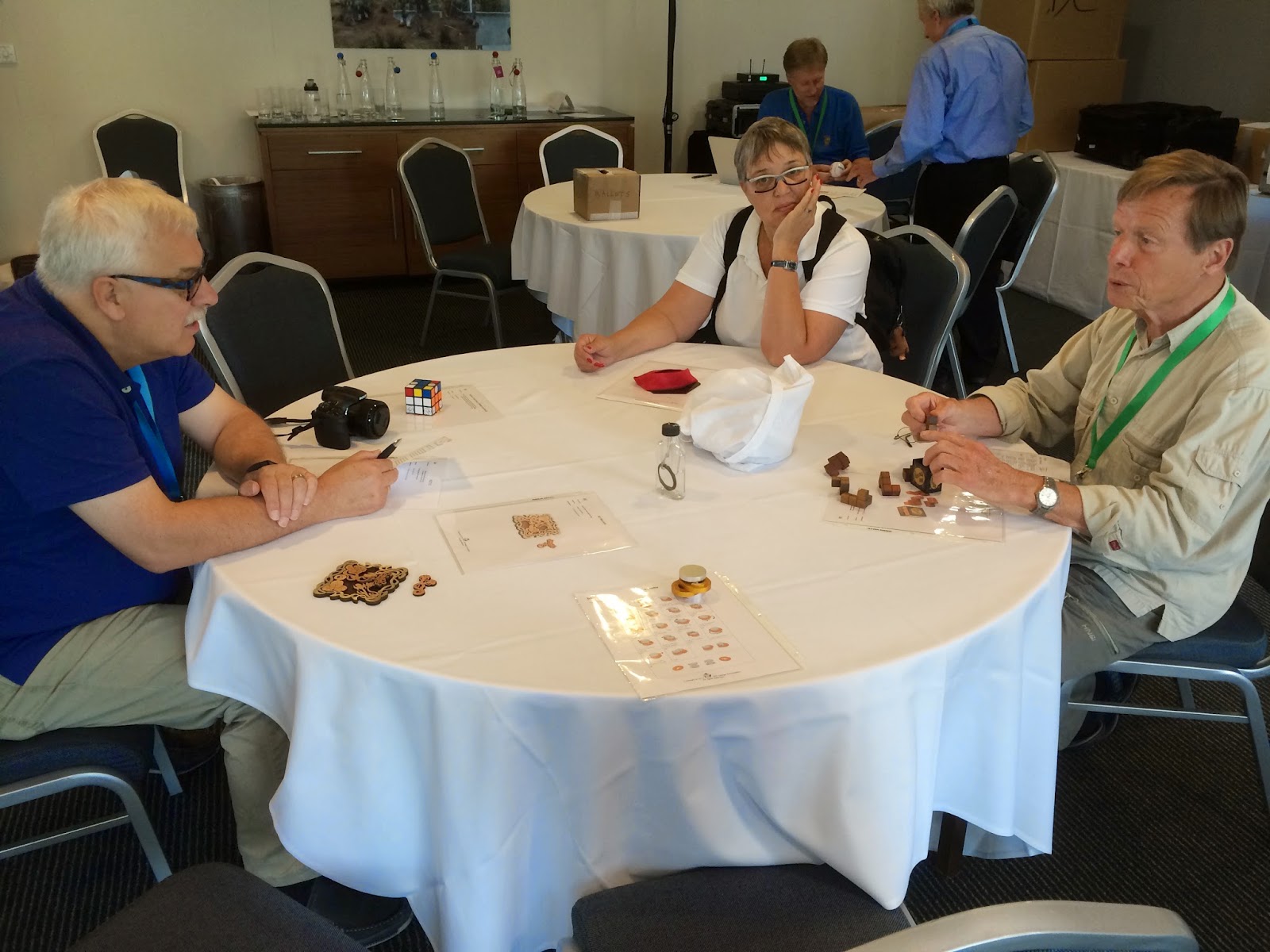
Below are photos of attendees reviewing the various designs. Solutions accompany the designs, so puzzlers won't get stuck. 

Winners are announced during the Awards Dinner on the third evening.


My 7 seconds of fame during the Awards Dinner

My selfie with Kyoo Wong (left) who won the Jury's Grand Prize for his Cast U&U design