Showing posts with label dovetail. Show all posts

Monday, 20 October 2014

Three-Layer Double Dovetail

The name is quite a mouthful but this doesn't detract from the fact that the TLDD is extremely beautifully made. About the size of a small jewellery/ring box, and looks like one too.


This was Robert Sandfield's IPP34 Exchange Puzzle in London this past August. Designed by Perry McDaniel, the TLDD was crafted by Kathleen Malcolmson from two exotic hardwoods, Honduran Mahogany and Primavera. 

If there are a couple of things that I really like about the TLDD, these are the very precise construction and finishing of the puzzle and the attention to detail. So precisely cut and edges sharp that if you are not careful, you can "pinch" your fingers accidentally during play. I really can't fathom the amount of work Kathleen went into making a hundred or so of these for the Exchange!

Unlike Sandfield's Rebanded Dovetail, the TLDD is more akin to the "impossible object" kind of dovetail puzzle, where you wonder, just by looking at it, if the two halves can be split apart at all.


The goal is not just to separate the two halves, but also to find a cavity within the puzzle which contains a cute little rubber star. From a puzzling perspective, not difficult for those who have experience with "impossible" dovetails, especially with the likes of Wil Strijbos' dovetail collection. But to the uninitiated, this one may take a while to figure out.

A very nicely made Exchange Puzzle, not too difficult, which displays well too!

Sunday, 16 March 2014

The Circle

Name
The Circle

Designer
Shane Hales, United Kingdom

Manufacturer
Shane Hales. Shane made only 4 copies. Mine is #003. #001 and #002 went to puzzle bloggers Kevin Sadler and Allard Walker respectively while the last one was kept by Shane himself. 

Type & Classification
Sequential movement; take-apart

Dimensions
9.2cm (diameter) x 6.5cm (Height).

Materials & Construction
The puzzle is made from Oak while the the square "knob" at the top is Ebony.

The Circle has a handmade (as in hand-tooled) Etsy-ish kind of look as opposed to the precision machine-cut Eric Fuller or Pelikan manufactured puzzles. This does not mean lower quality, in fact quite the contrary; as Shane had deliberately made the two dovetails with a looser fit so that the puzzle can be (slightly) more easily solved. As to why this was done, well, you can read more from Allard's and Kevin's write-ups about the Circle. 

Overview
I got to know Shane just over a year ago in February 2013. He is a reader of my blog and also a friend of Kevin's. The two gents had been talking about my BIC#1 which I had released in late 2012 (and Kevin had been amongst the first to try out my humble first production puzzle design). 

Anyhow, Shane got in touch with me about buying a copy of my BIC#1 and in the course of email exchanges, that's where I learnt that he was also in the midst of designing his first puzzle "The Block", which he later produced only a few copies. Over the course of the year we continued to keep in touch via email and last year, he acquired my special edition copper BIC#2, one of only 4 copies which I had produced.

Limited Edition #003/4
Several weeks ago, Shane asked me if I would like to receive from him as a gift the #003 copy of the Circle. Of course I would! I was elated. Not only was I getting one of only 4 copies made, but as a gift as well. A true gift giver, he even refused to accept my offer to pay for shipping from the UK to Singapore. Thank you very much Shane!

About 10 days later, a large box duly arrived at my home. When I first took the puzzle out and examined it, I could hear quite a bit of rattling inside the puzzle. If I had not read Allard's review, I would have assumed the puzzle had been damaged during shipment. It did sound like there were broken bits inside (as if a whole bunch of parts and screws had come apart).

The object of course was to separate the Circle into two halves. My experience with take apart dovetails were limited to Wil Strijbos's aluminium dovetails and the Wunder Puzzle. While challenging in their own way, these did not take very long for me to solve. All within minutes rather than hours. Kevin had commented he took a really long time and Allard took about half an hour. Considering both of them are hardcore puzzlers, I knew the Circle would probably take me no less than the time required by Allard, at the very best.

What was puzzling were the rattling noises! I couldn't figure out how the dovetails were kept together when there was all this ruckus going on inside (well I mean, loose parts can't possibly keep two halves interlocked tightly together, right?)

Anyway for the next two nights, I spent a couple of hours each playing with the Circle, pushing and tugging at the two halves here and there, and even shaking the puzzle (gently) tho' the instructions did say no force was required! No luck at all.

Thereafter I had to stop for about 5 days as I went on a family vacation. I brought the Circle with me but didn't spend any time it. I wasn't too keen to take it out of my suitcase just in case my 3.5 year old son wanted to have a bash at it :-)...he may just end up bashing it (and here there is no possibility of a replacement from Shane). When I got back from my holiday, I decided to dedicate some time to the Circle. With full focus and concentration, I embarked on the Circle again.

I continued with my investigative trial/error and random approach towards the puzzle. The 2 dovetail halves are locked together by 3 mechanisms, 1 primary and 2 secondary. The secondary mechanisms were easily discovered early on during play and these are the more common (and usual) methods deployed to keep two parts of a puzzle together. I knew they could not be the ones keeping the Circle together.

Anyway, I continue with what I was doing and after a fair amount of time, all of a sudden the two dovetails came apart a bit. Not the least solved yet... but here I had a partial view of the insides and immediately knew what was causing the rattling. More importantly, I now had an idea of how the puzzle worked and what I needed to do. I had stumbled upon and solved the first stage. But the puzzle was only about a fifth open. As I continued my (correct) approach, eventually my theory proved right and the two dovetails slid apart nicely.

First off, the internal mechanism keeping the dovetails together is not technically that complicated. In fact the mechanism/trick is rather simple, tho' unusual. The way Shane has employed the use of if is (in my opinion) very clever, and of course totally unexpected. The solution is not difficult to execute once you know it, just that it does take time to complete the steps, quite a number I might add. A gentle hand is required throughout. 

Reassembly involves the steps in reverse order, a bit of gentle twisting and everything is back to its original state.

The Circle even came with its own plastic display stand
Difficulty Level
As one cannot see (but only hear) what is going on inside the Circle, it is very difficult at the beginning, but with some persistence (and without the use of force), the first stage can eventually be reached. Once here, if you can understand the principle of how the puzzle works (yes, there are some physics involved), the next few stages which open the puzzle is very manageable.

Summary
The Circle is by far the most challenging (and hardest) dovetail interlocking puzzle I have come across so far. Marvellous use of an unusual and interesting mechanism/trick, which requires a bit of patience and effort to solve. A really great puzzle and both Allard and Kevin have asked a very reluctant Shane to enter the Circle for the IPP34 Puzzle Design Competition; I fully agree and concur!

Friday, 7 September 2012

Rebanded Dovetail

The Rebanded Dovetail was Robert Sandfield's and Kathleen Malcolmson's exchange puzzle at IPP32, held during August this year. I managed to get a copy from Wil Strijbos who had attended IPP32 and brought back with him extra copies of the Dovetail and some other puzzles.

This is my second Kathleen Malcolmson puzzle after Bowling Alley In A Briefcase which was reviewed some time back in this blog. The Dovetail is hand-crafted by Kathleen in her workshop. In fact she has recently started her own puzzle blog and her first post is about this Dovetail.

Constructed of light baltic birch plywood and contrasting with walnut and lacewood, the Dovetail spots four distinctive colour tones. In particular the lightly textured surface of the lacewood which forms the two bands surrounding the box gives the puzzle a rather classy and unusual appearance.


Dimensionally, the Dovetail measures 8cm x 6.2cm with an overall thickness of 3.7cm. The puzzle is very well made and fit and finish is excellent with all sharp edges smoothed out. All parts have been cut to very exact tolerances (see the dovetail joints) making everything feel solid and tight. Of course, all this quality came with a rather expensive price-tag.

The object of the Dovetail is to open the box and remove a one-dime coin within. The puzzle has been classified as a trick-opening/puzzle box. A number of steps are required to open the box and depending on how you count, there are six moves required to free the dime inside. While the Dovetail does not have as many moves needed as some of its more complicated Japanese style counterparts, the execution of the solution is quite unusual and rather clever.

The dime out of the box....smallest denomination around but don't underestimate this little guy! 
It didn't take me long to figure out the first step and the next two were pretty easy. The fourth step was also easy and thereafter, this was where I got stuck. Took me a good ten minutes or so, but eventually I discovered the fifth step and finally got the box to open. This step was rather tricky (probably the trickiest!) and quite unexpected. When I finally got to peek at the inside, I saw the amount of work that went into making the puzzle....hmm, maybe it isn't that expensive after all!

Overall, I found the Dovetail entertaining with a sufficiently nice amount of puzzle challenge. This is not to say that it is an easy solve...no, by no means at all. But definitely fun and most experienced puzzlers would be able to solve it without too much frustration.


Saturday, 11 August 2012

Cube Dovetail

Update 23 October 2017 - Dear Reader, please check out my new puzzle blog and e-store at http://mechanical-puzzles.com

This "impossible object" creation comes from aluminium puzzle designer/maker extraordinaire Wil Strijbos. You may have already come across Wil's first series of dovetail puzzles, the Convex and Concave Dovetail, followed later by the New Aluminium Dovetail. Now the latest incarnation, which even comes in its own numbered set of three is the Cube Dovetail(s).


The Cube Dovetails are really quite different from the earlier dovetails, the latter which all came rectangular shaped in just two colours, raw aluminium and anodised green (light or dark green depending on which batch your puzzle came from). In the numbered set, the colour combos are dark green/blue, orange/blue and purple/blue, the same blue that is found on his First Box puzzle. While this departure from the traditional raw aluminium/green combination from the earlier models is a welcome change, I wish he had a yellow/blue cube or even a raw aluminium/blue or some other better contrasting colours than dark green/blue. I actually asked Wil if he had other colours but he said "sorry no".

The cubes are excellently constructed and fit and finish are to very tight tolerances. Each cube measures about 4.1cm per side. As I have said in previous posts on the dovetails, these are more "works of art" than real serious puzzles (but of course to the uninitiated or non-puzzler, I suppose these would be pretty tough nuts to crack). However, the term "works of art" here takes on a truer meaning since the cubes have relatively bright colours (except for the green/blue) and a set of three placed together does rather look quite striking and stand out handsomely.

Solving the cubes is pretty easy if you have had prior experience with the earlier dovetails but each of the cubes dis-assemble (separate) quite differently. Once apart, you can see the precision milling/cutting that has gone into making them look impossible to separate...really quite amazing. As an aside here, veteran puzzle collector Michael Tanoff had remarked to me that  the "puzzle" associated (with the dovetail puzzles) is not how to separate the parts, but rather to try figure-out how the two parts fit together, as all three appear to be impossible objects...".

If you already own the earlier Dovetails, well...this set is certainly a colourful and fun must-have; and would enhance your collection. If you don't wish to buy all three, Wil does sell the cubes individually. Allard has also written about the cubes in his puzzle blog so you may wish to check out his thoughts on them.

Friday, 29 June 2012

New Aluminium Dovetail & Concave Dovetail

Last September, I reviewed the Convex Aluminium Dovetail puzzle from Wil Strijbos. At that time, two versions were released, the convex and concave models. After receiving the convex one and solving it, I decided to acquire the concave one as well. As mentioned in my review the concave version has a similar mechanism as the convex one.


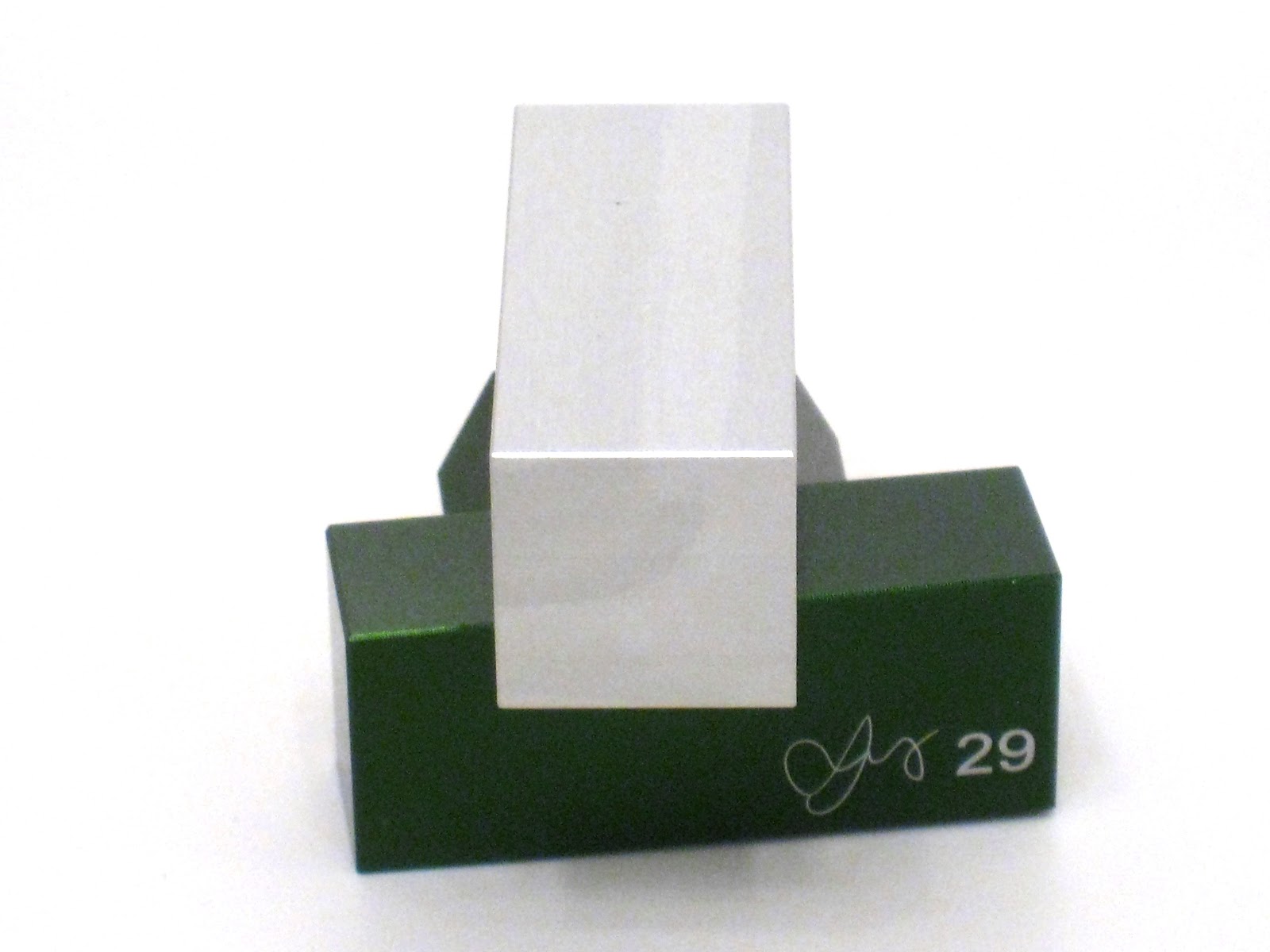
As for this latest version of the dovetail which I received yesterday (together with another of his latest puzzles The First Box) which Wil calls the "New" Dovetail, there is really not much to be said about it which has not already been covered in my Convex Dovetail review. The dimensions are the same and the quality of construction, fit and finish are excellent. The only difference here is the design of the dovetail joint. This latest incarnation sports a much more complicated looking dovetail joint design. The other difference is aesthetic; Wil has added his signature next to the serial number (mine is #29).


The puzzle itself is not difficult...once you have solved either one of the earlier dovetails, you pretty well can solve this one quite quickly. I think what is unique is the design itself and the way it has been put together which makes the dovetail range unusual and collectable. Not cheap mind you but well worth the money. To the casual observer or non-puzzler....how do you separate two seemingly impossible-to-separate pieces? Once solved, you can really see how the two portions mesh and fit together as one, which is rather amazing! I am sure this latest dovetail will not be Wil's last and I look forward to his next version.


Concave Dovetail
Solved Concave Dovetail
The Aluminium Dovetail Family