Showing posts with label sliding. Show all posts

Saturday, 5 January 2019

Coin Puzzles by Rex Rossano Perez

A very Happy New Year to my puzzling friends and blog readers. This is my first post of 2019.

I have just played with two of Rex Perez's Coin Puzzles and uploaded a post on them to my puzzle site below.

http://mechanical-puzzles.com/coin-puzzles-by-rex-perez/


Friday, 3 March 2017

Sliding Arrow Through The Bottle

Here's a nice sliding block puzzle that does not have a stratospheric number of moves. Its also a cute and colourful one and this was designed by Serhiy Grabarchuk, who is very well-known for his eye-catching and interesting looking sliding puzzle designs. 

START POSITION
END POSITION
I have two of his other works which were reviewed earlier, his Sorter and One Fish Another Fish. I obtained the Sliding Arrow puzzle via a private exchange with fellow puzzler Dinair Namdarian, who also produced it. The puzzle is precision laser cut and well-made.

The Sliding Arrow measures about 14cm x 11cm and consists of a typical tray and 9 loose pieces. Unlike most sliding puzzles consisting of squares and rectangular shaped pieces, Serhiy had designed some of the pieces in the shape of a "bottle" and an "arrow". And this was fashioned into their shapes using translucent green acrylic for the bottle and yellow for the arrow. The "shaft" of the arrow is not another individual moving piece but cleverly recessed into the base of the tray.


The object is to get from the Start to the End positions as shown in the photos. Officially, the least number of moves to arrive at the final solution is 31. Not a lot compared to some other other sliding puzzles, for example, those from Minoru Abe. However, the moves are tricky and if you get the sequence wrong from the early stages, you will hit a dead end(s) and will have to re-arrange the pieces and begin all over again. This happened to me quite a number of times! Good thing most sliding puzzles have exposed pieces!

The Sliding Arrow is one of Serhiy Grabarchuk's more well-known designs and while the number of moves is not a lot, it is far more challenging than it appears.

Monday, 17 October 2016

Magiq #8 & Tango 72

For this year's IPP36 Nob Yoshigahara Puzzle Design Competition, I submitted two entries. One was my own design (the subject of this post) while the second was a joint entry with fellow puzzler Primitivo Familiar Ramos, which I shall write about at a later date.

START
My first entry was called Magiq#8 and the goal (as can be seen from the photos) is to re-arrange the 5 pieces and change the #8 to a #0. Saying "abracadabra" would certainly help! I didn't manage to win any prizes...but hey, its the participation that counts right? 


Although this year's design bears some resemblance to my entry at last year's IPP competition, the "69", the Magiq#8 is totally different in terms of the solve. My design was expertly crafted by Tom Lensch and consists of exotic woods comprising walnut, holly, shedua and yellowheart. Construction, fit and finish is excellent and I particularly liked the perimeter trim added by Tom to the top edge of the box.


SOLVED STATE
Its not as straight forward a packing puzzle as one might expect and there is a trick to it. No spoilers so I shall not say anymore. What's the difficulty level? I can't say as I have not received any feedback so far, although puzzler Marc Pawliger did casually mention to me in the competition room that he found it quite devilish... If anyone is keen to purchase a copy, please contact Tom Lensch via his website to check on availability. 

My Exchange Puzzle is "Tango 72". This year, I designed a sliding block puzzle consisting of 5 pieces, 4 of which are identical. Like most sliding puzzles, the goal is to rearrange the pieces from a starting position to an end position, while only moving the pieces (left, right, up and down) within the tray. 


START
END
Here the end result is to form the words IPP36 from a scrambled state. It takes a minimum 72 moves to arrive at the final solution. I tried to make my design accommodate an additional but easier challenge with fewer moves, but somehow didn't quite manage to succeed. Tango 72 is made from 3mm laser cut acrylic and I have a couple of copies left for sale if anyone is interested.

Thursday, 18 August 2016

Sliding Block Puzzle Locks

Some weeks ago puzzle collector Otis Cheng from China had mentioned on his Facebook post that he had acquired two sliding puzzle locks that had been designed by a group of students from a Beijing 12th grade middle school. The students had designed the locks with the help of their teacher who happened to be a puzzler! 


I thought they look pretty impressive and a rather unique approach to a puzzle lock design. But thanks to Otis I managed to get my hands on two such puzzle locks when I met him at IPP36 in Kyoto this August.

Both lock designs were adapted and eventually mass produced by Mi-Toys. The two locks are about the same size measuring 11cm x 7.5cm x 1.5cm (including the shackle) with one a tad smaller than the other. They are layered and formed together with laser cut wood. The moving blocks within are covered by a clear acrylic cover with cut-outs sufficient for the acompanying key to aid in moving the blocks around inside the lock. Fingers would be too big for this puzzle...so the key actually serves a useful purpose here!


The shackle of each lock is restrained by the blocks inside the lock. Both puzzles work on the principle of sliding blocks and once the blocks have been moved into their intended final positions, the shackle extends upwards and is freed.

Of the two puzzles one is relatively easy while the other (with more pieces) is quite a bit harder. While travelling back to Singapore from Kyoto, I took the opportunity to play with both locks and thankfully managed to solve both during the one hour domestic flight from Osaka to Tokyo. Hence you will notice the less than acceptable photos of the solved puzzles as they were both solved on my lap during flight.

An interesting take on the traditional sliding block puzzle or puzzle padlock, or both, whichever way you choose to see it. As of this post, I can't seem to find them on the Mi-Toys site but I think eventually they will make their way there.

Monday, 25 April 2016

Slide X

Name
Slide X

Designer
Yasuhiro Hashimoto


Manufacturer & Availability
Produced by DYLAN-Kobo (PUZZLE of MINE). Copies may still be available.

Type & Classification
Sliding Block Puzzle

Dimensions
7.6cm x 9.8cm x 0.4cm


Materials & Construction
Laser cut acrylic. Very precisely cut with sharp edges, resulting in an excellent quality puzzle.  Tolerances are just nice and the combo colours of red, white, blue and black make the puzzle stand out.

Overview
Slide X was Iwahiro's (Hirokazu Iwasawa) IPP35 Exchange Puzzle in Ottawa, Canada last year. 

There are a total of 8 pieces; 4 white rectangles and 4 black "L" pieces. Together they cover a substantial part of the red tray.

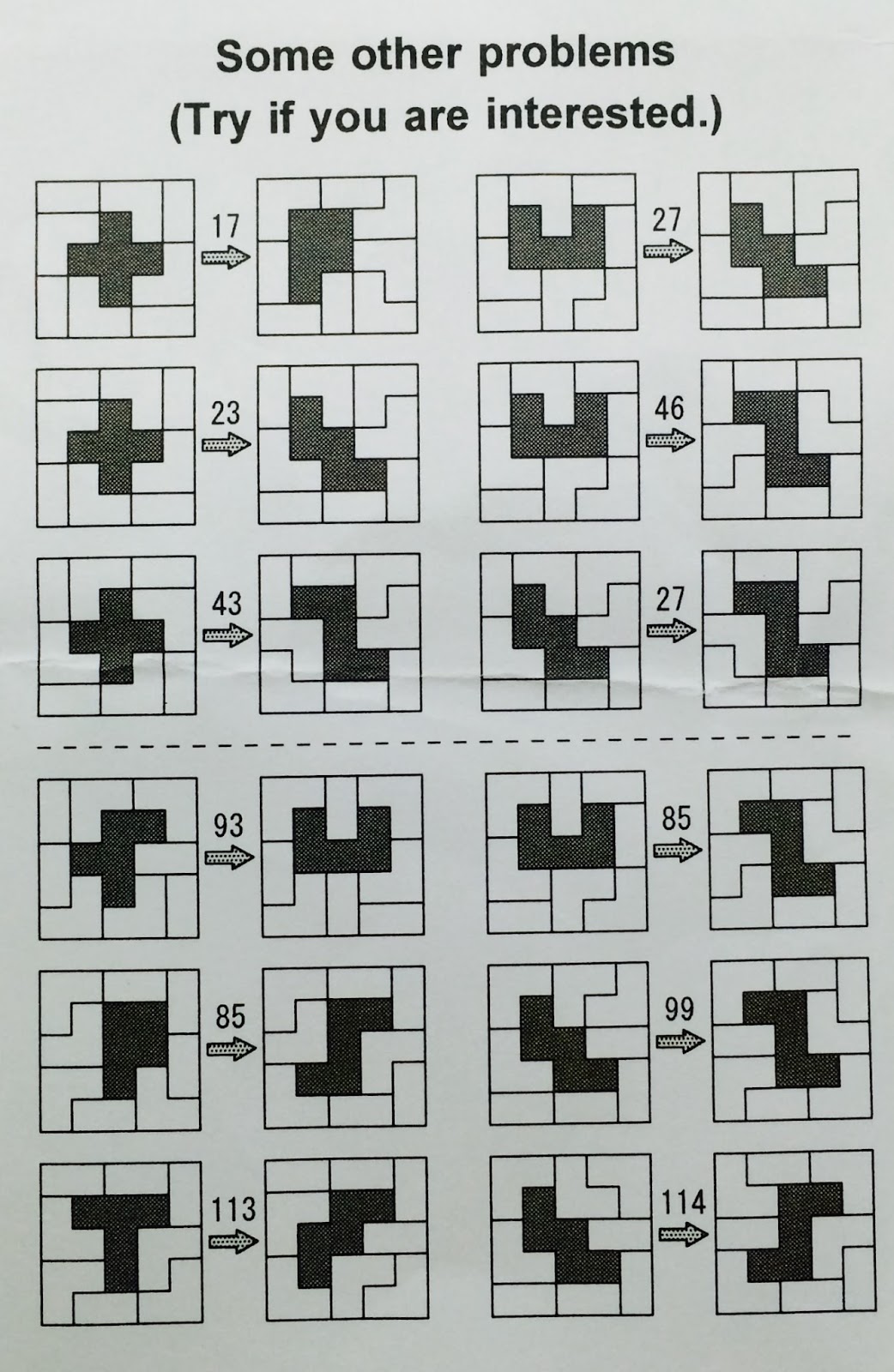
This is a sliding block puzzle with a bit of difference. Instead of moving the pieces from a start position to an end position as what most puzzlers are used to, the challenge is to form various silhouette shapes. A great and unusal design concept nonetheless!


The main challenge consist of a warm-up "practice run" (see photo) to change the silhouette of a "red cross" to a "U". This one takes 14 moves. Not a lot of moves but because now you are focusing on the "U" shape, the puzzle is harder than the 14 moves would suggest (at least for me). So what I did was to focus my attention on where the pieces should end up and tried to ignore the "U". 

Now for the main problem which requires a minimum of 48 moves, the instructions do not come showing the end position of the individual pieces. So the starting point is probably to pack the pieces into the tray to see how the "T" is formed. And then figure it out from there. A photo would certainly help! In any event, it was too difficult for me and I gave up after a number of tries. 8 pieces to slide is really no joke. But I did succeed in one of the other easier challenges on the separate problem sheet.


Difficulty
There are a total of 14 challenges in all with increasing levels of difficulty, ranging from 14 to 114 moves! I am not good at sliding puzzles. Notwithstanding, I think this one is really difficult especially for the higher level challenges. Definitely a sliding puzzle not to be missed by die-hard sliding puzzle enthusiasts.

Thursday, 4 February 2016

Antislide Tetramino

Name
Antislide Tetramino


Designer
Vladimir Krasnoukhov, Russia. The AT-Puzzle was also Vladimir's IPP35 Exchange Puzzle. For some of his other very nice puzzle designs, click here and here.

Manufacturer & Availability
Manufactured and sold by Vladimir himself. He may still have some copies available. 

Type & Classification
2D Packing

Dimensions
13.5cm x 7.5cm x 0.6cm

Materials & Construction
Laser cut acrylic used throughout. 3mm thickness for the pieces and the tray. Excellent quality and Vladimir went one step further by providing a red piece-holder so that all the pieces are are nicely held together when not in play.


Overview
This is not just your usual packing puzzle, but one with an added task; to pack all the 5 tetramino (each piece is 4 units) pieces into the tray in such a fashion that none of the pieces can slide (or move) in any direction. As a pure packing puzzle, this would have been a no-brainer, but with the anti-slide requirement, the AT-Puzzle becomes a very difficult puzzle indeed!

I took the better part of a day and still couldn't figure out the solution and decided to email fellow puzzle collector George Bell (who had solved it a while back) for a clue. But before he replied, something clicked in my brain and I tried arranging the pieces in a new way...and there, within seconds...I had solved it! I usually don't spend so much time on any one puzzle, but this one just drew me in and I went on and on playing with it, refusing to give up. I wish I could do the same for burrs.

Difficulty Level
Very difficult! thinking outside the norm is required no less. If you wish to see the solution, please click here - Password - antislide.

Summary
The AT-Puzzle is absolutely fantastic. It is also George Bell's favourite. So innocuously simple looking yet extremely challenging for a 5-piece puzzle. One of those puzzles that once you pick it up and know what you have to do, you simply can't put it down.


Thursday, 14 January 2016

Pity The Poor Kids Who Couldn't Get Their Candy

Name
Mint Man


Start Position

Designer
Unknown. 

Manufacturer & Availability
The Mint Man you see here was produced and sold by The Kelrack Ltd of Middlesex, England. A check revealed that Kelrack Ltd was a manufacturer of plastic products and incorporated in 1973. It has since been dissolved. 

As far as I can tell, this version is not available anymore. But other similar versions are available commercially (see below). I was very lucky to obtain one online for $5/- from a used toy seller (who probably didn't know much about puzzles).

Type & Classification
Sliding Block puzzle. For information generally on sliding block puzzles, click here and here. To see the vast variety of sliding block puzzles out there and their designers, click here.

Dimensions
9cm (H) x 7.5cm (W) x 2cm (D)


20 Moves

40 Moves

60 Moves


Materials & Construction
Plastic. Pretty decent quality but not heavy duty.

Overview
The Mint Man produced by Kelrack is one of many variations of the same puzzle that goes by a number of different names; a Chinese "army" version called Huarong Pass, a number of wooden commercial versions with names such as Setting Sun, Soccer Game etc adopting a variety of themes but the puzzle itself is essentially the same. Some years ago, there was even a Microsoft 3.1 Entertainment Pack digital version called Forget Me Not.

However, what's different here is that Kelrack produced the Mint Man to hold a piece of candy and the reward, apart from solving the puzzle, is to get the candy out of the largest piece. Within the plastic version, the Mint Man also came with a black tray and slightly different coloured pieces as well as other themes.


81 Moves. Mint Man with Gummy

Difficulty Level
Very difficult! The minimum number of moves required to solved the Mint Man is a whopping 81! I never managed to solve this one. I really pity those poor kids and their parents who tore their hair out trying to figure this one out to get the candy. Well, fortunately, the box tray can be split apart to remove the pieces if all else fails. While 81 is a lot of moves, there are designers like Minoru Abe that have come up with over 200 moves using very whimsical and cute themes. One of my personal favourite designers.

There are also a number of videos on the internet which shows the step by step solve, so help is at hand should you decide to purchase a copy.

Summary
Nice collectible! A more solid and heavy 3D printed version would be nice.

Monday, 3 August 2015

Sheep In A Bottle

What a cute pun of a name...this was the first thought through my mind as Goh Pit Khiam handed me the puzzle he had designed 8 years ago to play with during the SPP#1. In case you still don't know what I am talking about....you have probably seen or heard about "Ship In A Bottle"?


I only had a short time to play with this puzzle during the SPP#1; not enough time for a typical GPK puzzle which usually looks simple but very often way more difficult.

The Sheep puzzle is made of laser cut wood and produced by Walt Hoppe in 2007. Only several copies were ever produced as prototypes, none for commercial sale or exchange. Every time I meet with GPK, he always pulls something new out of the hat to surprise me.

Quality and finishing is very good. This one comes with an acrylic cover with cut-outs to assist in moving the pieces inside the "bottle" and to prevent "unauthorized" moves.

The object is to remove all the pieces through the slot on the right side of the tray. As you can tell from the start position, the head and fore legs of the sheep are obstructed.


This is a sliding block puzzle. While it has only 5 pieces, its not your run-of-the-mill sliding puzzle but a very tricky one indeed! It took me quite a while to figure out how to manoeuvre the pieces out, and even a longer time to get the pieces back in, as I had forgotten the steps. This is a sequential movement puzzle and require about 9 moves to get the first piece out. After the the first piece comes out, the rest are relatively easy. Just don't forget the sequence or you will be stuck for a pretty long time like I was! 

A challenging but fun puzzle with some unique moves thrown in. Once you figure out and memorize the moves, its pretty easily re-solvable. Its a great puzzle and I would definitely recommend GPK to produce more copies for sale.

Wednesday, 25 March 2015

Heart In Puzzle

Here's another Minoru Abe sliding puzzle I played with the last two evenings. It's the Heart In Puzzle with three challenges. The object of each of them is to move the "Heart" block to within the confines of the four identical L-shaped blocks.


Like all current Minoru Abe sliding puzzles available on the market today, the Heart In Puzzle puzzle is well made and packaging is in the form of a nice dark blue box. The instructions are in Japanese but the diagrams are self-explanatory. 

The tray is (likely) made of  pine, while the pieces are a different species of wood. Despite its high quality, Minoru Abe sliding puzzles are not expensive and prices range from about 2,100Y (US$17) to 3,700Y (US$31). They are available from online seller Torito (which unfortunately does not ship outside of Japan), CU-Japan and Amazon. The Heart In Puzzle cost about US$17/-, one of the cheapest.


Start Position No 1

Start Position No 2

Start Position No 3

Each of the three challenges is represented by three starting positions and the first requires a minimum of 28 moves. Not a lot moves compared to Minoru's other sliding puzzles (some of them in the hundreds) but I found this one rather difficult. It took me a rather good portion of an evening to solve the first challenge and the same for the second challenge. I didn't attempt the third. All the moves are linear. Initially I was wondering if the Japanese instructions (which I can't read) allowed for rotations, because if it did, it took me well less than 28 moves to solve. A quick check with sliding puzzle supremo Nick Baxter confirmed no rotations allowed so I had to take the more difficult route.


Solved Position For All 3 Challenges

For those into sliding block puzzles, the Heart In Puzzle is a must have and great value for money. Oh, and incidentally, the Heart In Puzzle does bear some similarities to Serhiy Grabarchuk's 22-move Sliding Stones.

Saturday, 10 January 2015

Slide Blocked Sliding Block

The Slide Blocked Sliding Block puzzle ("SBSB") was designed by Bill Cutler in 1986 and won the Grand Prize at the 1988 Hikimi Wooden Puzzle Competition. 


Start Position

The original design is not the "two arrows" layout you see in these photos although the solving principle is the same.

The "two arrows" version here is from Tom Lensch. The puzzle is made of Walnut for the frame while the pieces are Maple, Bubinga, Indian Rosewood and Yellowheart. Very well constructed with a nice fit and finish. The SBSB is also not to be confused with Goh Pit Khiam's Arrow Blocks puzzle which tho' the latter has a similar external appearance to the SBSB, the solution and method of solving is totally different (and a lot more difficult). 


The SBSB is a sliding block puzzle. Object is to slide the 5 pieces around to form a "complete arrow" on the left side, after removal of the Yellowheart start piece (which happens to be the only piece that can be removed from the frame). 

But the SBSB has a "trick" to it....the pieces have been constructed in such a way that certain movements are restricted (hence "slide blocked"); making it much harder than it looks. A normal 5 piece sliding block puzzle would have been a pretty easy solve. But here, the SBSB requires a minimum of 41 moves to complete.


Solved Position
Notwithstanding the restriction of movements of the pieces, the SBSB, while challenging is still quite manageable as it consists of only 5 pieces moving in rectilinear fashion. But I did find myself hitting some dead ends here and there along the way and backtracking before getting the arrows to their correct positions. With some persistence, one can eventually get to the end point, but probably taking more than 41 moves. To complete the solution, the goal is to get back to the original start position. Unless your memory is superb, you'll probably have to go through some trial and error to get it solved.

The SBSB is a different take on the traditional sliding block puzzle. And with the arrows design, it also displays very well. Available from Tom Lensch for US$125. [Edit 12 Jan 2015 - Someone has written to me to say that Tom does not have any more available]


Tuesday, 16 December 2014

Dinosaur Egg

The name of this puzzle, originally in Japanese, "Kyoryu No Tamago" translated means "Is It A Dinosaur Egg?". Its from Japanese designer Minoru Abe, renowned for his colourful, cute, whimsical and many very challenging sliding block puzzles. This one is no different and was designed 28 years ago, one of his earliest. The Dinosaur Egg today is rather hard to find (no pun intended) and I was very lucky to get my copy courtesy of my puzzling friend, Frederic Boucher who lives in Japan.

START
The object is to slide the pieces within the irregular shaped tray, (rectilinear moves only) from the given START position to the FINISH, which resembles a (dinosaur) egg. There are four pieces each piece forming a quarter of the egg. Three of the pieces have notches which are able to interact with the protrusions within the tray.

The instructions are in Japanese but the accompanying diagrams are pretty clear on what must be done. Frederic did a bit of the translation for me - the solution requires 22 moves. 

FINISH
I played with Dinosaur Egg for a good hour and after getting stuck and resetting the puzzle at least a half dozen times, I managed to reach the end stage. I am not sure if the 22-moves solution is "unique" though? Meaning that you need to get the sequence correct right from beginning to the end or you will invariably get stuck in the middle and have to back-track to the last correct position. Or could more moves be taken and still reach the end?

Only four pieces, but a unique and interesting idea for a sliding block design, and challenging too!

There appears to be very little information about Minoru Abe, the man himself. But check out Holt Davey's FaceBook page here about Abe.

Monday, 27 October 2014

Sorter

I had the pleasure of meeting renowned sliding block puzzle designer Serhiy Grabarchuk at IPP34 in London this past August where we exchanged puzzles. This is how I got his Sorter. 


Start Position
This is my second sliding block puzzle from Serhiy. The first was One Fish Another Fish reviewed earlier.

Very nicely constructed of colourful laser cut acrylic, the Sorter is a "sealed" puzzle; meaning the sliding pieces are encased in the tray and you can't remove the pieces....not unless you unscrew the top cover...which is not intended.


Finished Position
The object is this - to move the coloured pieces (which has various shapes cut into them) from their starting positions, to correspond with the cut-outs on the top cover. Only linear moves are allowed, no rotations permitted.

It took me a good several minutes to get the pieces into their intended positions and after the first time, I re-solved it and counted about 38 moves from start to finish. I am not sure if this is the optimal number of moves (probably not), so if anyone who has done it in lesser moves, please feel free to drop me a note.  

Overall a nice sliding block puzzle with an appropriate level of difficulty, just right for an exchange puzzle.

Edit 28 Oct 14: A well-known puzzle collector and sliding block puzzle designer has messaged me to say that the Sorter needs only 22 moves to solve!....well there you go!

Friday, 11 April 2014

Arrow Blocks

Name
Arrow Blocks

Designer
Goh Pit Khiam. Singaporean Goh has designed well over sixty puzzles to-date. For some of Goh's other puzzle designs, click here. 


Starting Position

Manufacturer
Tom Lensch. Currently unavailable.

Type & Classification

This one I think fits into several categories, but Sequential Movement is probably the best description. The Arrow Blocks resembles Bill Cutler's Slide-Blocked Sliding Block Puzzle but has a totally different concept. 

Dimensions
17.7cm (Length) x 14.0cm (Width) x 2.5cm (Height). This is a large puzzle!

Materials & Construction
The frame/box is made of Indian Rosewood, while the blocks are Maple.The arrows atop the blocks are Yellowheart and Brazilian Blackwood. 

Construction, fit and finish is top notch. Built to close tolerances but all the blocks slide smoothly. A really solid and very heavy duty feel puzzle. Another good thing about the construction is that Tom made the frame/box with a removable magnetic lid, so you can reset the puzzle easily (or if you are stuck)

IPP
Arrow Blocks was Goh's entry for the IPP32 Puzzle Design Competition held in Washington DC, USA in 2012.

Overview
I first saw the Arrow Blocks when I caught up with fellow puzzle blogger Roxanne Wong when she was in Singapore for a conference about a year ago. She was very kind to lend me her copy and even told me to keep it until we next met. 

I fiddled with it a bit but never really got down to playing with it. Life went on and I forgot about the puzzle. Before I knew it, I was packing up the Arrow Blocks to return it to her at IPP33 in Japan four months later.

After IPP33, I contacted Tom Lensch to see if he had any available. Initially he didn't have any but some weeks later he got back to me to say he had a spare copy which did not need to go to someone else...lucky me!

When you first look at the Arrow Blocks, it looks like another sliding block puzzle (albeit a very high-end one). You wonder how difficult can this be, after all its only 6 movable pieces, much less than the classic 15 Sliding Puzzle. 

For example, when you see a complicated looking burr, it usually is! Not many are intimidatingly looking yet manageable, perhaps for a handful such as the Orsi and HALT.

Well, in this case, the Arrow Blocks would probably qualify as one of the more deceptively simple (and easy) looking puzzles around, yet the level of difficulty is beyond what it appears!

The starting point of the Arrow Blocks is with the black arrow head on the left side with the yellow arrows and the object is to place the block with the yellow arrow head into the box frame to have two arrows,each with the same colour.


Solved Position
Unfortunately the Arrow Blocks is one of those puzzles that if I describe even the broad steps as to what needs to be done, it would give too big a hint/clue away. One thing's for sure, there is a minimum of over 50 moves to get the Arrow Blocks from the start to the solved state. A good bit of work involved. And I must add, some thinking out of the box (no pun intended) is required here!

I had a lot of difficulty with this one and only managed to solve the puzzle halfway...if there is such a thing.

It was a good thing that Tom included the solution write-up/analysis from Goh, which itself requires consumption of a fair amount of brain power to understand. I would not have been able to solve it without the solution. I must admit, my mental model of a sliding block puzzle kept getting in the way!

Difficulty Level
Very difficult! And when we exchanged SMS about his puzzle, Goh said; "it's a bit tough I agree"... "a bit" of an understatement here I think....

Summary

A very tough puzzle with a unique and great concept from a prolific designer. And excellent quality from a well-respected craftsman. Definitely a must-have for the serious collector. 

Wednesday, 19 March 2014

Snakes In A Plane, Swiss Cube & Puzzle Jam

I acquired these three puzzles during last year's IPP33 Puzzle Party in Tokyo, Japan. The Puzzle Party typically takes place on the last day of the IPP and here is where puzzlers, collectors, retailers and craftsmen sell (or fob off) their collection (or unwanted puzzles) to the IPP attendees. Its like a flea market, but more up-scale and takes place in a hotel ball room.

Generally considered one of the key highlights of IPP, here is where one can possibly get some puzzle gems, be it brand new, pre-loved or rare hard to find ones, tho' the last are usually snapped up in  jiffy. A number of Exchange Puzzles (past, present and spare ones) are also usually available for sale and this is great for attendees who do not participate in the Exchange.

Snakes In A Plane
This one reminds me of a thriller action movie of similar name that appeared in cinemas a number of years back. Unlike the movie, no one dies from snakes here (not playing with this puzzle anyway). Snakes In A Plane was Bob Hearn's exchange puzzle during IPP28 in Prague in 2008. This acrylic and plastic puzzle was designed and made by Oskar van Deventer.


The object is to "twist" the "red" spiral snake out of the frame by removing the other snakes in its path. In reality its a twist (no pun intended) on the traditional sliding style block puzzle. Not too difficult and provides great fun. Very flat and portable too. At 10.2cm x 8.4cm, its easily pocket-able for a (plane) trip. I think here is a good example of employing a traditional idea to devise a unique looking and cool puzzle. Click here for a video showing the puzzle in action.

Swiss Cube
Designed by Jung von Kanel in 2005, this is an interlocking puzzle. But instead of the usual wood typically used, it is made entirely from acrylic/plexi-glass. Red and white combination with cross(s) to resemble the Swiss flag. Very well made and tho' acrylic, the puzzle feels very solid. Not large, measuring about 5cm cube. I can't remember who I bought this puzzle from but it was the only piece on the table.


The cube is hollow inside and the object is to remove and fit back the 3 white removable notched burrs (two horizontal and one vertical). There are both an easy and hard challenges designed for this puzzle.

A sequence for removal and reassembly has to be followed and you need to get the orientation of the cube correct to avoid confusion. I used  the etched wordings on the front of the cube for reference.

Not too difficult by any means, even for the hard challenge. With some manipulation of the pieces trial and error or otherwise, quite a manageable puzzle. 

Puzzle Jam
Designed and handmade by Yoshiaki Hirano, this puzzle (jam) jar is an "Impossible Object" and was Yoshiaki-san's Exchange Puzzle at IPP33. 

The jar contains two Hanayama Cast puzzles (Cast Spiral and Cast Loop) and a burgundy coloured origami rose. Its easy to remove the paper rose but it would take (a lot) of figuring out how to disassemble and remove both the Spiral and Loop, since it is impossible for them to pass through the mouth of the jar. I didn't attempt to solve this one; its difficult as it is already to solve the cast puzzles on their own outside of any jar!


The puzzle comes in a very cute hand decorated/written cardboard box with a caricature of Yoshiaki-san pasted on the front...yes, he actually does look a lot like his cartoon picture! 

Along with the Puzzle Jam, I also bought from Yoshiaki-san another impossible jar with a golf ball inside! To see some impossible objects made from Hanayama Cast puzzles, click here and scroll down.