Showing posts with label Bill Cutler. Show all posts

Thursday, 23 February 2017

Trainspotting

Now here's an interesting series of packing puzzles that I received during the course of three puzzle exchanges since 2014.


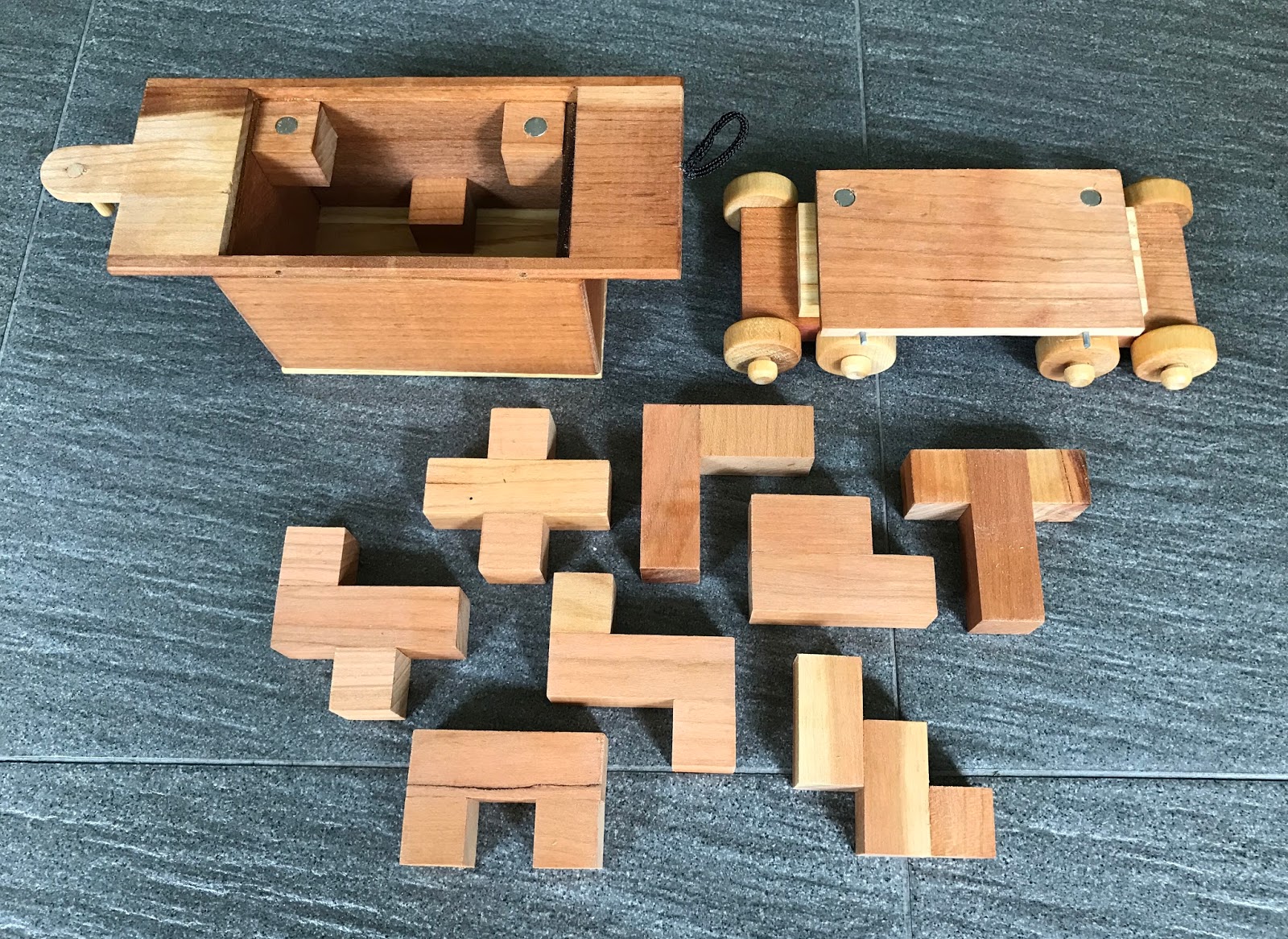
These are none other than Henry Strout's creations. The only other puzzle I have from Henry is his nice Flower String Puzzle. From what I understand, Henry started doing this series of train packing puzzles for exchange since 2013 and will finish off his series in 2018. Apparently, he's got another car/tender and an engine to complete (if anyone has more accurate information or otherwise, please PM me). 


These are fine works with wheels that spin, a simple coupler cum loop system to link train cars at both ends of each car and lids that are laser etched with the puzzle and IPP exchange details etc. The size of the train cars vary a bit but is pretty large and hefty with an average size of around 18cm x 10cm x 7cm. And all use just one type of wood (although I am not sure what it is).

All the puzzles bear the same style/theme...namely to pack anywhere between 8-10 irregular shaped block pieces into a train "car". Levels of difficulty also vary since each of the train cars or box contain different number of pieces and within each car, there are some protrusions or fixed restraining piece, which makes the puzzle that much harder. 

Each of the train packing puzzles have been/will be either designed by Henry himself, or someone else. As I joined the Puzzle Exchange only in 2014, I missed out on the earlier first train puzzle. What I have are the train puzzles for the last three years:-

IPP34
Sphinks Cargo Car
Designed by Brian Young (a.k.a Mr Puzzle Australia), 
Pack 6 pieces into the box


IPP35
Cutler Freight Car
Designed by Bill Cutler
Pack 10 pieces into the box


IPP36
Henry's Cargo Car
Designed by Henry Strout
Pack 8 pieces into the box


In terms of difficulty, lets just say these are not so easy as they seem. In fact they are pretty challenging. The hardest I think would be the Cutler Freight Car with its 10 pieces and easiest is the Sphinks Cargo Car with only 6 pieces (I know because I was able to solve the latter) and in between Henry's Cargo Car.

A nice idea to create a series of related puzzles for exchange. And for anyone who enjoys trains and/or packing puzzles, this will be an interesting addition to your collection, that is if you can get the complete set.


Saturday, 19 November 2016

Seal

This weekend, I played (or rather re-played) a puzzle that has seen a number of incarnations over the years. The puzzle is Naoaki Takashima's IPP36 Exchange Puzzle called Seal - Slide-Blocked Sliding Block Puzzle. 

Start Position

End Position
The original version of the SBSB with a garage and car theme was designed by Bill Cutler in 1987. Bill made a later version using the "seal and ball" theme and entered it in the 1988 Hikimi Wooden Puzzle Design Competition where he won the Grand Prize. Subsequently Tom Lensch also made versions of the original SBSB and his latest version is featured in one of my previous post, suing a "twin arrows" theme. 

Naoaki Takashima is a Japanese Puzzle collector who reputedly has the largest private collection of mechanical puzzles outside the USA/Europe and in Japan. His version of the SBSB for the Exchange is different from the original Bill Cutler and Tom Lensch versions in several respects:-

1. The design is an "upside down" version of the original.

2. The pieces are made of laser cut double layer glued acrylic and removable from the tray. You can't see it from the photos but there is a groove running along the inside bottom edge of the tray with two of the pieces having "notches". The Tom Lensch version is interlocking and pieces can't be removed. This feature is a God-send and very necessary if you are stuck halfway and want to reset it to the start position. Tom's version is not so easy.

3. Handy size of 11cm x 9cm for ease of carrying around.


SBSB made by Tom Lensch.
The pieces are un-removable, except for the holding piece
Like the previous versions, the Seal takes a minimum of 41 rectilinear moves to solve. The main notable feature is that the piece with the red ball restricts the movements of the other pieces depending on where the piece is at the moment, which have been described in my review of Tom Lensch's version of the SBSB

Although I have played with the SBSB nearly two years ago, it still took me a while to figure out the moves again with the Seal and several times I had to re-arrange the pieces and start from beginning. 

Perhaps the best part about this puzzle is that all the action (min. 41 moves or more) takes place within a simple looking 3 x 2 size grid, and involving five rectangular pieces only, moving one at a time left right up and down...incredible design feat here!


As far as I know, all the other versions of the SBSB are not currently available but perhaps Naoaki, like most puzzle exchangers, may have some copies still left over from IPP36 for sale. 

Tuesday, 22 September 2015

CCC-1 & Diamond Engagement

Over the weekend, I played with another two IPP35 Exchange Puzzles, of which only one I was able to solve.

Well I will start with the unsuccessful one first, which was the CCC-1 ("Coffin-Cutler Collaboration"). This was Bill Cutler's exchange puzzle and it was designed in collaboration with Stewart Coffin and based on Coffin's Design #177A. The CCC-1 was made by Coffin.


It's a packing puzzle and the object is to fit the 5 polyminoes (ranging from 4 to 6 units) into the tray. The puzzle came with its accompanying literature/explanation. I think both Cutler and Coffin knew that this was no easy puzzle so they also including a note containing a clue on how to solve it. But even with the clue, I was hopelessly lost and had to asked fellow Sinaporean puzzle collector/designer Goh Pit Khiam for help. 

Goh is quite an expert on these sort of packing puzzles having designed many of them himself including the IPP33 award winning Dancing Shoes. Goh had earlier borrowed the CCC-1 from me and solved it rather quickly.

Like always, only with the benefit of hindsight after seeing the solution, I felt perhaps I could have done better with the CCC-1. Very difficult puzzle indeed (at least for me) and I think the solving aid provided is probably quite necessary. Definitely would be of much interest to packing puzzle enthusiasts, and since its a Coffin/Cutler puzzle, a great addition to any puzzle collection. If the CCC-1 could be made with exotic woods, even better still. As far as I can tell, the CCC-1 is not available commercially so the only source is from Bill Cutler.

Diamond Engagement

I had much better luck with the Scott Elliot's Diamond Engagement Exchange Puzzle. Last year his exchange puzzle was "Join The Club". This year his exchange puzzle borrows the same theme as Join The Club with a similar solving method. Scott produced his puzzle via 3D printing. 


Although the puzzle consists of only 2 pieces, getting them together still required some effort and experimentation. But once you find the correct " entry" point, the pieces slide themselves nicely into each other. The solution is actually quite easy once you figure out what to do and the solving becomes very repeatable; ust a couple of seconds is all it takes. 


Diamond Engagement is one of those highly pocketable puzzles that you can easily take with you anywhere and have a play while waiting for someone, travelling on public transport etc to keep your fingers occupied. it is available for sale by PuzzleMaster of Canada for CA$24.99.

Diamond Engagement solving bears similarities to the Hanayama Cast Dot. The Cast Dot came out mid 2016.

Wednesday, 17 June 2015

Visible Burr

This interlocking burr gave me a real headache! In fact I was "visibly" frustrated trying to assemble the thing after it arrived in pieces....all twenty four of them. More about this later.


The Visible Burr, designed by Bill Cutler is a handsome puzzle. With its size about 13cm x 13cm x 13cm, this thing is relatively large and displays really well. Made by Eric Fuller, the craftsmanship is excellent. All the pieces are precisely cut and  slide smoothly against each other with just the right amount of tolerance. Eric had chosen Canarywood, Purpleheart and Paduak which gives it a contrast of rich colours. 


Now what is so special about the Visible Burr? Well, for one, its a classic and dates back to 1978. It has been made by different puzzle craftsmen since that time. Here's what Bill said about his design...

"I like to design burrs which are difficult to take apart. This requires irregular notches in the pieces, and I usually like to hide these in the interior of the puzzle. With the Visible Burr, I decided to make all of the notches visible to the solver. Solution of this puzzle can thus be done by analyzing the notches, rather then by using trial-and-error."


While it may look extremely complicated, dis-assembly is humanly possible as Kevin Sadler can testify. He has gotten it into pieces and now (still) figuring how to fix it back together; good luck Kevin! On paper its not that difficult being a Level 7 solution with a total of 46 moves. But its apparently a real tough cookie! And I am not so sure about the re-assembly tho'

I thought with the aid of that savior of puzzlers a.k.a Burr Tools, I could get the twenty four pieces backed to the solved state in a jiffy but no such luck. I was in for a rude shock! It is very difficult to assemble even with Burr Tools. The fact that the pieces slide smoothly caused me the biggest problem, I could not get the early six or seven pieces to "stay put" together in my left hand while using my right to handle the assembly. Identification of the pieces is also not easy at all, given there are so many and looking similar (Hint-mark your pieces according to the numbering in Burr Tools; it will save you a lot of hassle later). 


Missed a step and had to back track...with only two pieces left to go

So what did I do?...ha ha, I allowed the pieces to stay outside of my dehumidifier puzzle closet in the open to let the pieces expand a bit so they would be more "sticky" against each other. For once, I was really thankful that Singapore has high humidity, 70-90%. Two days of exposure to the environment and presto... the pieces "held" themselves and I could concentrate on the fixing instead of the grappling. But even with this problem solved, it was still a very tricky task...the movements of many of the pieces are very subtle, tiny even. Miss one and you can get stuck for a while wondering what went wrong. I made it all the way with only two pieces left before I discovered I had overlooked a step (and a piece) and had to back track about 5 moves and start again. 

All in, I think it took me nearly three hours from start to finish. The most difficult assembly I have ever done for a burr, and mind you, this is with guidance of Burr Tools.

The Visible Burr is still available from Eric for US$109, fully assembled. Previously you had to top up another US$10 for an assembled puzzle.

Saturday, 10 January 2015

Slide Blocked Sliding Block

The Slide Blocked Sliding Block puzzle ("SBSB") was designed by Bill Cutler in 1986 and won the Grand Prize at the 1988 Hikimi Wooden Puzzle Competition. 


Start Position

The original design is not the "two arrows" layout you see in these photos although the solving principle is the same.

The "two arrows" version here is from Tom Lensch. The puzzle is made of Walnut for the frame while the pieces are Maple, Bubinga, Indian Rosewood and Yellowheart. Very well constructed with a nice fit and finish. The SBSB is also not to be confused with Goh Pit Khiam's Arrow Blocks puzzle which tho' the latter has a similar external appearance to the SBSB, the solution and method of solving is totally different (and a lot more difficult). 


The SBSB is a sliding block puzzle. Object is to slide the 5 pieces around to form a "complete arrow" on the left side, after removal of the Yellowheart start piece (which happens to be the only piece that can be removed from the frame). 

But the SBSB has a "trick" to it....the pieces have been constructed in such a way that certain movements are restricted (hence "slide blocked"); making it much harder than it looks. A normal 5 piece sliding block puzzle would have been a pretty easy solve. But here, the SBSB requires a minimum of 41 moves to complete.


Solved Position
Notwithstanding the restriction of movements of the pieces, the SBSB, while challenging is still quite manageable as it consists of only 5 pieces moving in rectilinear fashion. But I did find myself hitting some dead ends here and there along the way and backtracking before getting the arrows to their correct positions. With some persistence, one can eventually get to the end point, but probably taking more than 41 moves. To complete the solution, the goal is to get back to the original start position. Unless your memory is superb, you'll probably have to go through some trial and error to get it solved.

The SBSB is a different take on the traditional sliding block puzzle. And with the arrows design, it also displays very well. Available from Tom Lensch for US$125. [Edit 12 Jan 2015 - Someone has written to me to say that Tom does not have any more available]


Wednesday, 5 November 2014

Blockhead


Update 23 October 2017 - Dear Reader, please check out my new puzzle blog and e-store at http://mechanical-puzzles.com

I have had the Blockhead puzzle (designed by Bill Cutler) for over a year now. In fact I have three. One from Brian Menold, a plastic version from ThinkFun (marketed under the name "a-ha Square Fit") and the third I chanced upon at a local flea market; very cheap at $3/- but works.


Needless to say, the largest and best (and most expensive but value for money at only US$30/-) of the three in my collection is the version made by Brian. It's constructed from Yellowheart and Paduak. Very nice contrast of colourful woods here. Quality, fit and finish is very good and it even has fine Paduak detailing at the four corners of the frame. 


The Blockhead has been around since 1983 and is generally considered a must-have classic. Over the years, it has been mass produced and marketed under different names. Its one of the most manufactured puzzles around, made by different puzzle craftsmen at different times.

It's a packing puzzle and the object is to fit four square blocks inside the box frame. At first glance, it seems really easy....but don't be deceived. What looks simple never usually is. And in this case, the square blocks are not really all that square either. Each block has its sides cut at an angle, making them more like 3D parallelograms. Even the insides of the box frame seem to be lop-sided! And fitting them all flush into the frame is no longer simple after all.


For the Blockhead, I already had some clues on how to go about solving it even before I got my copy, having watched someone else playing with it, so I had a head-start. But notwithstanding, I still fumbled for a while after taking out the pieces and causally scrambling them before re-arranging them correctly for insertion back into the frame. One block will always refuse to go in. I would have definitely taken much longer if I did not have any prior hints because it is a very challenging puzzle no less. And certainly one that is quite different from other more traditional packing puzzles. And too bad, Burr Tools won't help here!