Tuesday, 31 May 2016

Star Beams

This cute and colourful puzzle came courtesy of Dutchman Oskar van Deventer during the IPP34 Puzzle Exchange in London in 2014. But its an old design which dates back to 1989.


Oskar is one of the rarer prolific designers who is comfortable with both puzzle genres; the twisties and non-twisties and amongst the non-twisties, he has designed over a dozen of the Hanayama Cast puzzles to-date including the Cast Twist and Cast Nutcase. He has also designed some unusual ones that include his Boston Subway and Snakes In A Plane.

Star Beams is an interlocking puzzle consisting of six "beams" produced by 3D printing. Overall quality is good. As described on Oskar's Shapeway shop:-

"The puzzle has six pentagram-shaped beams that are woven through each other. It was in 1989 that Oskar discovered this geometry. It is based on the geometry of a regular dodecahedron (with twelve pentagonal faces). When each of the six axes is offset a bit, this nice tetrahedral geometry results" 

The entire assembly is held together by one beam that cuts through four others.


The object of course is to take it apart and put it back together. Don't let the cute and colourful form factor fool you. While its not difficult to figure out how to take it apart and I got this done rather quickly, the putting together proved impossible for me. Even with the aid of photographs taken along the way, I had a lot of difficulty trying to assemble the lot. The notches and grooves are precisely cut and if you mesh the beams together the wrong way, you have to re-start. Of course given that the puzzle is rather small (each beam is 5cm) made it very fiddly and difficult to handle as well.

Check out Oskar's youtube video of the Star Beams (too bad it doesn't show the solve). Its available from Shapeways for US$38.43 as well as Puzzlemaster, the latter much cheaper at CA$29.99. 

Thursday, 26 May 2016

Octassembly

Here's a second puzzle I played with designed by Bill Sheckels and exchanged by Norton Starr (what a cool name! And nice guy too!) at IPP34 in London two years ago. The earlier one was the Packed Pyramid, this one's called Octassembly.


This puzzle comprises 6 odd shaped pieces made from Zebrawood with a very nice stripey surface. There are three different shapes and each has one identical pair. All nicely cut! The object here is to form an Octahedron. Now if you don't know what an octahedron is, like I didn't at the beginning, you probably won't know even where to start nor what to do. I know its got something to do with eight tho'. Thanks to the internet....this is an octahedron. Basically two 4-sided pyramids joined together at the bottom.


From the puzzling point of view, its not too difficult...once you know what shape you need to form. But the way the pieces have been cut (and I am sure there is some mathematical aspect to this...don't ask me what it is) make it a tad tricky. Quite amazing how the odd looking pieces can form a symmetrical 3D object.

Overall a really nice good quality shape-forming puzzle that is just the right level of difficulty for an Exchange Puzzle, something you can solve in minutes rather than hours. PM me if anyone wants to see the photo solution

For anyone interested, the Octassembly, is available from Bill via his Etsy puzzle shop mentioned above. And it cost US$21/-

Wednesday, 18 May 2016

Multi-Grain 275-AS

Name
Multi-Grain 275-AS.

Designer
Stewart Coffin was the designer of the original Multi-Grain 275-A. This version, the 275-AS with a modified grain pattern was by Jerry Slocum.


Manufacturer & Availability
Manufactured by Brian Young of Mr Puzzle Australia. Available for AU$66/-.

Type & Classification
Interlocking solid

Dimensions
7cm x 7cm x 7cm.

Materials & Construction
Papua New Guinea Rosewood. Overall very good quality and finish with a nice snug fit.

Overview
This dissection puzzle was Jerry Slocum's IPP35 Exchange Puzzle.

The object is to take it apart and then re-assemble it. Even though its only 4 pieces, the taking apart was pretty tricky, given its symmetrical assembly. The pieces all fit very snugly and I had to pull and push a bit, here and there everywhere before something finally moved. It took me a bit of time to release the first piece.

Like all burr puzzles, I try to take apart the rest of the pieces slowly and memorizing the moves, and placing them in a systematic manner on the table, so that assembly wouldn't be such a pain later. Brian encourages puzzles who want a real challenge to scramble the pieces and "...go for a walk round the block or something..." and then try to fit the pieces back to its symmetrical pyramidal shape, the latter which of course I didn't.


Thankfully I managed to put the 4 pieces back together, and this is after some trial and error which got me a bit worried in the beginning. But I would imagine that if I had followed Brian's advice, the pieces would have looked so confusing later that I would not have been able to put it together correctly.

If it had come un-assembled, it would certainly have been very difficult indeed. Again quoting Brian from his site:


"Even though it’s a symmetrical shape when it's done; visualising that shape while you're assembling the puzzle is extremely difficult even with the supplied photo of the finished puzzle.
An extension of the famous 'Three Piece Block' puzzle that Stewart is famous for; this one is just as hard if not harder than the original"


Difficulty
It is rated as 7/10 by Mr Puzzle but comes assembled so the difficulty quotient is lower.

Thursday, 12 May 2016

Restricted Soma

Name
Restricted Soma

Designer
Martin Watson. This is the guy who designed the famous Digigrams puzzle.


Manufacturer & Availability
Manufactured by Brian Young of Mr Puzzle Australia. Available for AU$45/-

Type & Classification
3D Packing/Interlocking solid

Dimensions
Pretty heavy puzzle measuring about 7cm x 7cm x 7cm.

Materials & Construction
Looks to be Queensland Silver Ash for the pieces. The box is lacquered black. Construction fit and finish is very good.

Overview
This puzzle was Brian Young's IPP35 Exchange Puzzle.

To know what's a Restricted Soma, you need to know first what is a Soma. This Soma is "restricted" because the goal is remove the pieces and to pack them back into the box through a T-shaped opening....which of course makes it harder than the traditional Soma.


The puzzle came packed so the first task on hand was to remove the pieces. Not difficult and soon I had all out. With 7 pieces comprising of "simple shapes", it was not too difficult to remember where each piece went and I actually managed to get all the pieces back to their original positions inside. To aid in the solve, the box has round holes on all sides and the bottom, so fingers can go in to move the pieces about. But (unfortunately) the pieces cannot enter or exit from these holes!

The writing on one of the pieces states that there is more than one solution with rotational moves but only one solution that does not require rotations. I tried searching for this solution for a good part of the evening but not surprisingly, with no success. 

According to Brian on his site-

To find the unique solution without rotational moves is very difficult.  In a recent email even the designer admitted to having some difficulties although to be fair Martin did design it some time back so maybe it’s been a while since he tried to solve.


I don't feel so bad now. Burr Tools showed 3 possible solutions, but with one of the pieces doubling as a cover for the box, there is thus only one solution. And this solution involves some rather unusual moves. A total of 21 moves is required, with the 4th piece alone needing 8. A lot of fingering through the holes!

Difficulty
Not too difficult just to unpack and re-pack, unless you forget where the pieces are supposed to go. But as mentioned, very difficult to find the unique solution without rotation. It is rated as 7/10 by Mr Puzzle.

Summary
A must have for packing puzzle lovers. 

Tuesday, 10 May 2016

Almost There....Balancing The Egg!

Played with two puzzles this evening. Had success with one but not the other.

The first puzzle (which I managed to solve without help) was Larry Siedman's IPP35 Exchange Puzzle called "Almost There", designed by Goh Pit Khiam. 


This is a 2D packing puzzle entirely made from laser cut wood with 5 pieces consisting of 2 different identical shapes. Good quality manufacture here. Object is to fit all 5 pieces flush inside the tray.

Having played with several of Goh's packing puzzles and knowing his "signature style" of design, it didn't take me too long to solve. Please PM me if you want to the solution. The less initiated will find it pretty difficulty I guess. Challenging and tricky but not as hard as for example Fusion.

The second puzzle which I failed miserably at and no clue at all how to solve is Stephen Chin's "Ze Balancing Egg", his IPP35 Exchange Puzzle. Crafted out of what appears to be Mahogany, this is a beautifully made wooden turned egg, the size of a typical real egg. It even comes with it own decorative stand. Goal here is to balance the egg upright on its own (not on the stand).


I can hear a weight (possibly a ball bearing or similar) rolling around within the internal confines of the egg and I know the weight needs to be right at the bottom of the egg to get it standing upright...It's a dexterity puzzle of some sort probably but I just have no idea how to execute the necessary moves. A couple of times I thought I got it...but no! I am writing to Stephen for a clue, but he takes a while to reply. So if any of my readers can help me, please feel free to drop me a note. Any assistance will be much appreciated.

Tuesday, 3 May 2016

Turn The Plug

Name
Turn The Plug

Designer
Shane Hales


Manufacturer & Availability
Hand-crafted by Shane Hales.

Type & Classification
Trick/Puzzle Lock

Dimensions
This a large and heavy puzzle measuring 14.5cm x 5.8cm x 10.2cm (inclusive of the base).

Materials & Construction
The block where the door lock is attached to is made from both Oak and Walnut. The lock itself looks to be the type of lock you will typically find on an office door. Affixed to the side is an ordinary looking key. Both lock and key comes from ERA, a manufacturer of door locks and components. Overall construction fit and finish is very good.

Overview
This is an "Interval Puzzle" from Shane. On Shane's puzzle site this is what he says:


"Smaller simpler puzzle designs.
I have decided to create some simpler puzzle designs while i'm working on my next project. Something easier for me to make, and also keeping everybody else's excitement alive!  Anyone that knows me knows i love locks! 
So i have created my Interval puzzles"


Turn The Plug is also my second puzzle from Shane, the first being The Circle, a great puzzle I reviewed just over two years ago on this blog.  


Shane does not sell these Interval Puzzles nor any of his "main" project puzzles, the latter which he makes just four copies at time; preferring to gift them to other close puzzler friends. The only exception was his very popular Hales Lock #1 which sold out within days of launch. 

The object of Turn The Plug is to "move the black dot on the back from "locked to "Open". Nope, you can't try to turn the knob with the black dot with you fingers, it won't work. The puzzle comes with a key that is attached to the side of the wooden block. So as not to create any spoilers here, nothing more about this key shall be mentioned. Also, no force or banging whatsoever is needed

It is obvious the lock has a part to play in the solving. This is one of those puzzles you can't say too little nor too much without giving anything away. Suffice to say, the solution has a few tricks up its sleeve and I got no where for a while, before discovering how to move the black dot to "Open"


Difficulty
For an experienced puzzler, I won't say its very difficult, but as mentioned, certainly a tad tricky and like all puzzles of this nature, some experimentation here and there is required before one gets the A-ha moment. For novices, well, that's another story.

Summary
An very nice design concept; with Shane using commercially available products and parts to fabricate into a great working puzzle. 

Friday, 29 April 2016

Checkbox

Name
Checkbox

Designer
Designed in 2011 by Goh Pit Khiam


Manufacturer & Availability
Crafted by Brian Menold of Woodwonders. Sold for US$47 each but currently unavailable.

Type & Classification
2D Packing / Interlocking solid

Dimensions
7cm x 7cm x 2.2cm

Materials & Construction
The box is Granadillo while the pieces are East Indian Rosewood and Ash. Beautifully made (although the top surface of my box had a slight blemish, probably just my copy) and the pieces fit very nicely without being too snug.  

Overview
Here is another packing puzzle from prolific designer Goh Pit Khiam. Like most 2D packing puzzles, this one came un-assembled. However unlike a traditional packing puzzle, the pieces of the Checkbox have various protrusions which mesh with each other and the box (which has got a channel running along the insides). Thus, Checkbox is also an interlocking puzzle as well. Goh had mentioned to me that he had originally designed a 9 piece version with numbers 1 to 9, but felt it was too difficult to solve.

The goal is to insert the pieces into the box AND form a checked pattern as shown in the photo. Right from the start, you can tell that orthogonal sliding of the pieces is required and no rotations are allowed. In fact no rotations are physically possible anyway.


Goh is famous for this sort of "look-simple-but-is-not" puzzles. It has just 4 pieces but I can assure you that it is very tricky to get the pieces into the box correctly to produce the final result. Some thinking is required to determine how the pieces interact with each other and vis-a-vis the box. A couple of times, I thought I had nailed it but the final piece going in either didn't form a checked pattern or couldn't fit.

Difficulty
I would rate it as moderately difficult but rather tricky to assemble. It takes approximately 11 moves to get all the pieces in and there is a sequence to that. But once you get it right, a nice a-ha feeling! Taking the pieces out is much easier, hence the puzzle is shipped un-assembled.  

Summary
A very nice (and cute) well made little puzzle with a similar theme to Bill Cutler's Slide Block Sliding Block puzzle. If you like packing puzzles with an added twist, this is a must-have. Great fun and you won't tear your hair out trying to solve it.

Wednesday, 27 April 2016

Chain Store

Name
Chain Store

Designer
Goh Pit Khiam


Manufacturer & Availability
Crafted by Tom Lensch. Limited copies may be available but I can't be sure. PM me if interested.

Type & Classification
3D Packing

Dimensions
Box is 5cm x 5.7cm x 6cm. Each of the links in the chain is 4.7cm x 3.1cm x 0.8cm.

Materials & Construction
Box is yellowheart while the chain links are cherry. Excellent construction, fit and finish. Tolerances are just right and everything fits nicely.  

Overview
Chain Store is an old design from Goh Pit Khiam and it wasn't until recently that working copies of the puzzle were produced. The goal is simple; to fit the chain links (which are all interconnected and you can't separate them) into the box flush with the top. Hence the very appropriate name "Chain" - "store". It's been described by John Rausch as a "one piece packing puzzle"...well, quite literally true isn't it?

The links when stretched out look rather long and it is obvious that you can't just stuff them into the box. Because of the tight tolerances, any attempt to force in the links would most certainly result in jamming (and probably damage as well). According to Goh, there is only one solution to pack the links in. Sorry but Burr Tools doesn't work here (even with the "grouping" function).

It is clear that the links must somehow be grouped together in a certain way to take up the smallest and correct size footprint in order to fit into the box just nicely. The links can be rotated in different ways and this is a necessary part of the solving process. But this arranging and grouping of the links is no walk in the park, despite only 5 pieces. In fact it is darn right difficult and I found myself trying a great number of combinations to no avail. Always, one link would be protruding a bit and refuse to go in the box. This puzzle requires you to solve the links outside the box before insertion.

Difficulty
Very challenging puzzle. I don't know whether it was just my lucky day or not, but I managed to solve it in about 40 minutes. Got the 5 links all in their correct positions and popped it into the box. Still, I can imagine some puzzlers would take much longer than that. At the request of Goh, I have not placed a link here to the photo solution. 

Summary
Goh has designed a number of challenging and interesting packing puzzles, including IPP award winning ones such as Dancing Shoes and Road Blocks. But Chain Store is perhaps the most unusual and unique amongst them. A fabulous puzzle with a great design concept.  A must-have in any collection.

Monday, 25 April 2016

Slide X

Name
Slide X

Designer
Yasuhiro Hashimoto


Manufacturer & Availability
Produced by DYLAN-Kobo (PUZZLE of MINE). Copies may still be available.

Type & Classification
Sliding Block Puzzle

Dimensions
7.6cm x 9.8cm x 0.4cm


Materials & Construction
Laser cut acrylic. Very precisely cut with sharp edges, resulting in an excellent quality puzzle.  Tolerances are just nice and the combo colours of red, white, blue and black make the puzzle stand out.

Overview
Slide X was Iwahiro's (Hirokazu Iwasawa) IPP35 Exchange Puzzle in Ottawa, Canada last year. 

There are a total of 8 pieces; 4 white rectangles and 4 black "L" pieces. Together they cover a substantial part of the red tray.

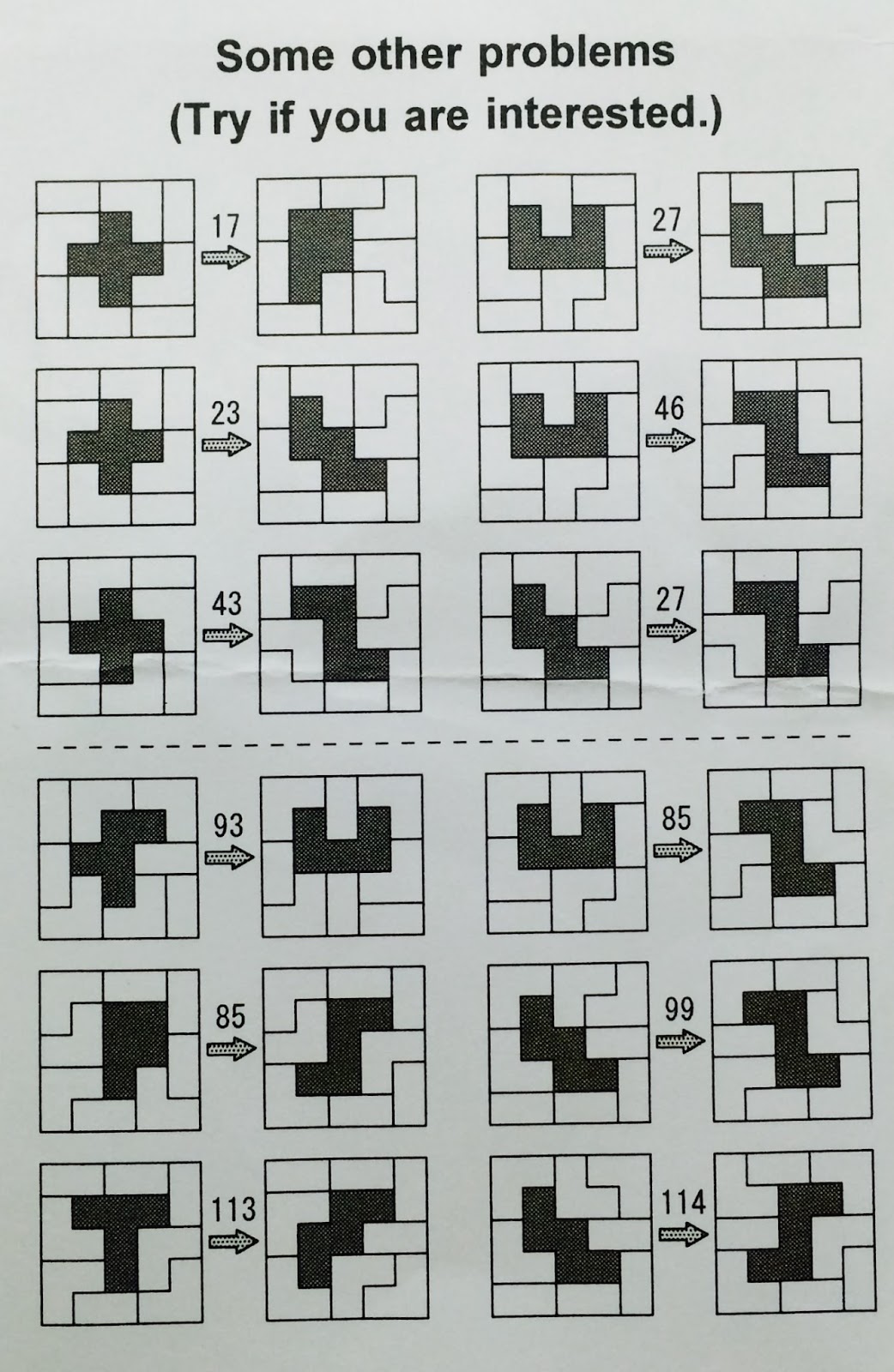
This is a sliding block puzzle with a bit of difference. Instead of moving the pieces from a start position to an end position as what most puzzlers are used to, the challenge is to form various silhouette shapes. A great and unusal design concept nonetheless!


The main challenge consist of a warm-up "practice run" (see photo) to change the silhouette of a "red cross" to a "U". This one takes 14 moves. Not a lot of moves but because now you are focusing on the "U" shape, the puzzle is harder than the 14 moves would suggest (at least for me). So what I did was to focus my attention on where the pieces should end up and tried to ignore the "U". 

Now for the main problem which requires a minimum of 48 moves, the instructions do not come showing the end position of the individual pieces. So the starting point is probably to pack the pieces into the tray to see how the "T" is formed. And then figure it out from there. A photo would certainly help! In any event, it was too difficult for me and I gave up after a number of tries. 8 pieces to slide is really no joke. But I did succeed in one of the other easier challenges on the separate problem sheet.


Difficulty
There are a total of 14 challenges in all with increasing levels of difficulty, ranging from 14 to 114 moves! I am not good at sliding puzzles. Notwithstanding, I think this one is really difficult especially for the higher level challenges. Definitely a sliding puzzle not to be missed by die-hard sliding puzzle enthusiasts.

Tuesday, 19 April 2016

Matchless

Name
Matchless

Designer
Ken Stevens


Manufacturer & Availability
Produced by Buttonius Puzzles & Plastics. A number of interesting laser cut acrylic puzzles, some past IPP exchange puzzles are available for sale from their site. Matchless is currently available from Wil Strijbos for 20 Euros.


Type & Classification
Dexterity (or so it seems)

Dimensions
7cm x 7cm x 1.2cm


Materials & Construction
Laser cut acrylic with steel screws and the match is blue coloured wood. Very well made and put together. Excellent quality. The option to use screws to clamp the several layers was a good choice otherwise the gluing would have been visible through the clear acrylic. 

Overview
Now Matchless is a very interesting and unusual puzzle. This was Peter Hajek's IPP35 Exchange Puzzle in Ottawa, Canada last year. 

The goal of the puzzle appears simple enough; to remove the match from the box, but the execution much more difficult than you can imagine. As you can see from the photo, there are two holes (just large enough for the match to go through) on two sides of the box. And the initial reaction is to try to use dexterity and turn, tap and shake the box and hope the match would slip out of the hole. Which is what I did and in fact I did succeed after a little while of trying. Several other puzzlers whom I shall not name achieved the same result this way.


However Peter indicated to me there is a way that is far more "elegant" and effective for extracting the match (without tools of course) and when I tried it, I couldn't agree more.

Difficulty
Difficult if you don't know the correct solution but very easy if you do! Definitely a nice change away from the usual genres of puzzles.

Friday, 15 April 2016

Derek's Half Dozen

Name
Derek's Half Dozen

Designer
Derek Bosch. Just did a review of his Pole Dancers in the previous post.


Manufacturer & Availability
Produced by Eric Fuller in 2013. A limited edition of 40 copies sold for US$69 each. Not available.


Type & Classification
Interlocking solid

Dimensions
6.5cm x 6.5cm x 6.5cm

Materials & Construction
Six pieces comprising three woods; ash, wenge and bubinga. Great looking! Excellent construction, fit and finish with tight tolerances. All the pieces slide and move very smoothly.

Overview
Externally it looks pretty just like an ordinary burr (save for the three pairs of different coloured sides) but the 6 pieces forming this puzzle are anything but ordinary. They are not your regular burr pieces with the typical notches and groves but rather odd shaped with loads of protrusions as you can see from the photo below.

This is an extremely difficult puzzle to take apart with a level 26.9.5.2 solution, meaning it requires 26 moves to remove the first piece. I was stuck for quite a while during the opening moves trying to figure out things. However, something totally unexpected happened next. I am not sure if it is my copy that was a bit looser than intended (because my wooden puzzles are usually kept in a camera dry box for a few days prior to play). But midway through the solving, I was actually able (to my great and pleasant surprise) to rotate one of the pieces out without any force whatsoever. Having done that, the rest of the pieces came out quite easily thereafter. OK, so its not the way it should have been done and I am not sure how I did it...but too late...its over! Was it an accidental discovery of something in the puzzle that neither Derek nor Eric were aware off?

[Edit 16 April 2016: I am informed by Derek that apparently this rotation is well known and certainly not intended]


Difficulty
"Fiendishly difficult" is what Eric describes on his site. Fully agree. The movements of the pieces are absolutely dizzying! Without Burr Tools, my copy will have remained on the shelf in their separate pieces. If the rotation of that one piece had not been possible, I definitely would not have been able to take the Half Dozen apart. Even with the aid of Burr Tools, trying to reassemble the six pieces was still quite a handful (no pun intended). 

Wednesday, 13 April 2016

Pole Dancers

Name
Pole Dancers


Designer
Derek Bosch. Very well known in the community for his cylindrical burr designs range, see for example the Helical Burr. For his other works, click here. I just realized I do have a copy of his "Derek's Half Dozen"....stay tuned for a future post on this one.

Manufacturer & Availability
Produced by Steve Nicholls. May be available but in limited quantities. You can contact Steve here.


Type & Classification
Interlocking

Dimensions
16cm x 4.5cm diameter

Materials & Construction
3D printed in plastic resin. Very well made and absolutely gorgeous colours. Mine's a bright yellow and purple. I saw other colourful combinations as well at IPP. Nicely presented in a transparent carrying tube. 

Overview
Looking like a delicious ice lolly, you can probably guess why the puzzle is called Pole Dancers. No prizes here. The puzzle was also Steve's IPP35 Exchange Puzzle in Ottawa, Canada last year. The goal here is to separate the purple and yellow pieces from the rod. 

For this type of cylindrical puzzles, 3D printing is probably the best (and only) choice available. I seriously doubt if they can be made in wood. As I mentioned previously in my review of the Helical Burr, the manipulation of a 3D printed burr like this is never going to be as slippery smooth as a well made interlocking wooden burr. However, it is sufficiently slick for comfortable play and I did not experience any jamming. One of the advantages of 3D printing is that the puzzle won't expand in humid climates unlike their wooden cousins. In fact as I played more, the puzzle got quit "seasoned" after a while and the movement of the pieces became smoother overall.


Solving consists of pulling, pushing and rotating the pieces around the axis of the rod. The pieces are interlocked together via grooves and notches on their insides and the surface of the rod. Typically trial and error is required at the beginning to see how the pieces interact with each other. Careful observation of the movements is also necessary, particularly when you want to re-assemble the puzzle later. And remember the orientation of the pieces too. I don't know the exact number of moves as I lost count somewhere after the first 5 to 6. But by my estimation, I think its somewhere between 13 to 15 moves for full dis-assembly. Honestly the dance gets quite confusing halfway through!

Difficulty
Its a difficult puzzle no doubt, but strangely I felt it was a bit less difficult than the Helical Burr which had four pieces (vs three for Pole Dancers) and even fewer moves. Maybe the Helical Burr was the first time I was playing with this sort of puzzle and hadn't gotten used to it yet.


While Helical Burr required only the removal of the first piece and the rest became pretty straight forward coming apart, Pole Dancers is tricky in the sense that you are not sure which end of the rod the two pieces emerge from (or is it from both ends?) and you get a bit confused halfway and need to back track once you hit a dead end. 

Summary

Another great design here from Derek Bosch. Well made, colourful and a nice alternative to the usual rectilinear wooden burrs. And what an appropriate name!

Sunday, 10 April 2016

Of Symmetry And Shapes

This weekend's puzzle play consisted of Symmetrick from Vesa Timonen of Finland and Four Triangles Five Shapes from Emrehan Halici of Turkey. 

Symmetrick

Symmetrick was a Top 10 Vote Getter during the IPP33 Puzzle Design Competition in Japan. It was also Vesa's exchange puzzle during IPP32 the previous year. In case you didn't know, vesa is a very prolific designer with a number of Hanayama Cast puzzle designs to his name.

Comprising of just two irregular shaped pieces made of Finnish Curly Birch wood in a raw finish, the goal here is to form a symmetrical shape. The instructions are clear....to place the two pieces on a flat surface to form a symmetrical shape...no tricks, no silhouette, hole in centre and the like.


One would wonder how difficult can that be with just two pieces right? Wrong...it is in fact a rather difficult puzzle, more so if you don't even understand what a symmetrical shape refers to. 

During IPP33 itself, I had already seen quite a number of puzzlers in the competition room trying to figure this one out.... and many couldn't solve it even by the end of the event. All round it received a lot of positive comments. I took about a couple of hours before hitting the jackpot. Please PM me if you would like to see the solution...it's really quite unexpected.

Symmetrick IMHO is really an example of a great puzzle design, so simple and innocuous looking with just two pieces, yet very challenging. For those who love this sort of shape forming puzzles, its a must have. Available from Mr Puzzle Of Australia and Sloyd of Finland.

Four Triangles Five Shapes

This puzzle came courtesy of Emrehan Halici. I had a privilege of meeting Emrehan the second time during IPP35 in Ottawa last year and his Four Triangles Five Shapes (FTFS) was his exchange puzzle to me.

The FTFS is made of 3mm red laser cut acrylic. The four pieces comprise of four triangles of different shapes. Nicely cut and pretty large pieces so easy to handle.


There are five different tasks here (hence the name "five shapes"). Using all the triangles to make the following shapes:-

1. 3 different Pararellograms
2. An Isoceles triangle
3. A Square

I was able to make just one of the parallelograms, the isoceles triangle and the square...or so I thought. I shot an email to Emrehan for the solutions to the other two parallelograms and when he replied I was in for a shock; I had only gotten the square correct!

How difficult is the FTFS? Well, I only managed to solve one of the five shapes, despite just four pieces. I would rate it as very challenging indeed. As this one is an exchange puzzle, it's only available from the designer (assuming he has any left), so please PM me if you would like to get a copy and I will link you up with Emrehan.

Sunday, 3 April 2016

Ladybird

Name
Ladybird


Designer
Robrecht Louage. Designed in 2014. For his other puzzles including his IPP31 award winning 4 Steps Visible Lock, click here.

Manufacturer & Availability
Produced in collaboration with collector Michel Van Ipenburg. There may still be some copies available from either gentlemen. PM me if you are keen to get a copy.


Type & Classification
Sequential movement; route finding.

Dimensions
16cm (incl the antennae) x 11.5cm x 1.5cm

Materials & Construction
Acrylic, tespa, steel screws and a 1 Euro coin. Construction fit and finish is excellent and all the parts move smoothly with no jamming. 


Overview

Robrecht is very well know for his "remove-the-coin" maze puzzles. And the best part is when you buy one of his puzzles, you get a 1 Euro discount! 

Unlike his other trapped coin puzzles, the Ladybird ups the ante in terms of sophistication of design and aesthetics. This time Robrecht encapsulates his puzzle within a ladybird design. 

Another main difference is that the Ladybird allows for some visibility of the maze route, hence you can see and feel your own progress. However, the Ladybird is no easier because the puzzle involves a double layer maze.

The goal is to navigate two pins (connected to the two antennae) along both maze channels, by manipulating the two maze plates either clockwise or the opposite. Upon successful completion, you are rewarded with the 1 Euro coin that leaves through the circular cut-out on the top cover.


Difficulty

Moderate difficulty but tricky at times. The starting steps gives you a feel of what you need to do. I found that somewhere about a fifth along the way, If you do not get both pins in their right respective positions within the maze channels, you will find yourself stuck much later on and this would require an almost full backtrack. If you are lucky and get it right near the beginning, navigation becomes quite a breeze for a majority of the way. It took me a couple of attempts and one or two backtracks to finally extract the coin. 

Overall a fun puzzle and one of those that once you pick it up, you won't want to put it down until the coin comes out. Done correctly, it doesn't take too long to solve and reset. A really beautiful and interesting looking puzzle.