Thursday, 23 February 2017

Trainspotting

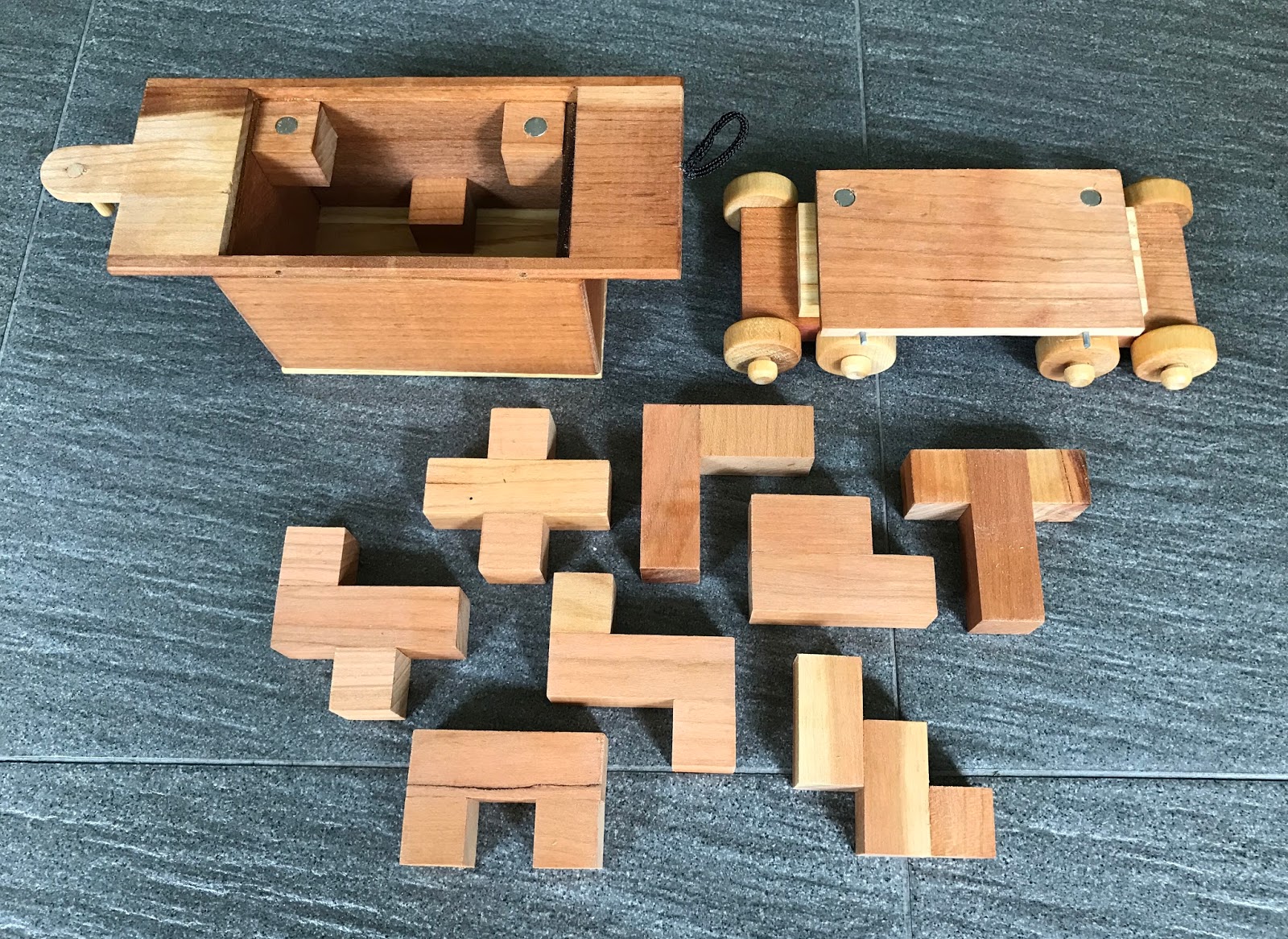
Now here's an interesting series of packing puzzles that I received during the course of three puzzle exchanges since 2014.


These are none other than Henry Strout's creations. The only other puzzle I have from Henry is his nice Flower String Puzzle. From what I understand, Henry started doing this series of train packing puzzles for exchange since 2013 and will finish off his series in 2018. Apparently, he's got another car/tender and an engine to complete (if anyone has more accurate information or otherwise, please PM me). 


These are fine works with wheels that spin, a simple coupler cum loop system to link train cars at both ends of each car and lids that are laser etched with the puzzle and IPP exchange details etc. The size of the train cars vary a bit but is pretty large and hefty with an average size of around 18cm x 10cm x 7cm. And all use just one type of wood (although I am not sure what it is).

All the puzzles bear the same style/theme...namely to pack anywhere between 8-10 irregular shaped block pieces into a train "car". Levels of difficulty also vary since each of the train cars or box contain different number of pieces and within each car, there are some protrusions or fixed restraining piece, which makes the puzzle that much harder. 

Each of the train packing puzzles have been/will be either designed by Henry himself, or someone else. As I joined the Puzzle Exchange only in 2014, I missed out on the earlier first train puzzle. What I have are the train puzzles for the last three years:-

IPP34
Sphinks Cargo Car
Designed by Brian Young (a.k.a Mr Puzzle Australia), 
Pack 6 pieces into the box


IPP35
Cutler Freight Car
Designed by Bill Cutler
Pack 10 pieces into the box


IPP36
Henry's Cargo Car
Designed by Henry Strout
Pack 8 pieces into the box


In terms of difficulty, lets just say these are not so easy as they seem. In fact they are pretty challenging. The hardest I think would be the Cutler Freight Car with its 10 pieces and easiest is the Sphinks Cargo Car with only 6 pieces (I know because I was able to solve the latter) and in between Henry's Cargo Car.

A nice idea to create a series of related puzzles for exchange. And for anyone who enjoys trains and/or packing puzzles, this will be an interesting addition to your collection, that is if you can get the complete set.


Wednesday, 15 February 2017

ZooLogical Garden #1

Here's a 2D packing puzzle that has occupied me for the last couple of evenings. The ZG#1 looks like your typical packing puzzle but comes with a twist...literally! Designed by Mineyuki Uyematsu (MINE) in 2013, it has a 3-unit piece anchored to the tray. This is a restraining piece that adds to the difficulty of the puzzle, even tho' it is able to rotate 360 degrees.


The four loose pieces look pretty "simple" enough and are precision laser cut to resemble the shape of "animals", hence the name of the puzzle. Don't know about you, but I can (see) a chicken, snake, skunk and coyote! The tray is a regular 7x7 grid square.

There are two challenges here:-

#1 - Place all the three white pieces into the tray
#2 - Place any two pieces AND the red piece into the tray. (Problem-it doesn't say which two to use)

Simple looking but the puzzling is anything but simple. In fact it is damn challenging especially #2.

I didn't have too much problem with challenge #1 for this puzzle, partly because I design some 2D puzzles myself and have played with a number of them, and some with rather odd solutions (hint). However challenge #2 eluded me all the while. It is very difficult because you need to first find the two correct white pieces and then combine them with the red piece. (my interpretation of challenge #2). Despite my many attempts at trying the (three) possible combinations to figure out which of the two white pieces to use, nothing worked. I could have been using the right white pieces  all the while (and didn't know it) but still couldn't manage to solve the puzzle.

With the aid of Burr Tools (thank goodness it works for this puzzle), I was able to narrow down the two required pieces and from there arrived at the solution; something which I have no hesitation to admit that I wouldn't have been able to do on my own. 


For packing puzzle lovers, definitely a must-get (unfortunately from what I can tell, its not available on MINE's site at the moment). When I bought it from MINE during the IPP in 2013, I remembered it was not expensive at all. So I would say its good value for money with plenty of puzzling; two challenges - the first easier (but probably will be hard for many, except seasoned packing puzzlers) and the second a real toughie!


Tuesday, 7 February 2017

Twelve Bow Ties 3

If there is a Twelve Bow Ties #3, then there must also be a #2 in between #1 and #3. I had posted a write up about Twelve Bow Ties #1 last year and for the life of me, I don't recall having exchanged a #2....okay, maybe I did and its somewhere is my puzzle closet and I need to go find it.


TBT#3 is (apparently) the last of the TBT series. Designed and made by Wayne Daniel, this was Marti Reis' IPP36 Exchange Puzzle in Kyoto, Japan last year. The puzzle is about 7cm x 5cm x 5cm and shaped like two pyramids joined at their bases. Its actually an Octahedron, with eight faces, each an equilateral triangle shape. 

My copy is made from what appears to be walnut and maple. Very well made with fine attention to the details and the very precise cuts of the notches and small pieces. Great work! Aesthetically a very pleasing puzzle to look at with the white colour accents on the faces.

The object is to take apart and re-assemble the puzzle, which actually splits up into 7 smaller pieces (the last two are either glued together or stuck somehow and I can't seem to take them apart). Each of the seven/eight pieces look identical but not quite. They are interlocked against one another and there is a certain sequence of sliding piece by piece out of the whole, one after another, in various directions. You can see from the photo how they come apart. 


Unlike TBT#1, this version is much more difficult and if you are not careful with how you take them apart or you deliberately (and masochistically) scramble them after dis-assembly, putting the pieces back will almost guarantee a nightmare, as I discovered. Now, let me go and find #2....and complete the lot!

Monday, 30 January 2017

3 Pentagons

This past weekend, I played with Japanese puzzler/designer Koshi Arai's 3 Pentagons. The object of the puzzle is to lay the pentagon shaped (5 sided) pieces on a flat surface and form a symmetric shape. 


For this puzzle, there were not one but three solutions and Koshi had in fact (generously) shown one of the symmetric shape solutions on the instructions that came with the puzzle. The task is figuring out the remaining two. 

This is the 1st symmetrical shape solution provided by Koahi Arai
3 Pentagons was not only Koshi's IPP34 Exchange Puzzle but he also entered it for the Puzzle Design competition. His exchange version is finely made of an exotic (dark) wood (cocobolo?) and all the pieces precisely cut. 

Unless you know the meaning of "symmetrical shape", you won't even know where to begin. There are typically two types of symmetrical shapes possible, one is mirror or line symmetry and the other is rotational symmetry. In most (if not all) of these symmetrical shape type puzzles, usually the object is to find a mirror/line symmetrical shape, which is the case here.

It took me several sessions over two days to find the two solutions. What makes the puzzle so difficult is that the three pieces are pretty similar in shape (and size) to each other and this sets up a huge number of possible combinations for joining the pieces side to side; yet only three symmetrical shapes exist. What an incredible design! I am very sure there is some complicated mathematics to all this but sorry folks, I am not capable of explaining any of it here...all I know is that I tried all sorts of ways to put the pieces together and eventually got the results I wanted.

Overall a very challenging puzzle indeed and a good thing that Koshi revealed one solution at least! If anyone wants to know the other two solution shapes, please contact me via my blog email.

Friday, 27 January 2017

9 Blocks Box & 9 Blocks Cube

Update 23 October 2017 - Dear Reader, please check out my new puzzle blog and e-store at http://mechanical-puzzles.com

I thought I would start my 401st post here with a brief mention of the above two puzzles, which lucky me, has been made into four different versions with four different sizes. First off, the 9 Blocks Box; this is a design I did in late 2015 which was produced several months later by Eric Fuller in a limited edition run of 50 copies for sale. 


From Left: 9 Blocks Box (made by Eric Fuller), 9 Blocks Box (made by Frederic Boucher),
9 Blocks Cube (made by Eric Fuller) and 9 Blocks Cube (made by Tom Lensch)

 The 9 Blocks Box comprised of a rectangular box and the object was to fit 9 irregular shaped pieces into it. It has a unique solution. I spent a fair amount of time trying to design all the blocks to be different from each other but in the end, I could only managed to do so with 7 of them while two of the pieces had to remain identical.


Eric's version of the 9 Blocks Box was small and constructed to fit a pocket. I think small is a bit of an understatement; it was Lilliputian. Each puzzle measured a diminutive 3.4 cm all round! Made of Holly, Zebrawood and Macassar Eboy, it was rather cute and certainly didn't go unnoticed, which saw all 50 copies sold out within a day after it was listed on his site. He also fashioned the box to have a cover that "locked" magnetically to keep the pieces in place (even in an unsolved state; quite clever I must say) and dimensionally the shape also became more of a cube as opposed to the original rectangular design.

A couple of months later, my puzzler friend Frederic Boucher made a limited run of just 5 copies (of which I received #1). He also upped the ante by machining the 9 pieces in gorgeous aluminium. Frederic's version was a real beauty and came with a wooden box with slanted corners and packaged in a plastic container to boot. He too, as I understand sold out all his copies after pictures of it were posted on Facebook. 


9 Blocks Cube made by Eric Fuller 


Sometime later, Primitivo Familar Ramos from Spain took my design and scaled up the original rectangular box to result in a cube. As a consequence, he was also able to resize the 9 blocks such that now, no two pieces were identical. We jointly entered this version, the 9 Blocks Cube for the IPP36 Nob Yoshigaha Design Competition in Japan last year. 

The first working copies of the 9 blocks Cube produced for the competition were crafted by Tom Lensch. Our competition puzzle was huge! Each cube measured 12.6cm x 12.6cm x 11.4cm. Heavy and rather difficult to lug around. The box was made of Maple while the pieces Mahogany. We didn't win any prizes at IPP36 but this modified design again attracted Mr Fuller, who subsequently went on to produce 150 copies which formed the first release of his "Limited Edition" series via his upgraded website. Eric's interpretation of the 9 Blocks Cube was made of Maple, Walnut and Purple Heart with a much more manageable size of 7.3cm cube. As of the date of this post, there are still copies available at a very affordable US$37.

Sunday, 15 January 2017

Haleslock 2

Update 24 October 2017 - Dear Reader, please check out my new puzzle blog and e-store at http://mechanical-puzzles.com

This is my 400th post! How time has flown by. And what better puzzle to write about than one coming from a really talented puzzle designer, Shane Hales from the UK. 


Shane started designing puzzles several years ago and I have had the good fortune to receive as gifts two of his very limited edition puzzles, first The Circle and later Turn The Plug. His puzzles are limited edition either because he produces only several of a particular design or he gifts them to friends. Until recently, Shane did not sell any but only gifted his puzzles to the lucky few. I am one of them lucky ones who got a Haleslock 2 as a Christmas present!

Recently Shane has progressed to producing puzzle locks. His works are not designed from ground up, example, in the style of Rainer Popp, meaning to say, he designs and produces a puzzle that looks like a lock, Instead, he goes the Dan Feldman way, where he uses existing commercial padlocks on the market and modifies them into a puzzle/trick lock. Shane's locks, the Haleslock 1 and Haleslock 2 were made available for a charity auction and sale respectively on his puzzle site but unfortunately for puzzlers, his Haleslock 2 are all sold out.

So coming back to the Haleslock 2...what is it like as a puzzle? Well, as I have alluded to, it is a typical looking padlock from a brand called Squire. The lock comes with two keys (one without any teeth as can be seen from the photo) and attached by a rather long chain to the shackle. The object of course is to un-shackle the lock.


I had read Allard Walker's blog post on how he had solved the Haleslock 2 and commented that it was "not extremely complex or complicated". For me personally, this couldn't have been further from the truth! I had solved Shane's previous puzzles, The Circle and Turn The Plug without too much frustration and without help, but for some (strange) reason, I could not solve the Haleslock 2 even after multiple sessions of playing over a number of days. Something was eluding me to the point I decided to ask Shane for not one, but two clues before I managed to figure out the first move...and the Hales Lock has four moves to free the shackle.

After the first move was done, everything else became easy and I released the shackle without a cinch. For me, the solution for the Haleslock 2 was totally unexpected. The "trick" (no pun intended) of the Haleslock 2 is IMHO a really a good one not easy to discover. With hindsight, I realized that I had missed something right at the beginning that I shouldn't have. Overall a great trick lock with an original and different idea/concept. Good work Shane!

Saturday, 7 January 2017

Cast Infinity

Update 24 October 2017 - Dear Reader, please check out my new puzzle blog and e-store at http://mechanical-puzzles.com

A very Happy New Year to everyone! This is my first post for 2017.

This weekend's puzzle was Vesa Timonen's Cast Infinity produced by Hanayama. In case you do not know Messr. Timonen, he has designed many puzzles and a number for Hanayama such as the Cast Loop, Square, Cylinder and Donuts.  A number of them award winning, including his non-Cast Symmetrick.


The Infinity comes with a shiny surface and is very well made (of zinc alloy). Tough and heavy. Generally I would prefer a matt to gloss surface for metal puzzles but in this instance, the shininess actually works pretty well and accentuates the curves of the Infinity. IMHO, it's one of the more beautiful and aesthetically pleasing puzzles around.

Size wise, its measures roughly about 5.3cm x 3.2cm x 1.7cm and large enough to be handled quite comfortably.

The object here is to remove the two inner circular pieces from the "8" shaped cage (the Greek symbol for Infinity).

From the puzzling aspect, this is not an easy puzzle. Hanayama rates it at a level 6 stars; ie most difficult in the Hanayama range. But with only two moving pieces, its not excruciatingly difficult and I would rate it rather at about 5 stars. Both pieces rotate within their respective housings inside the cage, but they are interlocked against each other via a series of notches on the pieces as well as the inside of the cage itself.  At any one time, only one of the two pieces will move in one particular direction. To solve the puzzle, the pieces need to be rotated in both clockwise and counter clockwise manner (as well as upwards and downwards) and there is a sort of sequence to this, otherwise one or the other piece would simply find a dead end.


In some ways, I kinda have the feeling that the Cast Infinity is almost a bit like a "N-ary puzzle" where there is a series of repeated moves, but technically I don't think this is the case [Edit 8 Jan 2017: Puzzler Michel van Ipenburg has confirmed to me that the Infinity is indeed a N-ary puzzle]. Other puzzles with a similar "style" that came to my mind when I was playing with the Infinity are the circular type burrs designed by Derek Bosch such as the Helical Burr, Pole Dancers and Vapors , where you manipulate two main opposing interlocking pieces in a particular sequence to disassemble. For lack of anything else, I guess you can call it a flat(ish) burr.

Overall the Infinity is great puzzle and I was rather surprise that I took less than 20 mins to disassemble the pieces and just a tad longer to put everything together again, the latter in the reverse order, but more difficult. Once you have gotten used to the moves, its fairly repeatable also. And coming from Hanayama, you can be assured of decent quality and value for money pricing.

Saturday, 24 December 2016

Portico J

First off, Merry Christmas to everyone!

This post is long overdue. In fact it is a year overdue. I received the Portico J as a Christmas present from Pelikan Puzzles of the Czech Republic during last Christmas in 2015. Portico J was designed by Stephane Chomine, who (at the time of this posting) has just done over 500 designs on PWBP.


I had played with Portico J for a while, found it a tad too difficult and put it away telling myself that I would come back to it sometime in early 2016...and promptly forgot about it for the next 12 months. 

But over the last couple of days after some much required puzzle closet spring cleaning, out appears the Portico J and I decided to give it a go again. But before that, here are the stats; Portico J measures about 10cm x 5.5cm x 4.5cm. Consisting of an inverted T-shaped support with 3 traditional burr pieces and 2 board ones, it is an unusual shaped and looking interlocking puzzle. I figure this sort of shape may not appeal to everyone, but hey, there are loads of cubes and rectangles about so this is nice change. And I certainly quite like it. Comprising of Wenge and Cherry woods, it's impeccably made by the Pelikan Workshop. Everything slides and moves smoothly. 


It took me a couple of hours spread over several sessions before I finally managed to remove the first piece. It has a level 20 solution and while the movable pieces can move only in certain directions within limits, it's a much harder puzzle to take apart than the shape (or the few number of pieces) would suggest. My early attempts were met with dead ends and when I finally got the first piece out, the process rather surprising, something I did not expect. After that, a bit more puzzling was still needed before the rest of the pieces were disentangled. Full take apart requires 35 moves. 

As with such puzzles I needed Burr Tools to help with the re-assembly before everything was back to original. Can't do by memory here unfortunately!

The Portico J is very tricky right from the start and although not a very high level burr on paper, still it makes for a very challenging solve indeed. Oh, and there is a 5-piece Little Portico around too!

Saturday, 17 December 2016

Still Yet Another Burr That's Not A Burr!

Sorry folks for a delayed post as I was on a family vacation to Taiwan...and had too much luggage to bring any puzzles along.


Well, here's yet another pseudo-burr, this time another variation of Ray Stanton's Slideways Burr series, after his Slideways Burr and Double Slideways Burr. This one is called the Quad Slideways Burr (QSB). The QSB was Ray's IPP36 Exchange Puzzle. Made of Cherry, Maple and Mahogany, it was produced for Ray by Pelikan Puzzles with great craftsmanship as per normal. The QSB measures about 8cm all around, a good and necessary size for handling this type of puzzle.


The QSB looks to be made up of many pieces but in reality comprise only 4 pieces each with slanted cuts and notches. Two of the larger pieces are actually several smaller pieces glued together. It is a co-ordinate motion puzzle and the object is to take it apart and re-assemble it.


I had difficulty with the Double Slideways Burr and so I took careful pains with this one to slowly "disentangle" the QSB...so that the pieces don't just fall apart suddenly, as usually happen to many co-ordinate motion puzzles. The high average 85% humidity of Singapore ensured that the sliding apart was snug but sufficiently smooth and allowed me to make small incremental movements. The puzzle expanded right to the point where one of the two smaller pieces fell apart, followed by the others. 


Its a good thing that Pelikan manufactured the QSB in such a way that the three opposing pairs of faces on the sides of the QSB feature a different type wood; which makes the identification and orientation of the pieces for re-assembly easier...at least I knew how the pieces were going to come together. Unlike the earlier Double Slideways Burr, which I needed the wifey's help to hold the pieces (there were 6!) this one I could comfortably manage on my own, sans wife's hands. Finding that single point, ie sweet-spot where all the 4 pieces started sliding back together to form the original shape was actually not as difficult as I had expected. All said and done, this was a pretty fast solve!

As far as I can tell, the QSB is not listed on sale on the Pelikan site. But Ray may have some extra copies left for sale if anyone is interested.

Wednesday, 30 November 2016

Another Burr That Is Not A Burr?

This is an interesting 3-piece "Burr" called "New Tam's Burr R-End", designed and crafted by Hidekuni Tamura. It was also his IPP36 Exchange Puzzle.


The concept design for this puzzle is similar to the Murbiter's Pseudo Burr. Like the Pseudo Burr, New Tam's Burr looks like an ordinary 6-piece burr from the outside. This one is made of a heavy exotic hardwood (I am not sure what it is) and consist of various blocks glue together. Construction is very good with the puzzle coming in its own box and instructions. One thing I am not sure of is what is the meaning of the name and the "R-End" bit??

The object is to dis-assemble and then re-assemble the 3 pieces which when taken apart, look uncannily similar to each other. And because of this, once you take it apart and scramble the pieces, you may have some difficulty putting the pieces back to the original state, particularly if you get their orientations wrong. A rather clever design as the designer has not only managed up the challenge quotient with similar looking pieces but also by the way the pieces connect to each other without leaving an voids in the centre of the puzzle.


Is it difficult to take apart? No, once you figure out which one of the pieces needs to be the first to move. What about re-assembly? Yes, harder obviously; but because there are only 3 pieces, its not difficult as such with some persistence. There are only so many ways available for randomly trying to connect all three together (and the signature on one of the pieces also helps).

Monday, 28 November 2016

Theta & Triple Tango

What does a puzzle blogger do when he hasn't had time (due to work and other commitments) to play with new puzzles to write about them? Well, easy...he blogs about his own designs that have been produced by well-known puzzle craftsmen...nothing to solve and fret over!


And here are two puzzles I am shamelessly featuring, which have been beautifully crafted by Eric Fuller. There is one more coming from Eric's stable (in the coming weeks I think) but I will let that one be released first before shamelessly blogging about it!

The first is my Theta (the exact name is 9 Theta) since it has 9 burr pieces plus a cage. Excellently constructed of Maple and Purpleheart, this one has a level 15.3.3.1.2.1.2 solution requiring a total of 29 steps to completely disassemble. Great attention to detail here and yes, I still need Burr Tools to help me re-assemble after taking it apart. 


Currently all 48 limited edition copies are sold out. Personally for me it was a nice design exercise and really a "no big deal" kind of interlocking burr. My burr design capabilities are pretty limited and I was surprise Eric chose Theta to produce for his site. But the few comments I have received from purchasers of this puzzle has generally been good. 

My second design is a sliding block puzzle called Triple Tango. I was able to design Triple Tango thanks to Goh Pit Khiam who shared with me his sliding block design program which he authored a while back (a software that works similar to Burr Tools, where you can specify the shape and units of the pieces etc). 

There is also a freeware programme called the SBP Solver by Pierre-Francois Culand but this program is rather limited in that the shapes for the pieces can only be either squares or rectangles. But for anyone who has never designed a sliding block puzzle, the SBP Solver is good enough to get you going for a start.

To see the many incredible sliding block puzzle designs out there including those by Minoru Abe, Serhiy Grabarchuk, Ed Pegg, Nob Yoshigahara just to name a few, check out Nick Baxter's Sliding Block Puzzle Page.

Start Position
 The version made by Eric consists of 6 pieces and the goal is to exchange the light and dark blocks found at the top and bottom. Eric had even made an acrylic cover with the starting position of all the blocks etched onto the surface. The puzzle is made of maple, mahogany and walnut.
End Position
This puzzle can be configured for various levels of difficulty. 78 moves (5 pieces only, move a single 2x1 block from the bottom slot to the top slot). 104 moves (the version shown here) and 122 moves, by adding another 2x1 block to be surrounded by the 4 larger blocks. And why is it called Triple Tango? Because the centre pieces "dance" three times round the inside of the tray (clockwise and anti-clockwise) during play before both the dark and light coloured 2x1 blocks exchange positions. Triple Tango was also the inspiration for my Tango 72 IPP36 Exchange Puzzle in Japan this year.

Again this was a surprise for me as I didn't think Eric would produce a sliding block puzzle like that where the pieces are uncovered. Anyway 46 copies of the Triple Tango were made and they are all also sold out!


Saturday, 19 November 2016

Seal

This weekend, I played (or rather re-played) a puzzle that has seen a number of incarnations over the years. The puzzle is Naoaki Takashima's IPP36 Exchange Puzzle called Seal - Slide-Blocked Sliding Block Puzzle. 

Start Position

End Position
The original version of the SBSB with a garage and car theme was designed by Bill Cutler in 1987. Bill made a later version using the "seal and ball" theme and entered it in the 1988 Hikimi Wooden Puzzle Design Competition where he won the Grand Prize. Subsequently Tom Lensch also made versions of the original SBSB and his latest version is featured in one of my previous post, suing a "twin arrows" theme. 

Naoaki Takashima is a Japanese Puzzle collector who reputedly has the largest private collection of mechanical puzzles outside the USA/Europe and in Japan. His version of the SBSB for the Exchange is different from the original Bill Cutler and Tom Lensch versions in several respects:-

1. The design is an "upside down" version of the original.

2. The pieces are made of laser cut double layer glued acrylic and removable from the tray. You can't see it from the photos but there is a groove running along the inside bottom edge of the tray with two of the pieces having "notches". The Tom Lensch version is interlocking and pieces can't be removed. This feature is a God-send and very necessary if you are stuck halfway and want to reset it to the start position. Tom's version is not so easy.

3. Handy size of 11cm x 9cm for ease of carrying around.


SBSB made by Tom Lensch.
The pieces are un-removable, except for the holding piece
Like the previous versions, the Seal takes a minimum of 41 rectilinear moves to solve. The main notable feature is that the piece with the red ball restricts the movements of the other pieces depending on where the piece is at the moment, which have been described in my review of Tom Lensch's version of the SBSB. 

Although I have played with the SBSB nearly two years ago, it still took me a while to figure out the moves again with the Seal and several times I had to re-arrange the pieces and start from beginning. 

Perhaps the best part about this puzzle is that all the action (min. 41 moves or more) takes place within a simple looking 3 x 2 size grid, and involving five rectangular pieces only, moving one at a time left right up and down...incredible design feat here!


As far as I know, all the other versions of the SBSB are not currently available but perhaps Naoaki, like most puzzle exchangers, may have some copies still left over from IPP36 for sale. 

Sunday, 6 November 2016

2016 8 August

There are packing puzzles and there are packing puzzles. And 2D packing puzzles come in all shapes and styles. Aside from the typical standard "fit X number of pieces" into the tray version, there are those which require the puzzler to find a symmetrical shape, an anti-slide formation or in the case of the "2016 8 August" puzzle here, leave a certain designated portion of the tray uncovered.


 "8 August" is not just a packing puzzle, but it also bears a theme...it is a calendar packing puzzle, but more on that later...

This puzzle is Rikishi (Lixy) Ramada's IPP36 Exchange Puzzle. It is made from precision laser cut acrylic for both the tray and pieces and fits nicely into a standard CD case as part of the packaging. The details, text, numerals etc and instructions are beautifully etched onto the top and inside surfaces of the tray. A very high quality piece indeed.


The object of the puzzle is to cover up the tray with all the 6 given pieces but leaving a single date open. Since there are 31 days in August, there are 31 challenges here. What is interesting is also that each of the 6 pieces is a pentomino (ie shape made up of 5 square units) selected from the total of 12 possible flat pentomino configurations.  

The design and shape of the tray provides 155 ways to pack the 6 pieces into the box, but for each date to be left uncovered, this will vary from date to date. The easiest challenge is the date 26th August, which has 22 solutions while 7 dates in the calendar have a unique solution. And of course the rest of the dates in between have varying number of solutions (see photo). Quite amazing how Lixy managed to find a combination of 6 pentomino pieces which can reveal any one of the 31 dates in the tray! Lixy had probably also chosen the month of August for his puzzle to coincide with IPP36 which officially ran from 5th to 7th August 2016.  


I tried 26th August and it was pretty easy (given there are 22 possibilities) and next I tried my own birthday (9th August). 9th August has 5 solutions and this took me a bit longer to find. When it came to the dates with only 1 solution, well, you can guess....


8 August is not only interesting and fun as a packing puzzle (with not too many pieces), but there are varying levels of challenges inherently built in which can test the novice and the expert alike and anyone else in between. And If you ignore the year and the days and just focused on the dates, this puzzle can actually be turned into a perpetual calendar.

Saturday, 29 October 2016

Vivaldi Burr

Of all the IPP36 Exchange Puzzles, the Vivaldi Burr must surely be one of the most unique and unusual looking ones present this year! Very nicely packaged, it even comes with portions of a score which act as cushioning in the box!


Exchanged and designed by Rene Dawir of Luxembourg, the Vivaldi Burr was produced by Marcel Gillen, the latter who is most well known for his chess piece puzzles. 

As you can see from the photos, the puzzle takes, IMHO the shape and form more of a cello (than a violin). It is reminiscent of the Japanese Kumiki puzzles, that are interlocking puzzles which take on a familiar shape eg animal or object.


The Vivaldi Burr is constructed entirely of thick MDF board and the pieces are precision cut using a CNC milling machine. Stripped down, it is essentially a "board burr" type puzzle. Quality, fit and finish is very good and everything is nicely put together and all pieces slide and move relatively smoothly.


The object is the disassemble and re-assemble the burr. Make no mistake here; while it doesn't look anything like a traditional burr and you can see everything you are doing, the Vivaldi Burr is not that easy to take apart, even though it may appear to be so. I don't have the exact solution steps but based on my own rough count, it takes about 9 steps to remove the first piece and approximately a total of 24 steps to dis-assemble the entire puzzle completely +/- a couple of steps. The first two steps are obvious. The steps are sequential and if one is missed, it may mean starting several steps from behind again. Putting it back to together is the exact reverse. It took me a good forty five minutes to take apart the thing apart and re-solve.


Moderately challenging to solve, overall a very nice design and well executed "burr" to collect. And something certainly very different from the usual.